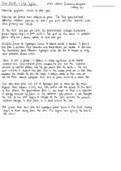
Star Birth +
Life cycle VERY WORDY (summary diagram
coming up)
Nebulae clouds of dust
.
gigantic +
gas
Nebulae
attraction between
are formed over millions of years .
The
tiny gravitational
particles of dust +
gas pulls particles towards each
other ,
forming vast clouds .
As the dust get closer the gravitational collapse accelerates
and gas ,
.
Denser
regions begin to form and in one part of the cloud a protostar
,
forms _
very hot t dense sphere of dust and gas
Nuclear fusion of hydrogen nuclei to helium nuclei is needed to form a
star from a protostar High .
pressures and temperatures are needed to overcome
the electrostatic forces between hydrogen nuclei for this to happen so ,
only
some protostars become stars .
When a star is formed it remains in stable equilibrium at an almost
,
constant size .
Gravitational forces compress the star but the radiation
pressure of emitted photons and the gas pressure from the nuclei in the core
push outwards to balance this force Stars in this stable phase are in their main .
sequence The smaller the star , the longer it remains stable as their cores are
.
less hot than massive supergiant stars and so fusion occurs at a slower rate .
Low mass stars often run out of hydrogen fuel ,
so move off the main
sequence Stars between 0.5 Mo and 10M o evolve into red
.
Giants At the start
.
of this phase the force is now larger as there
,
gravitational is a reduction
in energy released by fusion so the radiation +
gas pressure is less .
Therefore
the core of the star
begins to collapse .
As the core shrinks , the pressure
increases
enough to start fusion in a shell around the core .
Red
giants have inert cores but
hydrogen fusion occurs in the shell ,
causing
layers to move away from the core . The
layers cool ,
giving the star a
red colour .
, Eventually the red giant layers drift into space as planetary nebula leaving ,
behind as a white dwarf White dwarves are
hot
very dense and emit
the core .
photons created in their earlier evolutions .
The due to electron pressure Two electrons cannot
core stops collapsing degeneracy .
exist in the same
energy state and when the core collapses due to electrons
gravity ,
are squeezed together creating
,
a pressure that prevents further collapse .
High stars > 10
Mo consume mass ( ) hydrogen in their core in much
less time When the hydrogen in the .
core runs low the helium nuclei
,
formed from hydrogen fusion can go on to fuse into heavier elements as
the core is hot
enough for
the helium nuclei to move fast enough to overcome
electrostatic repulsion and fuse together .
These
changes cause the star to
expand ,
forming a red supergiant
Inside red the temperatures and pressures
high enough
a
supergiant ,
are
to fuse even massive nuclei
together forming ,
shells inside the star until
the star develops an iron core .
Iron nuclei cannot fuse making
.
the star
unstable This leads to .
a supernova -
a catastrophic implosion of the layers ,
ejecting the core mater
the remnant core is compressed into a neutron star or a black hole .
Neutron stars are almost
entirely made of neutrons ,
are
very small have ,
a
typical mass oh 2M o and a similar
density to an atomic nucleus
Black holes when the
gravitational collapse compresses the
occur core ,
creating
a
gravitational field strongso that an object would need an escape velocity
the speed of
greater than
light Not even photons can
.
black holes
escape .
Super -
massive black holes are
thought to be at the centre of most
galaxies
supernovae create all the
heavy elements -
everything above iron in the
Periodic Table was created in a
supernova
.
Life cycle VERY WORDY (summary diagram
coming up)
Nebulae clouds of dust
.
gigantic +
gas
Nebulae
attraction between
are formed over millions of years .
The
tiny gravitational
particles of dust +
gas pulls particles towards each
other ,
forming vast clouds .
As the dust get closer the gravitational collapse accelerates
and gas ,
.
Denser
regions begin to form and in one part of the cloud a protostar
,
forms _
very hot t dense sphere of dust and gas
Nuclear fusion of hydrogen nuclei to helium nuclei is needed to form a
star from a protostar High .
pressures and temperatures are needed to overcome
the electrostatic forces between hydrogen nuclei for this to happen so ,
only
some protostars become stars .
When a star is formed it remains in stable equilibrium at an almost
,
constant size .
Gravitational forces compress the star but the radiation
pressure of emitted photons and the gas pressure from the nuclei in the core
push outwards to balance this force Stars in this stable phase are in their main .
sequence The smaller the star , the longer it remains stable as their cores are
.
less hot than massive supergiant stars and so fusion occurs at a slower rate .
Low mass stars often run out of hydrogen fuel ,
so move off the main
sequence Stars between 0.5 Mo and 10M o evolve into red
.
Giants At the start
.
of this phase the force is now larger as there
,
gravitational is a reduction
in energy released by fusion so the radiation +
gas pressure is less .
Therefore
the core of the star
begins to collapse .
As the core shrinks , the pressure
increases
enough to start fusion in a shell around the core .
Red
giants have inert cores but
hydrogen fusion occurs in the shell ,
causing
layers to move away from the core . The
layers cool ,
giving the star a
red colour .
, Eventually the red giant layers drift into space as planetary nebula leaving ,
behind as a white dwarf White dwarves are
hot
very dense and emit
the core .
photons created in their earlier evolutions .
The due to electron pressure Two electrons cannot
core stops collapsing degeneracy .
exist in the same
energy state and when the core collapses due to electrons
gravity ,
are squeezed together creating
,
a pressure that prevents further collapse .
High stars > 10
Mo consume mass ( ) hydrogen in their core in much
less time When the hydrogen in the .
core runs low the helium nuclei
,
formed from hydrogen fusion can go on to fuse into heavier elements as
the core is hot
enough for
the helium nuclei to move fast enough to overcome
electrostatic repulsion and fuse together .
These
changes cause the star to
expand ,
forming a red supergiant
Inside red the temperatures and pressures
high enough
a
supergiant ,
are
to fuse even massive nuclei
together forming ,
shells inside the star until
the star develops an iron core .
Iron nuclei cannot fuse making
.
the star
unstable This leads to .
a supernova -
a catastrophic implosion of the layers ,
ejecting the core mater
the remnant core is compressed into a neutron star or a black hole .
Neutron stars are almost
entirely made of neutrons ,
are
very small have ,
a
typical mass oh 2M o and a similar
density to an atomic nucleus
Black holes when the
gravitational collapse compresses the
occur core ,
creating
a
gravitational field strongso that an object would need an escape velocity
the speed of
greater than
light Not even photons can
.
black holes
escape .
Super -
massive black holes are
thought to be at the centre of most
galaxies
supernovae create all the
heavy elements -
everything above iron in the
Periodic Table was created in a
supernova
.