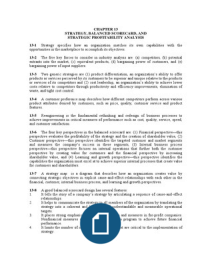
CHAPTER 13
STRATEGY, BALANCED SCORECARD, AND
STRATEGIC PROFITABILITY ANALYSIS
13-1 Strategy specifies how an organization matches its own capabilities with the
opportunities in the marketplace to accomplish its objectives.
13-2 The five key forces to consider in industry analysis are: (a) competitors, (b) potential
entrants into the market, (c) equivalent products, (d) bargaining power of customers, and (e)
bargaining power of input suppliers.
13-3 Two generic strategies are (1) product differentiation, an organization’s ability to offer
products or services perceived by its customers to be superior and unique relative to the products
or services of its competitors and (2) cost leadership, an organization’s ability to achieve lower
costs relative to competitors through productivity and efficiency improvements, elimination of
waste, and tight cost control.
13-4 A customer preference map describes how different competitors perform across various
product attributes desired by customers, such as price, quality, customer service and product
features.
13-5 Reengineering is the fundamental rethinking and redesign of business processes to
achieve improvements in critical measures of performance such as cost, quality, service, speed,
and customer satisfaction.
13-6 The four key perspectives in the balanced scorecard are: (1) Financial perspective—this
perspective evaluates the profitability of the strategy and the creation of shareholder value, (2)
Customer perspective—this perspective identifies the targeted customer and market segments
and measures the company’s success in these segments, (3) Internal business process
perspective—this perspective focuses on internal operations that further both the customer
perspective by creating value for customers and the financial perspective by increasing
shareholder value, and (4) Learning and growth perspective—this perspective identifies the
capabilities the organization must excel at to achieve superior internal processes that create value
for customers and shareholders.
13-7 A strategy map is a diagram that describes how an organization creates value by
connecting strategic objectives in explicit cause-and-effect relationships with each other in the
financial, customer, internal business process, and learning and growth perspectives.
13-8 A good balanced scorecard design has several features:
1. It tells the story of a company’s strategy by articulating a sequence of cause-and-effect
relationships.
2. It helps to communicate the strategy to all members of the organization by translating the
strategy into a coherent and linked set of understandable and measurable operational
targets.
3. It places strong emphasis on financial objectives and measures in for-profit companies.
Nonfinancial measures are regarded as part of a program to achieve future financial
performance.
4. It limits the number of measures to only those that are critical to the implementation of
strategy.
13-1
, 5. It highlights suboptimal tradeoffs that managers may make when they fail to consider
operational and financial measures together.
13-9 Pitfalls to avoid when implementing a balanced scorecard are:
1. Don’t assume the cause-and-effect linkages are precise; they are merely hypotheses. An
organization must gather evidence of these linkages over time.
2. Don’t seek improvements across all of the measures all of the time.
3. Don’t use only objective measures in the balanced scorecard.
4. Don’t fail to consider both costs and benefits of different initiatives before including
these initiatives in the balanced scorecard.
5. Don’t ignore nonfinancial measures when evaluating managers and employees.
13-10 Three key components in doing a strategic analysis of operating income are:
1. The growth component which measures the change in operating income attributable
solely to the change in quantity of output sold from one year to the next.
2. The price-recovery component which measures the change in operating income
attributable solely to changes in the prices of inputs and outputs from one year to the
next.
3. The productivity component which measures the change in costs attributable to a change
in the quantity and mix of inputs used in the current year relative to the quantity and mix of
inputs that would have been used in the previous year to produce current year output.
13-11 An analyst can incorporate other factors such as the growth in the overall market and
reductions in selling prices resulting from productivity gains into a strategic analysis of operating
income. By doing so, the analyst can attribute the sources of operating income changes to
particular factors of interests. For example, the analyst will combine the operating income effects
of strategic price reductions and any resulting growth with the productivity component to
evaluate a company’s cost leadership strategy.
13-12 Engineered costs result from a cause-and-effect relationship between the cost driver,
output, and the (direct or indirect) resources used to produce that output. Discretionary costs
arise from periodic (usually annual) decisions regarding the maximum amount to be incurred.
They have no measurable cause-and-effect relationship between output and resources used.
13-13 Downsizing (also called rightsizing) is an integrated approach configuring processes,
products, and people to match costs to the activities that need to be performed to operate
effectively and efficiently in the present and future. Downsizing is an attempt to eliminate
unused capacity.
13-14 A partial productivity measure is the quantity of output produced divided by the quantity
of an individual input used (e.g., direct materials or direct manufacturing labor).
13-15 No. Total factor productivity (TFP) and partial productivity measures work best together
because the strengths of one offset weaknesses in the other. TFP measures are comprehensive,
consider all inputs together, and explicitly consider economic substitution among inputs.
Physical partial productivity measures are easier to calculate and understand and, as in the case
of labor productivity, relate directly to employees’ tasks. Partial productivity measures are also
easier to compare across different plants and different time periods.
13-2
STRATEGY, BALANCED SCORECARD, AND
STRATEGIC PROFITABILITY ANALYSIS
13-1 Strategy specifies how an organization matches its own capabilities with the
opportunities in the marketplace to accomplish its objectives.
13-2 The five key forces to consider in industry analysis are: (a) competitors, (b) potential
entrants into the market, (c) equivalent products, (d) bargaining power of customers, and (e)
bargaining power of input suppliers.
13-3 Two generic strategies are (1) product differentiation, an organization’s ability to offer
products or services perceived by its customers to be superior and unique relative to the products
or services of its competitors and (2) cost leadership, an organization’s ability to achieve lower
costs relative to competitors through productivity and efficiency improvements, elimination of
waste, and tight cost control.
13-4 A customer preference map describes how different competitors perform across various
product attributes desired by customers, such as price, quality, customer service and product
features.
13-5 Reengineering is the fundamental rethinking and redesign of business processes to
achieve improvements in critical measures of performance such as cost, quality, service, speed,
and customer satisfaction.
13-6 The four key perspectives in the balanced scorecard are: (1) Financial perspective—this
perspective evaluates the profitability of the strategy and the creation of shareholder value, (2)
Customer perspective—this perspective identifies the targeted customer and market segments
and measures the company’s success in these segments, (3) Internal business process
perspective—this perspective focuses on internal operations that further both the customer
perspective by creating value for customers and the financial perspective by increasing
shareholder value, and (4) Learning and growth perspective—this perspective identifies the
capabilities the organization must excel at to achieve superior internal processes that create value
for customers and shareholders.
13-7 A strategy map is a diagram that describes how an organization creates value by
connecting strategic objectives in explicit cause-and-effect relationships with each other in the
financial, customer, internal business process, and learning and growth perspectives.
13-8 A good balanced scorecard design has several features:
1. It tells the story of a company’s strategy by articulating a sequence of cause-and-effect
relationships.
2. It helps to communicate the strategy to all members of the organization by translating the
strategy into a coherent and linked set of understandable and measurable operational
targets.
3. It places strong emphasis on financial objectives and measures in for-profit companies.
Nonfinancial measures are regarded as part of a program to achieve future financial
performance.
4. It limits the number of measures to only those that are critical to the implementation of
strategy.
13-1
, 5. It highlights suboptimal tradeoffs that managers may make when they fail to consider
operational and financial measures together.
13-9 Pitfalls to avoid when implementing a balanced scorecard are:
1. Don’t assume the cause-and-effect linkages are precise; they are merely hypotheses. An
organization must gather evidence of these linkages over time.
2. Don’t seek improvements across all of the measures all of the time.
3. Don’t use only objective measures in the balanced scorecard.
4. Don’t fail to consider both costs and benefits of different initiatives before including
these initiatives in the balanced scorecard.
5. Don’t ignore nonfinancial measures when evaluating managers and employees.
13-10 Three key components in doing a strategic analysis of operating income are:
1. The growth component which measures the change in operating income attributable
solely to the change in quantity of output sold from one year to the next.
2. The price-recovery component which measures the change in operating income
attributable solely to changes in the prices of inputs and outputs from one year to the
next.
3. The productivity component which measures the change in costs attributable to a change
in the quantity and mix of inputs used in the current year relative to the quantity and mix of
inputs that would have been used in the previous year to produce current year output.
13-11 An analyst can incorporate other factors such as the growth in the overall market and
reductions in selling prices resulting from productivity gains into a strategic analysis of operating
income. By doing so, the analyst can attribute the sources of operating income changes to
particular factors of interests. For example, the analyst will combine the operating income effects
of strategic price reductions and any resulting growth with the productivity component to
evaluate a company’s cost leadership strategy.
13-12 Engineered costs result from a cause-and-effect relationship between the cost driver,
output, and the (direct or indirect) resources used to produce that output. Discretionary costs
arise from periodic (usually annual) decisions regarding the maximum amount to be incurred.
They have no measurable cause-and-effect relationship between output and resources used.
13-13 Downsizing (also called rightsizing) is an integrated approach configuring processes,
products, and people to match costs to the activities that need to be performed to operate
effectively and efficiently in the present and future. Downsizing is an attempt to eliminate
unused capacity.
13-14 A partial productivity measure is the quantity of output produced divided by the quantity
of an individual input used (e.g., direct materials or direct manufacturing labor).
13-15 No. Total factor productivity (TFP) and partial productivity measures work best together
because the strengths of one offset weaknesses in the other. TFP measures are comprehensive,
consider all inputs together, and explicitly consider economic substitution among inputs.
Physical partial productivity measures are easier to calculate and understand and, as in the case
of labor productivity, relate directly to employees’ tasks. Partial productivity measures are also
easier to compare across different plants and different time periods.
13-2