CHAPTER 3
COST-VOLUME-PROFIT ANALYSIS
NOTATION USED IN CHAPTER 3 SOLUTIONS
SP: Selling price
VCU: Variable cost per unit
CMU: Contribution margin per unit
FC: Fixed costs
TOI: Target operating income
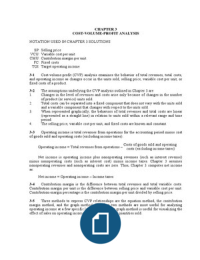
3-1 Cost-volume-profit (CVP) analysis examines the behavior of total revenues, total costs,
and operating income as changes occur in the units sold, selling price, variable cost per unit, or
fixed costs of a product.
3-2 The assumptions underlying the CVP analysis outlined in Chapter 3 are
1. Changes in the level of revenues and costs arise only because of changes in the number
of product (or service) units sold.
2. Total costs can be separated into a fixed component that does not vary with the units sold
and a variable component that changes with respect to the units sold.
3. When represented graphically, the behaviors of total revenues and total costs are linear
(represented as a straight line) in relation to units sold within a relevant range and time
period.
4. The selling price, variable cost per unit, and fixed costs are known and constant.
3-3 Operating income is total revenues from operations for the accounting period minus cost
of goods sold and operating costs (excluding income taxes):
Costs of goods sold and operating
Operating income = Total revenues from operations – costs (excluding income taxes)
Net income is operating income plus nonoperating revenues (such as interest revenue)
minus nonoperating costs (such as interest cost) minus income taxes. Chapter 3 assumes
nonoperating revenues and nonoperating costs are zero. Thus, Chapter 3 computes net income
as:
Net income = Operating income – Income taxes
3-4 Contribution margin is the difference between total revenues and total variable costs.
Contribution margin per unit is the difference between selling price and variable cost per unit.
Contribution-margin percentage is the contribution margin per unit divided by selling price.
3-5 Three methods to express CVP relationships are the equation method, the contribution
margin method, and the graph method. The first two methods are most useful for analyzing
operating income at a few specific levels of sales. The graph method is useful for visualizing the
effect of sales on operating income over a wide range of quantities sold.
3-1
, 3-6 Breakeven analysis denotes the study of the breakeven point, which is often only an
incidental part of the relationship between cost, volume, and profit. Cost-volume-profit
relationship is a more comprehensive term than breakeven analysis.
3-7 CVP certainly is simple, with its assumption of output as the only revenue and cost
driver, and linear revenue and cost relationships. Whether these assumptions make it simplistic
depends on the decision context. In some cases, these assumptions may be sufficiently accurate
for CVP to provide useful insights. The examples in Chapter 3 (the software package context in
the text and the travel agency example in the Problem for Self-Study) illustrate how CVP can
provide such insights. In more complex cases, the basic ideas of simple CVP analysis can be
expanded.
3-8 An increase in the income tax rate does not affect the breakeven point. Operating income
at the breakeven point is zero, and no income taxes are paid at this point.
3-9 Sensitivity analysis is a “what-if” technique that managers use to examine how an
outcome will change if the original predicted data are not achieved or if an underlying
assumption changes. The advent of the electronic spreadsheet has greatly increased the ability to
explore the effect of alternative assumptions at minimal cost. CVP is one of the most widely
used software applications in the management accounting area.
3-10 Examples include:
Manufacturing––substituting a robotic machine for hourly wage workers.
Marketing––changing a sales force compensation plan from a percent of sales dollars to
a fixed salary.
Customer service––hiring a subcontractor to do customer repair visits on an annual
retainer basis rather than a per-visit basis.
3-11 Examples include:
Manufacturing––subcontracting a component to a supplier on a per-unit basis to avoid
purchasing a machine with a high fixed depreciation cost.
Marketing––changing a sales compensation plan from a fixed salary to percent of sales
dollars basis.
Customer service––hiring a subcontractor to do customer service on a per-visit basis
rather than an annual retainer basis.
3-12 Operating leverage describes the effects that fixed costs have on changes in operating
income as changes occur in units sold, and hence, in contribution margin. Knowing the degree of
operating leverage at a given level of sales helps managers calculate the effect of fluctuations in
sales on operating incomes.
3-13 CVP analysis is always conducted for a specified time horizon. One extreme is a very
short-time horizon. For example, some vacation cruises offer deep price discounts for people
who offer to take any cruise on a day’s notice. One day prior to a cruise, most costs are fixed.
The other extreme is several years. Here, a much higher percentage of total costs typically is
variable.
3-2
COST-VOLUME-PROFIT ANALYSIS
NOTATION USED IN CHAPTER 3 SOLUTIONS
SP: Selling price
VCU: Variable cost per unit
CMU: Contribution margin per unit
FC: Fixed costs
TOI: Target operating income
3-1 Cost-volume-profit (CVP) analysis examines the behavior of total revenues, total costs,
and operating income as changes occur in the units sold, selling price, variable cost per unit, or
fixed costs of a product.
3-2 The assumptions underlying the CVP analysis outlined in Chapter 3 are
1. Changes in the level of revenues and costs arise only because of changes in the number
of product (or service) units sold.
2. Total costs can be separated into a fixed component that does not vary with the units sold
and a variable component that changes with respect to the units sold.
3. When represented graphically, the behaviors of total revenues and total costs are linear
(represented as a straight line) in relation to units sold within a relevant range and time
period.
4. The selling price, variable cost per unit, and fixed costs are known and constant.
3-3 Operating income is total revenues from operations for the accounting period minus cost
of goods sold and operating costs (excluding income taxes):
Costs of goods sold and operating
Operating income = Total revenues from operations – costs (excluding income taxes)
Net income is operating income plus nonoperating revenues (such as interest revenue)
minus nonoperating costs (such as interest cost) minus income taxes. Chapter 3 assumes
nonoperating revenues and nonoperating costs are zero. Thus, Chapter 3 computes net income
as:
Net income = Operating income – Income taxes
3-4 Contribution margin is the difference between total revenues and total variable costs.
Contribution margin per unit is the difference between selling price and variable cost per unit.
Contribution-margin percentage is the contribution margin per unit divided by selling price.
3-5 Three methods to express CVP relationships are the equation method, the contribution
margin method, and the graph method. The first two methods are most useful for analyzing
operating income at a few specific levels of sales. The graph method is useful for visualizing the
effect of sales on operating income over a wide range of quantities sold.
3-1
, 3-6 Breakeven analysis denotes the study of the breakeven point, which is often only an
incidental part of the relationship between cost, volume, and profit. Cost-volume-profit
relationship is a more comprehensive term than breakeven analysis.
3-7 CVP certainly is simple, with its assumption of output as the only revenue and cost
driver, and linear revenue and cost relationships. Whether these assumptions make it simplistic
depends on the decision context. In some cases, these assumptions may be sufficiently accurate
for CVP to provide useful insights. The examples in Chapter 3 (the software package context in
the text and the travel agency example in the Problem for Self-Study) illustrate how CVP can
provide such insights. In more complex cases, the basic ideas of simple CVP analysis can be
expanded.
3-8 An increase in the income tax rate does not affect the breakeven point. Operating income
at the breakeven point is zero, and no income taxes are paid at this point.
3-9 Sensitivity analysis is a “what-if” technique that managers use to examine how an
outcome will change if the original predicted data are not achieved or if an underlying
assumption changes. The advent of the electronic spreadsheet has greatly increased the ability to
explore the effect of alternative assumptions at minimal cost. CVP is one of the most widely
used software applications in the management accounting area.
3-10 Examples include:
Manufacturing––substituting a robotic machine for hourly wage workers.
Marketing––changing a sales force compensation plan from a percent of sales dollars to
a fixed salary.
Customer service––hiring a subcontractor to do customer repair visits on an annual
retainer basis rather than a per-visit basis.
3-11 Examples include:
Manufacturing––subcontracting a component to a supplier on a per-unit basis to avoid
purchasing a machine with a high fixed depreciation cost.
Marketing––changing a sales compensation plan from a fixed salary to percent of sales
dollars basis.
Customer service––hiring a subcontractor to do customer service on a per-visit basis
rather than an annual retainer basis.
3-12 Operating leverage describes the effects that fixed costs have on changes in operating
income as changes occur in units sold, and hence, in contribution margin. Knowing the degree of
operating leverage at a given level of sales helps managers calculate the effect of fluctuations in
sales on operating incomes.
3-13 CVP analysis is always conducted for a specified time horizon. One extreme is a very
short-time horizon. For example, some vacation cruises offer deep price discounts for people
who offer to take any cruise on a day’s notice. One day prior to a cruise, most costs are fixed.
The other extreme is several years. Here, a much higher percentage of total costs typically is
variable.
3-2