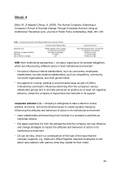
Week 3
White, K., Habib, R., & Hardisty, D. J. (2019). How to SHIFT Consumer Behaviors to
be More Sustainable: A Literature Review and Guiding Framework. Journal of
Marketing, 83(3), 22-49.
SHIFT proposes that consumers are emir included to engage in pro-environmental
behaviors when the message or context leverages the ve psychological factors.
Marketing and Sustainable Consumer Behavior:
- marketers should be cognisant that the consumption mindset that conventional
marketing encourages is a key driver of negative environmental impacts
- sustainable business focus has advantages, e.g. identifying new products and
markets, leveraging emerging technologies, spurring innovation, driving
organizational e ciency, and motivating and retaining employees
- a comprehensive framework will allow practitioners to develop the most e ective
interventions, apply it to constantly changing environments and delineate a
broader set of challenges to sustainable consumer behavior changes
- sustainable consumer behavior = result in decreases in adverse environmental
impacts as well as decreased utilisation of natural resources across the lifecycle
of the product, behavior, or service
SHIFT Framework
1. Social In uence:
- social norms can have a powerful impact on sustainable consumer behaviors,
they can shape intentions, which then predict behavior
- descriptive norms can be stronger predictors than other factors, such as self-
interest, and people tend to underestimate how in uential such norms can be,
most e ective when combined with reference to similar contexts
- descriptive norms may unintentionally lead to decreases in the desired action
- injunctive norms convey what behaviors other people approve or disapprove of,
most e ective when combined with thoughts about the in-group and when they
do not threaten feelings of autonomy
24
ff fl ffi fl fi ff
, - social identities, consumers are more likely to engage in sustainable actions if
in-group members are doing so
- individuals desire to view their in-groups positively and do not wish to see their
in-group outperformed by other groups, especially with “dissociative groups”
(groups you don’t want to be part of)
- social identity e ects are heightened for those high in “in-group identi cation”
- social desirability, consumers tend to select sustainable options to make a
positive impression on others and they endorse high-involvement sustainable
options to convey social status to others
2. Habit Formation
- habits = behaviors that persist because they have become relatively automatic
over time as a result of regularly encountered contextual cues
- discontinuity to change bad habits: disruption in the stable context in which
automatic behaviors arise can crease ideal conditions for habit changes
- penalties = type of punishment that decreases the tendency to engage in an
undesirable behavior (e.g. nes, taxes, tari s, etc.)
- implementation intentions as a means of transitioning people from an old to a
new habit
- encouraging habit changes by making it easy and simple
- prompts = ,messages that are given before the behavior occurs to remind the
consumer what the desired sustainable behavior is
- incentives, such as rewards, gifts (monetary or intrinsic) or feedback
3. Individual Self
- consumers desire to maintain a positive self-concept
- people rea rm a component of the self-concept or engaging in a sustainable
behavior at one time point often leas to consistent sustainable behaviors in the
future (self-consistency)
- inconsistency and consistency can emerge in the same context; people who
bought a reusable shopping bag subsequently spend more money on both
sustainable and indulgent food options
25
ffi ff fi ff fi
White, K., Habib, R., & Hardisty, D. J. (2019). How to SHIFT Consumer Behaviors to
be More Sustainable: A Literature Review and Guiding Framework. Journal of
Marketing, 83(3), 22-49.
SHIFT proposes that consumers are emir included to engage in pro-environmental
behaviors when the message or context leverages the ve psychological factors.
Marketing and Sustainable Consumer Behavior:
- marketers should be cognisant that the consumption mindset that conventional
marketing encourages is a key driver of negative environmental impacts
- sustainable business focus has advantages, e.g. identifying new products and
markets, leveraging emerging technologies, spurring innovation, driving
organizational e ciency, and motivating and retaining employees
- a comprehensive framework will allow practitioners to develop the most e ective
interventions, apply it to constantly changing environments and delineate a
broader set of challenges to sustainable consumer behavior changes
- sustainable consumer behavior = result in decreases in adverse environmental
impacts as well as decreased utilisation of natural resources across the lifecycle
of the product, behavior, or service
SHIFT Framework
1. Social In uence:
- social norms can have a powerful impact on sustainable consumer behaviors,
they can shape intentions, which then predict behavior
- descriptive norms can be stronger predictors than other factors, such as self-
interest, and people tend to underestimate how in uential such norms can be,
most e ective when combined with reference to similar contexts
- descriptive norms may unintentionally lead to decreases in the desired action
- injunctive norms convey what behaviors other people approve or disapprove of,
most e ective when combined with thoughts about the in-group and when they
do not threaten feelings of autonomy
24
ff fl ffi fl fi ff
, - social identities, consumers are more likely to engage in sustainable actions if
in-group members are doing so
- individuals desire to view their in-groups positively and do not wish to see their
in-group outperformed by other groups, especially with “dissociative groups”
(groups you don’t want to be part of)
- social identity e ects are heightened for those high in “in-group identi cation”
- social desirability, consumers tend to select sustainable options to make a
positive impression on others and they endorse high-involvement sustainable
options to convey social status to others
2. Habit Formation
- habits = behaviors that persist because they have become relatively automatic
over time as a result of regularly encountered contextual cues
- discontinuity to change bad habits: disruption in the stable context in which
automatic behaviors arise can crease ideal conditions for habit changes
- penalties = type of punishment that decreases the tendency to engage in an
undesirable behavior (e.g. nes, taxes, tari s, etc.)
- implementation intentions as a means of transitioning people from an old to a
new habit
- encouraging habit changes by making it easy and simple
- prompts = ,messages that are given before the behavior occurs to remind the
consumer what the desired sustainable behavior is
- incentives, such as rewards, gifts (monetary or intrinsic) or feedback
3. Individual Self
- consumers desire to maintain a positive self-concept
- people rea rm a component of the self-concept or engaging in a sustainable
behavior at one time point often leas to consistent sustainable behaviors in the
future (self-consistency)
- inconsistency and consistency can emerge in the same context; people who
bought a reusable shopping bag subsequently spend more money on both
sustainable and indulgent food options
25
ffi ff fi ff fi