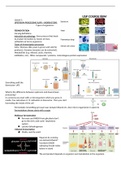
USP COURSE 8BM
Lesson 1:
UPSTREAM PROCESSING (USP) – BIOREACTORS
Types of organisms:
FERMENTATION
Varying definitions
Industrial microbiology: Every process that leads
to product formation by means of mass
cultivation of micro-organisms
Types of fermentation processes
Cells / Biomass (like yeast is grown and sold for
products), Enzymes (enzyme can be extracted),
Metabolites (e.g. ethanol, acids, vitamins,
antibiotics, etc), Other compounds / proteins, Heterologous protein expression
Everything until the
bioreactor: UPS
What is the difference between upstream and downstream
processing?
In a process you start with a microorganism which you grow in
media. You subculture it cultivation in bioreactor. Then you start
harvesting the inside of the cell
Everything until the bioreactor: UPS
Fermentatie (omzetting pyruvaat naar lactaat/ethanol etc. door micro-organismen in spieren)
Fermentation always starts with a sugar
Melkzuur fermentation
Pyruvate and NADH from glycolysis don’t
go to the citric acid cycle/ respiratory
system
Lactate dehydrogenase
Ethanol fermentation
Moslty used by yeast
Waarom de vorming
van lactaat/ethanol?
Voorkomt NADH
ophoping (houdt redox
balans in stand
The end product depends on organism and metabolism in the organism.
,Glycolysis chain: you start with sugars and then it goes to citric acid cycle. Here again different
(end)products can be formed.
Als eerst is er glycolyse, dit is in het cytosol/plasma
Dan omzetten pyruvaat – acetyl coa: mitochondrien
Citroenzuurcyclus: mitochondrien
Ademhalingsketen/oxidatie fosforylatie: membraan mitochondrien
Stap 1: glycolyse
Glucose 2 pyruvaat + vrije energie
(gereduceerd) (gedeeltelijk geoxideerd)
Beter gezegd:
Glucose + 2 ADP + 2 Pi + 2 NAD- 2 pyruvaat + 2 ATP + 2 NADH + 2 H20
+ 2 H+
Glycolyse bestaat uit een voorbereidende fase/investeringsfase en
uitbetalingsfase
Pyruvaat wordt in de mitochondriën
getransporteerd en omgezet in acetyl-COA
= pyruvaat shuttle: transport van cytoplasma
naar mitochondriële matrix (kost 1 ATP)
=acetyl-COA wordt gevormd
Citroenzuurcyclus:
2 acetyl-CoA + 6 NAD+ + 2 FAD + 2 GDP + 2 Pi
+ 4 H20
4 CO2 + 6 NADH + 6 H+ + 2 FADH2 + 2 GTP + 2
CoA
GLUCOSE
CONSUMPTION
When oxygen is absent, anaerobic: fermentation, without O2 turning
glucose in ethanol or lactic acid.
, When oxygen is present, aerobic: to mitochondria, citric acid cycle
RESPIRATION VS. FERMENTATION
ANAEROBIC GLUCOSE
CONSUMPTION
DISSOLVED OXYGEN
(a) strictly aerobe, really needs oxygen
(Micrococcus)
(b) strictly anaerobe, does not need oxygen
(Bacteroides)
(c) facultative anaerobe, don’t really care but will change their metabolites (Escherichia coli)
(d) micro-aerophile, need some but not a lot of oxygen (Helicobacter pylori)
(e) aerotolerant, they always have the same metabolism so oxygen is not necessary
(Clostridium intestinale)
with this test you can see what type of bacteria it is, like
strictly aerobic or anaerobic
Furthermore temperature is important per micro-organism.
Human cells will grow the best at 37 degrees.
TEMPERATURE RANGES: every micro-organism has its
optimum temperature
Lesson 1:
UPSTREAM PROCESSING (USP) – BIOREACTORS
Types of organisms:
FERMENTATION
Varying definitions
Industrial microbiology: Every process that leads
to product formation by means of mass
cultivation of micro-organisms
Types of fermentation processes
Cells / Biomass (like yeast is grown and sold for
products), Enzymes (enzyme can be extracted),
Metabolites (e.g. ethanol, acids, vitamins,
antibiotics, etc), Other compounds / proteins, Heterologous protein expression
Everything until the
bioreactor: UPS
What is the difference between upstream and downstream
processing?
In a process you start with a microorganism which you grow in
media. You subculture it cultivation in bioreactor. Then you start
harvesting the inside of the cell
Everything until the bioreactor: UPS
Fermentatie (omzetting pyruvaat naar lactaat/ethanol etc. door micro-organismen in spieren)
Fermentation always starts with a sugar
Melkzuur fermentation
Pyruvate and NADH from glycolysis don’t
go to the citric acid cycle/ respiratory
system
Lactate dehydrogenase
Ethanol fermentation
Moslty used by yeast
Waarom de vorming
van lactaat/ethanol?
Voorkomt NADH
ophoping (houdt redox
balans in stand
The end product depends on organism and metabolism in the organism.
,Glycolysis chain: you start with sugars and then it goes to citric acid cycle. Here again different
(end)products can be formed.
Als eerst is er glycolyse, dit is in het cytosol/plasma
Dan omzetten pyruvaat – acetyl coa: mitochondrien
Citroenzuurcyclus: mitochondrien
Ademhalingsketen/oxidatie fosforylatie: membraan mitochondrien
Stap 1: glycolyse
Glucose 2 pyruvaat + vrije energie
(gereduceerd) (gedeeltelijk geoxideerd)
Beter gezegd:
Glucose + 2 ADP + 2 Pi + 2 NAD- 2 pyruvaat + 2 ATP + 2 NADH + 2 H20
+ 2 H+
Glycolyse bestaat uit een voorbereidende fase/investeringsfase en
uitbetalingsfase
Pyruvaat wordt in de mitochondriën
getransporteerd en omgezet in acetyl-COA
= pyruvaat shuttle: transport van cytoplasma
naar mitochondriële matrix (kost 1 ATP)
=acetyl-COA wordt gevormd
Citroenzuurcyclus:
2 acetyl-CoA + 6 NAD+ + 2 FAD + 2 GDP + 2 Pi
+ 4 H20
4 CO2 + 6 NADH + 6 H+ + 2 FADH2 + 2 GTP + 2
CoA
GLUCOSE
CONSUMPTION
When oxygen is absent, anaerobic: fermentation, without O2 turning
glucose in ethanol or lactic acid.
, When oxygen is present, aerobic: to mitochondria, citric acid cycle
RESPIRATION VS. FERMENTATION
ANAEROBIC GLUCOSE
CONSUMPTION
DISSOLVED OXYGEN
(a) strictly aerobe, really needs oxygen
(Micrococcus)
(b) strictly anaerobe, does not need oxygen
(Bacteroides)
(c) facultative anaerobe, don’t really care but will change their metabolites (Escherichia coli)
(d) micro-aerophile, need some but not a lot of oxygen (Helicobacter pylori)
(e) aerotolerant, they always have the same metabolism so oxygen is not necessary
(Clostridium intestinale)
with this test you can see what type of bacteria it is, like
strictly aerobic or anaerobic
Furthermore temperature is important per micro-organism.
Human cells will grow the best at 37 degrees.
TEMPERATURE RANGES: every micro-organism has its
optimum temperature