LECTURE 1 – COURSE INTRODUCTION
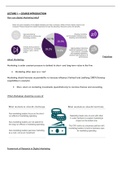
How can digital Marketing help?
Prejudices
about Marketing:
Marketing is under constant pressure to defend its short- and long-term value to the firm
• Marketing often seen as a ‘cost’
Marketing should increase accountability to increase influence (Verhoef and Leeflang 2009) Develop
capabilities in analytics
• Show return on marketing investments (quantitatively) to convince finance and accounting
What Marketeer should be aware of
Framework of Research in Digital Marketing
,
, LECTURE 2 – DIGITAL MARKETING USING EXPERIMENTS (Methods for Digital Marketing research)
Paper: Goldfarb, A., Tucker, C., & Wang, Y. (2022). Conducting Research in Marketing with Quasi-
Experiments. Journal of Marketing, 86(3), 1–20.
Different from lab experiments or field experiments, most digital marketing research uses field data based
on (quasi-) experiments. Challenges that arise in this setting are:
• the scale of observations
• the presence of a time component in observations.
Furthermore, when a quasi-experiment is analyzed, we need to ensure valid inference of causal effects. Next,
we review several analysis strategies for such data:
• Matching estimators
• Difference-in- difference models
• Synthetic control methods.
• We will also pay attention to the R implementation of these methods.
Difference between Experimental Design and Quasi-Experimental Design:
A quasi-experimental design is pretty much different from an experimental design, except for the fact that they
both manifest the cause-effect relationship between the independent and dependent variables. Unlike
experimental design, quasi-experiments do not include random assignments of participants. Meaning, the
participants are placed in the experimental groups based on some of the other criteria.
Experiment (lab or field) Quasi-Experiment
Randomly assigned to groups Not randomly assigned to groups
Equal chance of getting into any experimental Participants are categorized and put into respective
group experimental group
Treatment design No treatment design
No various groups of treatments Researchers study the existing groups of treatments
received
Control groups and treatment groups Does not require control groups, but are generally
used
Does not include a pre-test Includes a pre-test
Advantages of Quasi-Experiments
• They perfect determine what is best for the population. Also known as external validity
• Control of the variables
• Can be combined with other experimental methods
• Transferability to a greater extend
• Involves real-world problems, no artificial ones
• Better control over the third, cofounding variable, which influences the cause and effect
Disadvantages of Quasi-Experiments
• Less internal validity
How can digital Marketing help?
Prejudices
about Marketing:
Marketing is under constant pressure to defend its short- and long-term value to the firm
• Marketing often seen as a ‘cost’
Marketing should increase accountability to increase influence (Verhoef and Leeflang 2009) Develop
capabilities in analytics
• Show return on marketing investments (quantitatively) to convince finance and accounting
What Marketeer should be aware of
Framework of Research in Digital Marketing
,
, LECTURE 2 – DIGITAL MARKETING USING EXPERIMENTS (Methods for Digital Marketing research)
Paper: Goldfarb, A., Tucker, C., & Wang, Y. (2022). Conducting Research in Marketing with Quasi-
Experiments. Journal of Marketing, 86(3), 1–20.
Different from lab experiments or field experiments, most digital marketing research uses field data based
on (quasi-) experiments. Challenges that arise in this setting are:
• the scale of observations
• the presence of a time component in observations.
Furthermore, when a quasi-experiment is analyzed, we need to ensure valid inference of causal effects. Next,
we review several analysis strategies for such data:
• Matching estimators
• Difference-in- difference models
• Synthetic control methods.
• We will also pay attention to the R implementation of these methods.
Difference between Experimental Design and Quasi-Experimental Design:
A quasi-experimental design is pretty much different from an experimental design, except for the fact that they
both manifest the cause-effect relationship between the independent and dependent variables. Unlike
experimental design, quasi-experiments do not include random assignments of participants. Meaning, the
participants are placed in the experimental groups based on some of the other criteria.
Experiment (lab or field) Quasi-Experiment
Randomly assigned to groups Not randomly assigned to groups
Equal chance of getting into any experimental Participants are categorized and put into respective
group experimental group
Treatment design No treatment design
No various groups of treatments Researchers study the existing groups of treatments
received
Control groups and treatment groups Does not require control groups, but are generally
used
Does not include a pre-test Includes a pre-test
Advantages of Quasi-Experiments
• They perfect determine what is best for the population. Also known as external validity
• Control of the variables
• Can be combined with other experimental methods
• Transferability to a greater extend
• Involves real-world problems, no artificial ones
• Better control over the third, cofounding variable, which influences the cause and effect
Disadvantages of Quasi-Experiments
• Less internal validity