APPLYING RESEARCH METHODS
Lecture notes
10/28/2019
Lecture 1
Introduction
Ways of minimizing confirmation bias:
Method of multiple working hypotheses: brainstorm on all plausible hypotheses the research might
touch upon
o Objectivity: separate you from your hypotheses
o Efficiency: research design that allows multiple (competing) hypotheses to be tested
o Research questions hypotheses
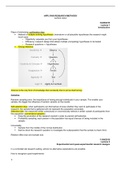
Strong inference
Science is the only form of knowledge that constantly tries to prove itself wrong.
Sampling
Random sampling error: the importance of having enough individuals in your sample. The smaller your
sample, the bigger the influence of random variants on the results.
Self-selection bias: when participants can themselves choose whether they want to participate in the
research, the sample that is gathered will not represent the population accurately.
Selection bias: the researcher either consciously or unconsciously selects a certain subset of participants from
the population (convenience samples).
Keep the promotion of the research neutral in order to prevent self-selection.
Probability sampling: each person in the population has equal chances of being included in the
sample.
Universality
Sample from the middle of the normal distribution.
Narrow down the research question to investigate the subpopulation that the sample is drawn from.
Relation effect size and sample size.
11/04/2019
Lecture 2
Experimental and quasi-experimental research designs
In a controlled lab research setting, almost no alternative explanations are possible.
How to recognize quasi-experiments:
1
Lecture notes
10/28/2019
Lecture 1
Introduction
Ways of minimizing confirmation bias:
Method of multiple working hypotheses: brainstorm on all plausible hypotheses the research might
touch upon
o Objectivity: separate you from your hypotheses
o Efficiency: research design that allows multiple (competing) hypotheses to be tested
o Research questions hypotheses
Strong inference
Science is the only form of knowledge that constantly tries to prove itself wrong.
Sampling
Random sampling error: the importance of having enough individuals in your sample. The smaller your
sample, the bigger the influence of random variants on the results.
Self-selection bias: when participants can themselves choose whether they want to participate in the
research, the sample that is gathered will not represent the population accurately.
Selection bias: the researcher either consciously or unconsciously selects a certain subset of participants from
the population (convenience samples).
Keep the promotion of the research neutral in order to prevent self-selection.
Probability sampling: each person in the population has equal chances of being included in the
sample.
Universality
Sample from the middle of the normal distribution.
Narrow down the research question to investigate the subpopulation that the sample is drawn from.
Relation effect size and sample size.
11/04/2019
Lecture 2
Experimental and quasi-experimental research designs
In a controlled lab research setting, almost no alternative explanations are possible.
How to recognize quasi-experiments:
1