Transition State Theory
Transition State
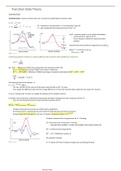
Transition State: enzymes enhance the rate of reaction by stabilising the transition state
K‡ = equilibrium constant btwn A + B and transition state X‡
k' = rate constant for the conversion from X‡ to P + Q
(a) X‡ : transition state is not a stable intermediate
- Cannot purify or capture the TS
- Shares features of both the reactant and the
product
‡
Enzyme lowers the activation energy barrier by ∆∆
‡
(b) ∆
∆ ∆H
Central Assumption: X‡ (TS) is in rapid equilibrium with reactants with equilibrium constant K‡
‡
K‡
‡
∆ = difference in Gibb's free energy btwn the reactants and X‡ (TS)
∆ : standard Gibbs free energy in equilibrium
‡ ‡ ‡ ‡
∆ K‡) : Definition of Gibbs free energy in transition state theory & ∆ ∆ ∆
The observed rate of the reaction = k
‡
- The rate constant of the system (k) decreases exponentially as ∆ ‡ increase
- Thus, larger the difference btwn the free energy difference in TS and the reactants (less stable the TS), slower the reaction
Enzyme: stabilises the TS, does not change the pathway of the catalytic reaction
Enzymatic rate acceleration: achieved by lowering the activation energy barrier btwn reactants and the TS
- Thus, by increasing the fraction of reactants able to achieve the TS
‡ ‡ ‡
∆∆ ∆ ∆
- Catalyst accelerates the reaction w/o affecting the equilibrium
- b/c kinetic barrier is lowered by the same extent for both forward and reverse reactions
‡
- Catalyst lower the Ea by ∆∆ ‡ the rate of reaction increases by factor of
1st peak: represents the energy barrier for E + S binding
ES: G decreases due to decrease in entropy
- substrate loses mobility + rotation by binding to the enzyme active site
‡
transition state energy barrier
‡
: stabilisation reduces G
EP: product is formed
E + P: release of P from E requires energy such as breaking H-bonds
Enzymes Page 1
Transition State
Transition State: enzymes enhance the rate of reaction by stabilising the transition state
K‡ = equilibrium constant btwn A + B and transition state X‡
k' = rate constant for the conversion from X‡ to P + Q
(a) X‡ : transition state is not a stable intermediate
- Cannot purify or capture the TS
- Shares features of both the reactant and the
product
‡
Enzyme lowers the activation energy barrier by ∆∆
‡
(b) ∆
∆ ∆H
Central Assumption: X‡ (TS) is in rapid equilibrium with reactants with equilibrium constant K‡
‡
K‡
‡
∆ = difference in Gibb's free energy btwn the reactants and X‡ (TS)
∆ : standard Gibbs free energy in equilibrium
‡ ‡ ‡ ‡
∆ K‡) : Definition of Gibbs free energy in transition state theory & ∆ ∆ ∆
The observed rate of the reaction = k
‡
- The rate constant of the system (k) decreases exponentially as ∆ ‡ increase
- Thus, larger the difference btwn the free energy difference in TS and the reactants (less stable the TS), slower the reaction
Enzyme: stabilises the TS, does not change the pathway of the catalytic reaction
Enzymatic rate acceleration: achieved by lowering the activation energy barrier btwn reactants and the TS
- Thus, by increasing the fraction of reactants able to achieve the TS
‡ ‡ ‡
∆∆ ∆ ∆
- Catalyst accelerates the reaction w/o affecting the equilibrium
- b/c kinetic barrier is lowered by the same extent for both forward and reverse reactions
‡
- Catalyst lower the Ea by ∆∆ ‡ the rate of reaction increases by factor of
1st peak: represents the energy barrier for E + S binding
ES: G decreases due to decrease in entropy
- substrate loses mobility + rotation by binding to the enzyme active site
‡
transition state energy barrier
‡
: stabilisation reduces G
EP: product is formed
E + P: release of P from E requires energy such as breaking H-bonds
Enzymes Page 1