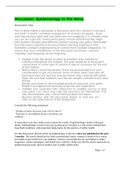
PUBH 6035 Module 1 Discussion; Epidemiology in the News
DiscussionTips Part of what makes a discussion a discussion and not a lecture is the back and forth, indepth, animated engagement of at least two people. If you start discussing a topic andyour peers are not engaging in it, consider what you can do to get the conversationgoing. Include something that might elicit further thoughts and different opinions amongyourpeers.Rememberthatdiscussionsupportsadiscovery-basedlearningexperiencethat facilitates a deeper understanding of content from multiple viewpoints. To ensurethat your contributions to the Discussion are timely, relevant, insightful, and engaging,dothefollowing: • Engage in the discussion as early as possible, and continue to conversethroughoutthemodule.Thegoalshouldbetobringeachconversationtosometypeofnaturalorlogicalconclusionbythe endofthemodule. • Notice that in some Discussions, there are several topics for your considerationtogetyou started.Someofthoseideas maytakeoffandsomemaynot,andyouand your peers may come up with other ideas. Be sure that whatever youdiscuss remainsrelevanttothetopicthread. • Designyourpoststoelicitmultiplepointsofviewfromyourpeers.Respectandappreciatediversityofopinionandexperience. • Validate your assertions with references to credible sources so that your peerscancheckand readthesource(s)forthemselves.Thisalsodemonstratesyourcritical thinkingaboutthetopics. • BecomefamiliarwiththeDiscussion Rubricsothatyouareclearontheexpectationsof theassignment. Considerthefollowingstatements: “Eatingredmeatincreasesyourriskofcancer!”“Exposuretosecondhandsmokeisharmingyourchildren!” It seems that every day media sources report the results of epidemiologic studies with greatdrama. Epidemiologic research may get exciting press, but there is a real science behind thesehyperbolicheadlines,withimportant implicationsforthepracticeofpublic health. For this Discussion, find an article on epidemiology in the news that was published in the past3 months. The article should not be from a professional source; instead, it needs to be a sourceaccessible to and written for a lay audience. Sources can include but are not limited to onlinemagazines, online newspapers, and health news websites. Make sure that the article represents anepidemiological studyandnotanother typeofpublichealth study. For your summary, briefly describe the research and discuss how this article represents anepidemiologicalstudy.Whyisthisanepidemiologicalstudyandnotanothertypeofhealth research? What have you discovered about the current practice of epidemiology from readingthis article? Then, using information in the Learning Resources and other scholarly sources,discuss the connections you see between your current study and the historical development ofepidemiology. How has the past informed how the current study was conducted? Include connections to at least one historical epidemiological study or figure. Make sure to include the article's URL as a reference in your initial posting. This Discussion will be available fromDay1throughDay7ofthismodule.

Geschreven voor
- Instelling
- Walden University
- Vak
- PUBH 6035 (PUBH6035)
Documentinformatie
- Geüpload op
- 16 april 2022
- Aantal pagina's
- 7
- Geschreven in
- 2022/2023
- Type
- Overig
- Persoon
- Onbekend
Onderwerpen
-
pubh 6035 module 1
-
pubh 6035 discussion
-
pubh 6035
-
pubh6035
-
pubh 6035 module 1 discussion

Ook beschikbaar in voordeelbundel