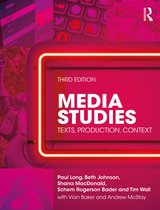
Media Studies
Text, production, context
Third edition
Paul Long, Beth Johnson, Shana MacDonald,
Schem Rogerson Bader, and Tim Wall
SUMMARY | Media Studies (Long et. Al.)
,Contents
Chapter 1 – How do media make meaning?............................................................................... 3
Analytical tools: rhetoric ........................................................................................................ 3
Analytical tools: semiology .................................................................................................... 4
Summary ................................................................................................................................. 7
Chapter 2 – Organising meaning in media texts: genre and narrative ....................................... 8
Studying genre ........................................................................................................................ 8
Narrative, narratology, and genre study ................................................................................. 9
Summary ............................................................................................................................... 10
Chapter 3 – Media representations ........................................................................................... 11
Conceptualising and defining representation ....................................................................... 11
Media professionals and the ‘politics’ of representation ...................................................... 12
Method: content analysis ...................................................................................................... 12
Representations of individuality: stars, personalities, celebrities ......................................... 13
Summary ............................................................................................................................... 14
Chapter 8 – Media power ......................................................................................................... 15
Conceptualising power ......................................................................................................... 15
Media and power .................................................................................................................. 15
Ideology ................................................................................................................................ 16
Discourse, power, and media ................................................................................................ 17
Summary ............................................................................................................................... 18
Chapter 9 – Mass society and media ........................................................................................ 19
Theories of mass society....................................................................................................... 19
Who are the masses? ............................................................................................................. 20
Summary ............................................................................................................................... 21
= examples
= (important) people
= main concepts
SUMMARY | Media Studies (Long et. Al.)
, Chapter 1 – How do media make meaning? Week 2 - The Creation of Meaning
Long et. Al., Chapter 1, p34-82
Three-part relationship of labelling media output:
1. physical form -> artefactual aspect (DVD, newspapers, etc.)
2. economic value -> commodity aspect (costs of media production: cinema ticket)
3. meaning value -> textual aspect (what meaning the output has for us)
Making meaning of media in three ways:
1. the work of media producers themselves
2. results from our upbringing and wider cultural, social, and historical contexts
3. our regular acquaintance with various forms of media (starts from the day we’re born)
-> media make meaning through a variety of means, as part of a relationship between producer and
consumer -> text and textual meanings are always contextualized
- media and their products are not natural -> how they operate is not necessarily consensual
Analytical tools: rhetoric
Analytical tools: rhetoric
Rhetoric = the construction and manipulation of language by the creator of a text for affective
purposes (elicit emotional, psychological, or physical responses from audiences)
Rhetorical analysis = how are media texts put together as media texts?
- media and their meanings constructed out of the use of available techniques, styles, and
conventions
The aim of media in organizing meaning: to get audiences to pay attention
-> cognition = the way we acquire AND apply knowledge (the process through which we comprehend
events and ideas in order to come to understand the world)
-> the cognition/interpretation of the media text is a mode of communication
- meaning is not mainly about information, but about how it’s presented and the particularities of the
medium (medium is the message)
(example: cover Harry grinning and Meghan looking happy)
Language = the material out of which communication is created. It provides basic units
(words, phrases, sounds, images) and rules that determine how they can be used
(grammar)
Rhetoric = the way in which language is manipulated to a particular purpose
Meaning = the interpretation of messages by the ‘reader’ of the text
Empty rhetoric = that an argument can be convincingly put, suggesting that it is very
interesting/profound, but in reality it is quite insubstantial
Rhetorical question = question designed to have an obvious answer
SUMMARY | Media Studies (Long et. Al.)
Text, production, context
Third edition
Paul Long, Beth Johnson, Shana MacDonald,
Schem Rogerson Bader, and Tim Wall
SUMMARY | Media Studies (Long et. Al.)
,Contents
Chapter 1 – How do media make meaning?............................................................................... 3
Analytical tools: rhetoric ........................................................................................................ 3
Analytical tools: semiology .................................................................................................... 4
Summary ................................................................................................................................. 7
Chapter 2 – Organising meaning in media texts: genre and narrative ....................................... 8
Studying genre ........................................................................................................................ 8
Narrative, narratology, and genre study ................................................................................. 9
Summary ............................................................................................................................... 10
Chapter 3 – Media representations ........................................................................................... 11
Conceptualising and defining representation ....................................................................... 11
Media professionals and the ‘politics’ of representation ...................................................... 12
Method: content analysis ...................................................................................................... 12
Representations of individuality: stars, personalities, celebrities ......................................... 13
Summary ............................................................................................................................... 14
Chapter 8 – Media power ......................................................................................................... 15
Conceptualising power ......................................................................................................... 15
Media and power .................................................................................................................. 15
Ideology ................................................................................................................................ 16
Discourse, power, and media ................................................................................................ 17
Summary ............................................................................................................................... 18
Chapter 9 – Mass society and media ........................................................................................ 19
Theories of mass society....................................................................................................... 19
Who are the masses? ............................................................................................................. 20
Summary ............................................................................................................................... 21
= examples
= (important) people
= main concepts
SUMMARY | Media Studies (Long et. Al.)
, Chapter 1 – How do media make meaning? Week 2 - The Creation of Meaning
Long et. Al., Chapter 1, p34-82
Three-part relationship of labelling media output:
1. physical form -> artefactual aspect (DVD, newspapers, etc.)
2. economic value -> commodity aspect (costs of media production: cinema ticket)
3. meaning value -> textual aspect (what meaning the output has for us)
Making meaning of media in three ways:
1. the work of media producers themselves
2. results from our upbringing and wider cultural, social, and historical contexts
3. our regular acquaintance with various forms of media (starts from the day we’re born)
-> media make meaning through a variety of means, as part of a relationship between producer and
consumer -> text and textual meanings are always contextualized
- media and their products are not natural -> how they operate is not necessarily consensual
Analytical tools: rhetoric
Analytical tools: rhetoric
Rhetoric = the construction and manipulation of language by the creator of a text for affective
purposes (elicit emotional, psychological, or physical responses from audiences)
Rhetorical analysis = how are media texts put together as media texts?
- media and their meanings constructed out of the use of available techniques, styles, and
conventions
The aim of media in organizing meaning: to get audiences to pay attention
-> cognition = the way we acquire AND apply knowledge (the process through which we comprehend
events and ideas in order to come to understand the world)
-> the cognition/interpretation of the media text is a mode of communication
- meaning is not mainly about information, but about how it’s presented and the particularities of the
medium (medium is the message)
(example: cover Harry grinning and Meghan looking happy)
Language = the material out of which communication is created. It provides basic units
(words, phrases, sounds, images) and rules that determine how they can be used
(grammar)
Rhetoric = the way in which language is manipulated to a particular purpose
Meaning = the interpretation of messages by the ‘reader’ of the text
Empty rhetoric = that an argument can be convincingly put, suggesting that it is very
interesting/profound, but in reality it is quite insubstantial
Rhetorical question = question designed to have an obvious answer
SUMMARY | Media Studies (Long et. Al.)