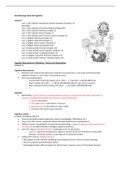
Aantekeningen Brain & Cognition
Lecture 1
- Lect. 1 (Van Opstal): Introduction & Brain Anatomy (Chapter 1 &
Appendix)
- Lect. 2 (Van Opstal): more Brain Anatomy (Appendix)
- Lect. 3 (Van Opstal): Methods (Chapter 2)
- Lect. 4 (Van Opstal): Vision (Chapter 3)
- Lect. 5 (Van Opstal): Other sensory systems (Chapter 4)
- Lect. 6 (Sligte): Attention (Chapter 6)
- Lect. 7 (Sligte): Attention (Chapter 7)
- Lect. 8 (Sligte): Motor system (Chapter 5)
- Lect. 9 (Sligte): Memory (Chapters 8-9)
- Lect. 10 (Starreveld): Emotion (Chapter 10)
- Lect. 11 (Starreveld): Social Cognition (Chapter 11)
- Lect. 12 (Starreveld): Language (Chapter 12)
- Lect. 13 (Sligte): Executive functions (Chapter 13)
- Lect. 14 (Starreveld): Decision making (Chapter 14)
Cognitive Neuroscience: Definitions, Themes and Approaches
(Chapter 1)
Cognitive Neuroscience
• Relatively new research discipline that combines neuroscience (i.e., the study of the brain) with
cognitive science (i.e., the study of mental processes)
• Very promising discipline
o Human Brain Project (European union, 2013 - ...). Total cost: 1.019.000.000 Euros.
o Brain Initiative (US, 2013 - ...). 300 to 500.000.000 USD per year (10 to 12 years).
o Allen Institute for Brain Science (US, 2014 - ...). Paul Allen: 500.000.000 USD.
o • ....
Cognition
• DEFINITION: ‘set of processes to perceive external stimuli, to extract key information and hold it in
memory, and generate thoughts and actions to reach desired goals’
✓ acquire information
✓ store and retrieve information in memory
✓ generate and use information to reach a goal
✓ Conscious and unconscious processes
Cognitive science
A SHORT HISTORICAL SKETCH
• Plato and Aristotle already studied the nature of knowledge (~500 before Chr.)
• Only in the 19th century: empirical evidence through experimental manipulations!
• Wilhelm Wundt - the godfather of experimental psychology – used introspection (only processes you
are aware of) to experimentally investigate cognitive processes.
• Early 20th century: rise of behaviorism (especially in the United States).
o Objective experimental approach: objective external stimuli are matched to measurable
behavior. All mental activity can be reduced to behavioral activity.
• Halfway 20th century: Cognitive Science
✓ Rats appear to learn without rewarding stimuli (experiment by Tolman on latent learning)
✓ Rise of computers and information theory
✓ Psychological states affect responses to stimuli (tired, stressed, more to it that fixed memory)
, Skinner box: animals (rats) can perform complex behaviors through reward-
based learning (i.e. operant conditioning). Skinner was able to learn pigeons
how to read!
Memory is shaped by reward/punishment and, thus, passive.
Memory is not a passive representation of sensory stimuli, but an active recoding off
different pieces of information carried by the stimulus! There is something between the
stimulus and the response.
Cognitive science
Cognitive models
• Predict how sensory stimuli leads to behavioral responses.
• Model components are not necessarily related to physical processes in the
brain
• Make use of psychological constructs (e.g., ‘attention’, ‘arousal’).
Cognitive model on tinnitus distress (McKenna et al., 2014)
Neuroscience
• How is the nervous system (of humans and other animals) organized and how does it function?
IMPORTANT HISTORICAL MOMENTS:
• Gall: Cognitive functions and personality traits are associated with different parts
of the cerebral cortex. The extend of a function of trait could be mapped by
measuring bumps on the skull (phrenology).
➢ Although phrenology is now dismissed, the idea that functions can be
localized in specific brain areas is still very popular (but very wrong in many –
or most – cases!!).
• Only in 2nd half of 19th century the neuron doctrine emerged: the nervous system
is made up of discrete individual cells (i.e., neurons).
• Soon after came the discovery that neurons communicate via electrical impulses (action potentials)
and biochemical substances (neurotransmitters). Much more on this later!!
,Cognitive Neuroscience
• As stated before: the intersection of cognitive science and
neuroscience
• !! The goal is not just to create maps of brain function. It is not the
search for the neural correlates of a cognitive function. Move away
from the ‘phrenological approach’.
• The goal is to understand cognition in terms of the underlying neural
computations. We want to develop ‘neurobiologically grounded
models of cognitive functions’!!
Cognitive Neuroscience
• Wealth of research methods, but all methods have limitations (see Lecture 3 on Methods)
Temporal resolution
Cognitive Neuroscience
• Ideally: address same research question with multiple methods and research paradigms.
• CONVERGENCE: study a theoretical concept with different paradigms. A hypothesis that is tested with
different experimental designs that all give the same results (i.e., they converge), provides very strong
empirical evidence. Combining information from multiple studies can be done by performing a meta-
analysis (‘analyses of analyses’).
• COMPLEMENTARITY: different methods provide different sorts of information. For example, some
methods have a high temporal resolution, other have a high spatial resolution.
OVERVIEW
1. ANATOMICAL TERMINOLOGY
2. STRUCTURAL ORGANIZATION OF THE HUMAN NERVOUS SYSTEM
- PERIPHERAL NERVOUS SYSTEM
- CENTRAL NERVOUS SYSTEM
o SPINAL CORD
o BRAINSTEM
o CEREBELLUM
o FOREBRAIN
1. Anatomical terminology
• Human terminology based on animal
Dorsal: the back (dorsum in Latin)
Ventral: the belly (ventrum in Latin)
Rostral: the beak (rostrum in Latin)
Caudal: the tail (caudum in Latin)
, • Cross-sections (slices) of the brain
o Coronal (frontal): front to back (or anterior to posterior)
o Sagittal (longitudinal): left to right
o Axial (horizontal, transverse): top to bottom (or dorsal to
ventral, for the brain)
1. Anatomical terminology
What you need to remember (and be able to apply):
Lecture 1
- Lect. 1 (Van Opstal): Introduction & Brain Anatomy (Chapter 1 &
Appendix)
- Lect. 2 (Van Opstal): more Brain Anatomy (Appendix)
- Lect. 3 (Van Opstal): Methods (Chapter 2)
- Lect. 4 (Van Opstal): Vision (Chapter 3)
- Lect. 5 (Van Opstal): Other sensory systems (Chapter 4)
- Lect. 6 (Sligte): Attention (Chapter 6)
- Lect. 7 (Sligte): Attention (Chapter 7)
- Lect. 8 (Sligte): Motor system (Chapter 5)
- Lect. 9 (Sligte): Memory (Chapters 8-9)
- Lect. 10 (Starreveld): Emotion (Chapter 10)
- Lect. 11 (Starreveld): Social Cognition (Chapter 11)
- Lect. 12 (Starreveld): Language (Chapter 12)
- Lect. 13 (Sligte): Executive functions (Chapter 13)
- Lect. 14 (Starreveld): Decision making (Chapter 14)
Cognitive Neuroscience: Definitions, Themes and Approaches
(Chapter 1)
Cognitive Neuroscience
• Relatively new research discipline that combines neuroscience (i.e., the study of the brain) with
cognitive science (i.e., the study of mental processes)
• Very promising discipline
o Human Brain Project (European union, 2013 - ...). Total cost: 1.019.000.000 Euros.
o Brain Initiative (US, 2013 - ...). 300 to 500.000.000 USD per year (10 to 12 years).
o Allen Institute for Brain Science (US, 2014 - ...). Paul Allen: 500.000.000 USD.
o • ....
Cognition
• DEFINITION: ‘set of processes to perceive external stimuli, to extract key information and hold it in
memory, and generate thoughts and actions to reach desired goals’
✓ acquire information
✓ store and retrieve information in memory
✓ generate and use information to reach a goal
✓ Conscious and unconscious processes
Cognitive science
A SHORT HISTORICAL SKETCH
• Plato and Aristotle already studied the nature of knowledge (~500 before Chr.)
• Only in the 19th century: empirical evidence through experimental manipulations!
• Wilhelm Wundt - the godfather of experimental psychology – used introspection (only processes you
are aware of) to experimentally investigate cognitive processes.
• Early 20th century: rise of behaviorism (especially in the United States).
o Objective experimental approach: objective external stimuli are matched to measurable
behavior. All mental activity can be reduced to behavioral activity.
• Halfway 20th century: Cognitive Science
✓ Rats appear to learn without rewarding stimuli (experiment by Tolman on latent learning)
✓ Rise of computers and information theory
✓ Psychological states affect responses to stimuli (tired, stressed, more to it that fixed memory)
, Skinner box: animals (rats) can perform complex behaviors through reward-
based learning (i.e. operant conditioning). Skinner was able to learn pigeons
how to read!
Memory is shaped by reward/punishment and, thus, passive.
Memory is not a passive representation of sensory stimuli, but an active recoding off
different pieces of information carried by the stimulus! There is something between the
stimulus and the response.
Cognitive science
Cognitive models
• Predict how sensory stimuli leads to behavioral responses.
• Model components are not necessarily related to physical processes in the
brain
• Make use of psychological constructs (e.g., ‘attention’, ‘arousal’).
Cognitive model on tinnitus distress (McKenna et al., 2014)
Neuroscience
• How is the nervous system (of humans and other animals) organized and how does it function?
IMPORTANT HISTORICAL MOMENTS:
• Gall: Cognitive functions and personality traits are associated with different parts
of the cerebral cortex. The extend of a function of trait could be mapped by
measuring bumps on the skull (phrenology).
➢ Although phrenology is now dismissed, the idea that functions can be
localized in specific brain areas is still very popular (but very wrong in many –
or most – cases!!).
• Only in 2nd half of 19th century the neuron doctrine emerged: the nervous system
is made up of discrete individual cells (i.e., neurons).
• Soon after came the discovery that neurons communicate via electrical impulses (action potentials)
and biochemical substances (neurotransmitters). Much more on this later!!
,Cognitive Neuroscience
• As stated before: the intersection of cognitive science and
neuroscience
• !! The goal is not just to create maps of brain function. It is not the
search for the neural correlates of a cognitive function. Move away
from the ‘phrenological approach’.
• The goal is to understand cognition in terms of the underlying neural
computations. We want to develop ‘neurobiologically grounded
models of cognitive functions’!!
Cognitive Neuroscience
• Wealth of research methods, but all methods have limitations (see Lecture 3 on Methods)
Temporal resolution
Cognitive Neuroscience
• Ideally: address same research question with multiple methods and research paradigms.
• CONVERGENCE: study a theoretical concept with different paradigms. A hypothesis that is tested with
different experimental designs that all give the same results (i.e., they converge), provides very strong
empirical evidence. Combining information from multiple studies can be done by performing a meta-
analysis (‘analyses of analyses’).
• COMPLEMENTARITY: different methods provide different sorts of information. For example, some
methods have a high temporal resolution, other have a high spatial resolution.
OVERVIEW
1. ANATOMICAL TERMINOLOGY
2. STRUCTURAL ORGANIZATION OF THE HUMAN NERVOUS SYSTEM
- PERIPHERAL NERVOUS SYSTEM
- CENTRAL NERVOUS SYSTEM
o SPINAL CORD
o BRAINSTEM
o CEREBELLUM
o FOREBRAIN
1. Anatomical terminology
• Human terminology based on animal
Dorsal: the back (dorsum in Latin)
Ventral: the belly (ventrum in Latin)
Rostral: the beak (rostrum in Latin)
Caudal: the tail (caudum in Latin)
, • Cross-sections (slices) of the brain
o Coronal (frontal): front to back (or anterior to posterior)
o Sagittal (longitudinal): left to right
o Axial (horizontal, transverse): top to bottom (or dorsal to
ventral, for the brain)
1. Anatomical terminology
What you need to remember (and be able to apply):