
Chapter 2: Models of man
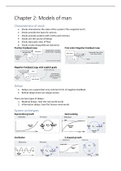
Characteristics of stock
• Stocks characterise the state of the system ("the snapshot test”)
• Stocks provide the basis for actions
• Stocks provide systems with inertia and memory
• Stocks are the source of delays
• Stocks decouple rates of flow
• Stocks create disequilibrium dynamics
Positive feedback loop First-order Negative feedback loop
Negative feedback loop with explicit goals
Delays
• Delays are a special but very common form of negative feedback
• Behind delays there are always stocks
There are two types of delays:
1. Material delays: how the real-world works
2. Information delays: how the human mind works
System archetypes
Exponential growth Goal-seeking
Oscillation S-shaped growth
,Overshoot & collapse
,Chapter 3 Boundedly rational
Living in a complex world
• Increased volatility
• Technological complexity
• Interconnectedness
Rationality filters
Homo economicus
• Core assumption of many economic theories is that humans are
o Fully objectively rational
o Make optimal decisions
o Based upon complete information
o Attempt to maximize utility as consumers and economic profit as producers
Cognitive filters
We are ill-equipped to deal with dynamic complexity
• We find it hard to deal with feedback, delays, and accumulations
Behavioural filters
Philosophers argue that any observation is theory-based
• The focus of attention is theory-loaded: the things you investigate, as well as the
things you do NOT look at le.g, female composers, the curve of the earth at the
beach)
• Observations are theory-loaded: what you see when you investigate is determined
by your background knowledge (e.g., a chicken in a movie of New York for a group of
pygmees, or the Ponzo-illusion)
• Observation reports are theory-loaded: what you report of your investigations
afterwards is coloured
The tortoise and the hare
, Organisational filters
5 reasons why our respondents were sensible enough not to improve management
information & decision-making:
1. Managers do not know what information they need
2. Managers do not want to escalate and share data
3. People are incentivized to manipulate data and data definitions
4. Managers manipulate the KPls against which they are rewarded
5. The supply chain is too complex to be understood by most
Strategic filters
• Capability trap
• Experience trap
• Service rampup trap
Overt and implicit decisions
• Overt decisions are here defined as the conscious decisions by people as part of
management and economic processes. Overt decisions include executive decisions
and consumer purchase decisions.
• Implicit decisions are the unavoidable result of the state of a system.
• For instance: Actual, present production rate is usually the result of an implicit
decision function that shows how production rate is a consequence of employment,
available equipment, and materials.
o It is not usually an overt decision; it is not possible to decide arbitrarily on a
production rate and thereby have that rate exist immediately and with
certainty.
o The accompanying overt managerial decisions are the decisions to attempt to
hire people and to order equipment and materials.
Characteristics of stock
• Stocks characterise the state of the system ("the snapshot test”)
• Stocks provide the basis for actions
• Stocks provide systems with inertia and memory
• Stocks are the source of delays
• Stocks decouple rates of flow
• Stocks create disequilibrium dynamics
Positive feedback loop First-order Negative feedback loop
Negative feedback loop with explicit goals
Delays
• Delays are a special but very common form of negative feedback
• Behind delays there are always stocks
There are two types of delays:
1. Material delays: how the real-world works
2. Information delays: how the human mind works
System archetypes
Exponential growth Goal-seeking
Oscillation S-shaped growth
,Overshoot & collapse
,Chapter 3 Boundedly rational
Living in a complex world
• Increased volatility
• Technological complexity
• Interconnectedness
Rationality filters
Homo economicus
• Core assumption of many economic theories is that humans are
o Fully objectively rational
o Make optimal decisions
o Based upon complete information
o Attempt to maximize utility as consumers and economic profit as producers
Cognitive filters
We are ill-equipped to deal with dynamic complexity
• We find it hard to deal with feedback, delays, and accumulations
Behavioural filters
Philosophers argue that any observation is theory-based
• The focus of attention is theory-loaded: the things you investigate, as well as the
things you do NOT look at le.g, female composers, the curve of the earth at the
beach)
• Observations are theory-loaded: what you see when you investigate is determined
by your background knowledge (e.g., a chicken in a movie of New York for a group of
pygmees, or the Ponzo-illusion)
• Observation reports are theory-loaded: what you report of your investigations
afterwards is coloured
The tortoise and the hare
, Organisational filters
5 reasons why our respondents were sensible enough not to improve management
information & decision-making:
1. Managers do not know what information they need
2. Managers do not want to escalate and share data
3. People are incentivized to manipulate data and data definitions
4. Managers manipulate the KPls against which they are rewarded
5. The supply chain is too complex to be understood by most
Strategic filters
• Capability trap
• Experience trap
• Service rampup trap
Overt and implicit decisions
• Overt decisions are here defined as the conscious decisions by people as part of
management and economic processes. Overt decisions include executive decisions
and consumer purchase decisions.
• Implicit decisions are the unavoidable result of the state of a system.
• For instance: Actual, present production rate is usually the result of an implicit
decision function that shows how production rate is a consequence of employment,
available equipment, and materials.
o It is not usually an overt decision; it is not possible to decide arbitrarily on a
production rate and thereby have that rate exist immediately and with
certainty.
o The accompanying overt managerial decisions are the decisions to attempt to
hire people and to order equipment and materials.



