Neuronal Communication
13.1 Coordination
13.1 Coordination
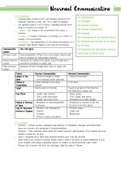
- Communication systems involve cells releasing chemicals that
stimulate responses in other cells. This is called cell signalling. 13.2 neurones
- Cell signalling requires a cell to release a signalling molecule which 13.3 sensory receptors
binds to receptors on a target cell.
- Stimulus ~ any change in the environment that causes a 13.4 nervous transmission
response 13.5 synapses
- Response ~ a change in behaviour or physiology as a result of a
13.6 organisation of the nervous system
change in the environment.
- Homeostasis ~ the maintenance of the internal environment in a 13.7 structure and function of the brain
constant state despite changes in the external environment. 13.8 reflexes
Communication How cells signal 13.9 voluntary and involuntary muscles
system
13.10 sliding filament model
Nervous system Neurotransmitters diffuse from a presynaptic neurone and
bind to receptors on postsynaptic neurones.
Animal endocrine Hormones are released from glands, travel through blood
system and bind to receptors on target cells.
Plant hormonal Hormones diffused through plant tissue to target cells.
system
Feature Nervous Communication Hormonal Communication
Nature of the - Electrical changes in charge - Chemical messengers
Signal - Nerve impulses/action potentials
Method of Action potentials travel along In the blood
Transmitting neurons
Target Specific parts of the body Travels to all parts of the body but
only detected by target cells
Time Period - Usually, rapid response - Slower acting
- Over a short time period - Over a longer time period
- Usually, short lived effect - Permanent irreversible changes
Method of Removal - Breakdown of neurotransmitters - Breakdown by enzymes in the liver
of Signal by enzymes - Excretion from the kidneys.
Type of Structures - Receptor cells (transducers) - Receptor organs
Involved or Required - Neurons - Target cells
- Synapses - Bloodstream
- Effector muscles and glands
13.2 Neurones
- Cell body ~ contains nucleus, cytoplasm, large amounts of endoplasmic reticulum and mitochondria –
these are involved in the production of neurotransmitters
- Dendrons ~ short extensions which divide into smaller branches called dendrites. They transmit electrical
impulses towards the cell body.
- Axons ~ elongated nerve fibres that transmit impulses away from the cell body
- Some neurons are covered in a myelin sheath, which is made from layers of plasma membrane. It acts
as an insulator which allows myelinated neurons to conduct an electrical impulse much faster.
- Between the Schwann cells there are small gaps called the nodes of Ranvier.
, - Sensory neurons transmit impulses from a sensory receptor
to the central nervous system. Long dendron and short axons
- Relay neurones transmit
impulses between sensory and
motor neurones. They have a short axons and short dendrons
- Motor neurons transmit impulses from the
central nervous system to effectors. They
have a long axon and many short dendrites.
Parasympathetic Sympathetic
- A few nerves from the central nervous system - Many nerves from the central nervous system
divide up to different effectors to separate effectors
- Ganglia in the effector tissue - Ganglia just outside the central nervous system
- Long preganglionic neurons - Short preganglionic neurons
- Short postganglionic neurons - Long postganglionic neurons
- Uses acetylcholine as a neurotransmitter - Uses noradrenaline as a neurotransmitter
- Decreases activity to conserve energy - Tends to increase levels of activity
• Heart rate decrease • Heart rate increase
• Pupils constrict • Pupil dilation
• Reduced ventilation rate • Increased ventilation rate
• Constriction of bronchioles • Dilation of bronchioles
• Increased peristalsis • Reduced peristalsis
• Increased urination • Decreased urine
• Sexual arousal • Orgasm
- Active during sleep/relaxation - More active in times of stress
13.3 Sensory Receptors
- Sensory receptors are specific to a single type of stimulus, Type of sensory Stimulus
and they act as transducers (they convert a stimulus into receptor
a nerve impulse). Mechanoreceptor Pressure and movement
- They convert the stimulus into a nervous impulse called a Chemoreceptor Chemicals
generator potential. Thermoreceptor Heat
Pacinian Corpuscle: Photoreceptor Light
- Pacinian corpuscles are specific sensory receptors that
detect mechanical pressure.
- They are deep in the skin, mainly in fingers and soles of the feet and joints to allow you know which
way joints are changing direction.
- The end of the sensory neuron is the centre of the corpuscle, surrounded by layers of connective
tissue. Each layer is separated. By a layer of gel.
- Within the membrane of the neuron there are sodium ion channels for transport
13.1 Coordination
13.1 Coordination
- Communication systems involve cells releasing chemicals that
stimulate responses in other cells. This is called cell signalling. 13.2 neurones
- Cell signalling requires a cell to release a signalling molecule which 13.3 sensory receptors
binds to receptors on a target cell.
- Stimulus ~ any change in the environment that causes a 13.4 nervous transmission
response 13.5 synapses
- Response ~ a change in behaviour or physiology as a result of a
13.6 organisation of the nervous system
change in the environment.
- Homeostasis ~ the maintenance of the internal environment in a 13.7 structure and function of the brain
constant state despite changes in the external environment. 13.8 reflexes
Communication How cells signal 13.9 voluntary and involuntary muscles
system
13.10 sliding filament model
Nervous system Neurotransmitters diffuse from a presynaptic neurone and
bind to receptors on postsynaptic neurones.
Animal endocrine Hormones are released from glands, travel through blood
system and bind to receptors on target cells.
Plant hormonal Hormones diffused through plant tissue to target cells.
system
Feature Nervous Communication Hormonal Communication
Nature of the - Electrical changes in charge - Chemical messengers
Signal - Nerve impulses/action potentials
Method of Action potentials travel along In the blood
Transmitting neurons
Target Specific parts of the body Travels to all parts of the body but
only detected by target cells
Time Period - Usually, rapid response - Slower acting
- Over a short time period - Over a longer time period
- Usually, short lived effect - Permanent irreversible changes
Method of Removal - Breakdown of neurotransmitters - Breakdown by enzymes in the liver
of Signal by enzymes - Excretion from the kidneys.
Type of Structures - Receptor cells (transducers) - Receptor organs
Involved or Required - Neurons - Target cells
- Synapses - Bloodstream
- Effector muscles and glands
13.2 Neurones
- Cell body ~ contains nucleus, cytoplasm, large amounts of endoplasmic reticulum and mitochondria –
these are involved in the production of neurotransmitters
- Dendrons ~ short extensions which divide into smaller branches called dendrites. They transmit electrical
impulses towards the cell body.
- Axons ~ elongated nerve fibres that transmit impulses away from the cell body
- Some neurons are covered in a myelin sheath, which is made from layers of plasma membrane. It acts
as an insulator which allows myelinated neurons to conduct an electrical impulse much faster.
- Between the Schwann cells there are small gaps called the nodes of Ranvier.
, - Sensory neurons transmit impulses from a sensory receptor
to the central nervous system. Long dendron and short axons
- Relay neurones transmit
impulses between sensory and
motor neurones. They have a short axons and short dendrons
- Motor neurons transmit impulses from the
central nervous system to effectors. They
have a long axon and many short dendrites.
Parasympathetic Sympathetic
- A few nerves from the central nervous system - Many nerves from the central nervous system
divide up to different effectors to separate effectors
- Ganglia in the effector tissue - Ganglia just outside the central nervous system
- Long preganglionic neurons - Short preganglionic neurons
- Short postganglionic neurons - Long postganglionic neurons
- Uses acetylcholine as a neurotransmitter - Uses noradrenaline as a neurotransmitter
- Decreases activity to conserve energy - Tends to increase levels of activity
• Heart rate decrease • Heart rate increase
• Pupils constrict • Pupil dilation
• Reduced ventilation rate • Increased ventilation rate
• Constriction of bronchioles • Dilation of bronchioles
• Increased peristalsis • Reduced peristalsis
• Increased urination • Decreased urine
• Sexual arousal • Orgasm
- Active during sleep/relaxation - More active in times of stress
13.3 Sensory Receptors
- Sensory receptors are specific to a single type of stimulus, Type of sensory Stimulus
and they act as transducers (they convert a stimulus into receptor
a nerve impulse). Mechanoreceptor Pressure and movement
- They convert the stimulus into a nervous impulse called a Chemoreceptor Chemicals
generator potential. Thermoreceptor Heat
Pacinian Corpuscle: Photoreceptor Light
- Pacinian corpuscles are specific sensory receptors that
detect mechanical pressure.
- They are deep in the skin, mainly in fingers and soles of the feet and joints to allow you know which
way joints are changing direction.
- The end of the sensory neuron is the centre of the corpuscle, surrounded by layers of connective
tissue. Each layer is separated. By a layer of gel.
- Within the membrane of the neuron there are sodium ion channels for transport