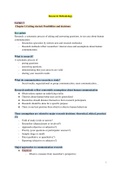
Research Methodology
Lecture 1
Chapter 1.Getting started: Possibilities and decisions:
Key points
Research: a systematic process of asking and answering questions, in our case about human
communication
- Researches specialize by interest area and research method(s)
- Research methods reflect researchers’ interest areas and assumptions about human
communication
What is research?
A systematic process of
- posing questions
- answering questions
- demonstrating that your answers are valid
- sharing your research results
What do communication researchers study?
- Social media, organizational or group communication, mass communication…
Research methods reflect contestable assumptions about human communication
● Observations capture an underlying reality
● Theories about human behaviour can be generalized
● Researches should distance themselves from research participants
● Research should be done for a specific purpose
● There is one best position from which to observe human behaviour
These assumptions are related to major research decisions: theoretical, ethical, practical
(½)
- Field of study (wide or narrow?
- Researcher (dispassionate or involved?)
- Approach (objective or subjective?)
- Priority (your questions or participants’ answers?)
- Sample (large or small)
- Data (qualitative or quantitative?)
- Reporting (objective or subjective?)
Major approaches to communication research
● Empirical
- Observe, measure from researcher’s perspective
1
Lecture 1
Chapter 1.Getting started: Possibilities and decisions:
Key points
Research: a systematic process of asking and answering questions, in our case about human
communication
- Researches specialize by interest area and research method(s)
- Research methods reflect researchers’ interest areas and assumptions about human
communication
What is research?
A systematic process of
- posing questions
- answering questions
- demonstrating that your answers are valid
- sharing your research results
What do communication researchers study?
- Social media, organizational or group communication, mass communication…
Research methods reflect contestable assumptions about human communication
● Observations capture an underlying reality
● Theories about human behaviour can be generalized
● Researches should distance themselves from research participants
● Research should be done for a specific purpose
● There is one best position from which to observe human behaviour
These assumptions are related to major research decisions: theoretical, ethical, practical
(½)
- Field of study (wide or narrow?
- Researcher (dispassionate or involved?)
- Approach (objective or subjective?)
- Priority (your questions or participants’ answers?)
- Sample (large or small)
- Data (qualitative or quantitative?)
- Reporting (objective or subjective?)
Major approaches to communication research
● Empirical
- Observe, measure from researcher’s perspective
1