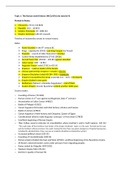
Topic 1: The Roman world history (MCQ 50%) (do tutorial 4)
Periods in Rome:
1. Monarchy (753 to 510 BCE)
2. Republic (510 – 30 BCE)
3. Empire: Principate (27- 3284 CE)
4. Empire: Dominate (284 CE onward)
Timeline of noteworthy events in roman history:
Slides:
Rome founded in the 8th century BC
Kings – expulsed in 509 BC (Last king Tarquin the Proud)
Republic – council of elder Statesmen (Senatus)
Control firmly established by 275 BC [SPQR]
Second Punic War (218 BC – 202 BC) against Hannibal
Julius Caesar (100 – 44 BC)
Augustus Caesar (ruled 27 BC to AD 14)
Emperor = ruled as leader of the Senate
Uneasy partnership: emperor + senate = diarchy
Emperor Diocletian (ruled AD 284 -305) = monarchy
Emperor Constantine the Great (ruled AD 311 – 337) = Christianity
Empire divided in two parts
Barbarians (Odoacer v Romulus Augustulus) = end of West
Eastern Empire (Greek/ Byzantine) existed another 1000 years
Course reader:
o Founding of Rome (753 BCE)
o Roman victory in 2nd war against Carthaginians (late 3rd century)
o Assassination of Julius Caesar (44BCE)
o Battle of Philippi (42 BCE)
o Caesar Augustus (Octavian) and Mark Antony v Brutus and Cassius
o Battle of Actium (27BCE)
o Caesar Augustus v Mark Antony and Cleopatra, Queen of Egypt
o Constitutional reforms make Augustus ‘princeps’ or first citizen (27BCE)
o Unofficial beginning of Roman Empire
o Then Follow several centuries of consolidation where Hadrian’s wall is built (approx. 120 CE)
*This wall marks off the Northern most border of the Empire (Scotland). Spain is in the west, The Red Sea the east,
and the Northern African provinces’ the south. During this time there was great emergence of imperial bureaucracy
including the administration of law. Law was an academic discipline (an interpretive system)
o Increased political unrest (220 CE)
o Founding of Constantinople (330 CE)
o Roman empire divided into East and West (395CE)- unofficial beginning of the Byzantine empire.
o All Rome’s external borders came under pressure from migrating peoples.
o Rome sacked by Visigoths (409/10CE)
o Western Empire falls (476 CE)
o Decline in quality of human life
,o Meanwhile, Eastern Empire acted as a continuation of Roman empire (aka Byzantine empire)
under reign of Byzantine emperor Justinian (527-565CE)
o Conquest of Constantinople by the Ottoman empire and the end of the Byzantine empire (1453
CE)
Timeline of SA history profile as per slides:
4th century - Migrants from the north settle, joining the indigenous San and Khoikhoi
people.
1480s - Portuguese navigator Bartholomeu Dias is the first European to travel round the
southern tip of Africa.
1497 - Portuguese explorer Vasco da Gama lands on Natal coast.
1652 - Jan van Riebeeck, representing the Dutch East India Company, founds the Cape
Colony at Table Bay.
1795 - British forces seize Cape Colony from the Netherlands. Territory is returned to the
Dutch in 1803; ceded to the British in 1806.
1816-1826 - Shaka Zulu founds and expands the Zulu empire, creates a formidable fighting
force.
1835-1840 - Boers leave Cape Colony in the 'Great Trek / Groot trek and found the Orange
Free State and the Transvaal.
1852 - British grant limited self-government to the Transvaal. (independence)
1856 - Natal separates from the Cape Colony.
Late 1850s - Boers proclaim the Transvaal a republic.
1860-1911 - Arrival of thousands of labourers and traders from India, forebears of the
majority of South Africa's current Indian population.
1867 - Diamonds discovered at Kimberley.
1877 - Britain annexes (seizes) the Transvaal.
1879 - British defeat the Zulus in Natal.
1880-81 - Boers rebel against the British, sparking the first Anglo-Boer War. Conflict ends
with a negotiated peace. Transvaal is restored as a republic.
Mid 1880s - Gold is discovered in the Transvaal, triggering the gold rush.
1899 - British troops gather on the Transvaal border and ignore an ultimatum to disperse.
The second Anglo-Boer War begins.
1902 - Treaty of Vereeniging ends the second Anglo-Boer War. The Transvaal and Orange
Free State are made self-governing colonies of the British Empire. (independence)
1910 - Formation of Union of South Africa by former British colonies of the Cape and Natal,
and the Boer republics of Transvaal, and Orange Free State.
1912 - Native National Congress founded (NNC), later renamed the African National
Congress (ANC).
1913 - Land Act introduced to prevent blacks, except those living in Cape Province, from
buying land outside reserves.
1914 - National Party founded.(NP)
1918 - Secret Broederbond (brotherhood) established to advance the Afrikaner cause.
1919 - South West Africa (Namibia) comes under South African administration.
1934 - The Union of South Africa parliament enacts the Status of the Union Act, which
declares the country to be "a sovereign independent state". The move followed on from
Britain's passing of the Statute of Westminster in 1931, which removed the last vestiges of
British legal authority over South Africa.
Apartheid set in law
, 1948 - Policy of apartheid (separateness) adopted when National Party (NP) takes power.
1950 - Population classified by race. Group Areas Act passed to segregate blacks and whites.
Communist Party banned. ANC responds with campaign of civil disobedience, led by Nelson
Mandela.
1960 - Seventy black demonstrators killed at Sharpeville. ANC banned.
1961 - South Africa declared a republic, leaves the Commonwealth. Mandela heads ANC's
new military wing, which launches sabotage campaign.
1960s - International pressure against government begins, South Africa excluded from
Olympic Games.
1964 - ANC leader Nelson Mandela sentenced to life imprisonment.
1966 September - Prime Minister Hendrik Verwoerd assassinated.
1970s - More than 3 million people forcibly resettled in black 'homelands'.
1976 - More than 600 killed in clashes between black protesters and security forces during
uprising which starts in Soweto (Soweto uprising).
1984-89 - Township revolt, state of emergency.
1989 - FW de Klerk replaces PW Botha as president, meets Mandela. Public facilities
desegregated. Many ANC activists freed.
1990 - ANC unbanned, Mandela released after 27 years in prison. Namibia becomes
independent.
1991 - Start of multi-party talks. De Klerk repeals remaining apartheid laws, international
sanctions lifted. Major fighting between ANC and Zulu Inkatha movement.
1993 - Agreement on interim constitution.
1994 April - ANC wins first non-racial elections. Mandela becomes president, Government of
National Unity formed, Commonwealth membership restored, remaining sanctions lifted.
South Africa takes seat in UN General Assembly after 20-year absence.
Law in Rome
Periods in the evolution of Roman law:
1. Archaic (from the time of the monarchy until 100BCE (note the 12 tables in 450BCE)
2. Formative (100 BCE – 100 CE)
3. Classical (100 CE – 220 CE)
4. Post-classical/ Justinianic (220 CE- 565b CE)
Sources of law:
1. Praetor’s Edict:
A document issued annually by the Urban Praetor (the magistrate overseeing civil
law) that contains quasi-legislative provisions and formulae (specimen pleadings
for litigation).
Praetors’ general function: issuing edict
Particular function: presiding over litigation
Praetors’ ability to change edict aided the fast development of the law and its
upkeep with the pace of social change.
However, edict was codified in early 2nd century CE and development ceased.
2. Juristic writing:
An important substantive source, rather than a technical source of law.
, Includes monographs, commentaries, textbooks, problematic literature, etc.
Jurists’ role is to advise praetor, judges (iudex), and litigants. Important classical jurists
include Gaius, Julian, Celsus, Paul, Ulpian, Papinian.
3. Character of classical roman law:
casuistic: juristic literature that takes form of commentary on praetor’s edict.
Necessary and unsystematic, having built up over time due to social pressures.
Gaius Institutes a relatively abstract systematic account of the law according to
substantive categories (property, succession, contract, delict).
4. Cessation of juristic activity during post-classical period:
Emperor did most of the law making.
In 529 CE, the Byzantine emperor Justinian began work on corpus Iuris Civilis (a
compilation of classical and post classical sources complied under the auspices of
Tribonian (Minister of justice), Consisting of the institutes, Digest, Code, and
Novels.)
5. Institutes:
2nd edition of Gaius Institutes.
Largely contained original content and structure [four books, substantive divisions
into persons (book 1), things (property, succession, obligations), and actions
(criminal law). 4-fold division was mapped (i.e., delict in book 4)]
6. Digest:
50 book libraries of classical juristic writings.
Eccentric method of composition (Bluhme): classical texts read by 3 committees,
excerpts placed in pigeonholes corresponding to title of digest, titles ordered
according to edict.
Unsystematic.
Led to the destroying of all other record of the writing of classical jurists.
7. Code:
similar to Digest but made up of excerpts from imperial constitutions.
8. Novels:
Imperial enactments subsequent to the issuing of the Code in 534 CE
9. Corpus iuris Civilis:
Little contemporaneous impact in the East.
10. The Barbarian codes in the West:
e.g., the Lex Romana Visigothorum (Alaric’s Breviary): an attempt to state the
elementary rules of Roman private law for application to Romans living within
territory conquered by the Visigoths (personal law)
Medieval reception of roman law:
After the dark ages in Western Europe, the glossators flourished at Pavia, Bologna (1100CE+)
Periods in Rome:
1. Monarchy (753 to 510 BCE)
2. Republic (510 – 30 BCE)
3. Empire: Principate (27- 3284 CE)
4. Empire: Dominate (284 CE onward)
Timeline of noteworthy events in roman history:
Slides:
Rome founded in the 8th century BC
Kings – expulsed in 509 BC (Last king Tarquin the Proud)
Republic – council of elder Statesmen (Senatus)
Control firmly established by 275 BC [SPQR]
Second Punic War (218 BC – 202 BC) against Hannibal
Julius Caesar (100 – 44 BC)
Augustus Caesar (ruled 27 BC to AD 14)
Emperor = ruled as leader of the Senate
Uneasy partnership: emperor + senate = diarchy
Emperor Diocletian (ruled AD 284 -305) = monarchy
Emperor Constantine the Great (ruled AD 311 – 337) = Christianity
Empire divided in two parts
Barbarians (Odoacer v Romulus Augustulus) = end of West
Eastern Empire (Greek/ Byzantine) existed another 1000 years
Course reader:
o Founding of Rome (753 BCE)
o Roman victory in 2nd war against Carthaginians (late 3rd century)
o Assassination of Julius Caesar (44BCE)
o Battle of Philippi (42 BCE)
o Caesar Augustus (Octavian) and Mark Antony v Brutus and Cassius
o Battle of Actium (27BCE)
o Caesar Augustus v Mark Antony and Cleopatra, Queen of Egypt
o Constitutional reforms make Augustus ‘princeps’ or first citizen (27BCE)
o Unofficial beginning of Roman Empire
o Then Follow several centuries of consolidation where Hadrian’s wall is built (approx. 120 CE)
*This wall marks off the Northern most border of the Empire (Scotland). Spain is in the west, The Red Sea the east,
and the Northern African provinces’ the south. During this time there was great emergence of imperial bureaucracy
including the administration of law. Law was an academic discipline (an interpretive system)
o Increased political unrest (220 CE)
o Founding of Constantinople (330 CE)
o Roman empire divided into East and West (395CE)- unofficial beginning of the Byzantine empire.
o All Rome’s external borders came under pressure from migrating peoples.
o Rome sacked by Visigoths (409/10CE)
o Western Empire falls (476 CE)
o Decline in quality of human life
,o Meanwhile, Eastern Empire acted as a continuation of Roman empire (aka Byzantine empire)
under reign of Byzantine emperor Justinian (527-565CE)
o Conquest of Constantinople by the Ottoman empire and the end of the Byzantine empire (1453
CE)
Timeline of SA history profile as per slides:
4th century - Migrants from the north settle, joining the indigenous San and Khoikhoi
people.
1480s - Portuguese navigator Bartholomeu Dias is the first European to travel round the
southern tip of Africa.
1497 - Portuguese explorer Vasco da Gama lands on Natal coast.
1652 - Jan van Riebeeck, representing the Dutch East India Company, founds the Cape
Colony at Table Bay.
1795 - British forces seize Cape Colony from the Netherlands. Territory is returned to the
Dutch in 1803; ceded to the British in 1806.
1816-1826 - Shaka Zulu founds and expands the Zulu empire, creates a formidable fighting
force.
1835-1840 - Boers leave Cape Colony in the 'Great Trek / Groot trek and found the Orange
Free State and the Transvaal.
1852 - British grant limited self-government to the Transvaal. (independence)
1856 - Natal separates from the Cape Colony.
Late 1850s - Boers proclaim the Transvaal a republic.
1860-1911 - Arrival of thousands of labourers and traders from India, forebears of the
majority of South Africa's current Indian population.
1867 - Diamonds discovered at Kimberley.
1877 - Britain annexes (seizes) the Transvaal.
1879 - British defeat the Zulus in Natal.
1880-81 - Boers rebel against the British, sparking the first Anglo-Boer War. Conflict ends
with a negotiated peace. Transvaal is restored as a republic.
Mid 1880s - Gold is discovered in the Transvaal, triggering the gold rush.
1899 - British troops gather on the Transvaal border and ignore an ultimatum to disperse.
The second Anglo-Boer War begins.
1902 - Treaty of Vereeniging ends the second Anglo-Boer War. The Transvaal and Orange
Free State are made self-governing colonies of the British Empire. (independence)
1910 - Formation of Union of South Africa by former British colonies of the Cape and Natal,
and the Boer republics of Transvaal, and Orange Free State.
1912 - Native National Congress founded (NNC), later renamed the African National
Congress (ANC).
1913 - Land Act introduced to prevent blacks, except those living in Cape Province, from
buying land outside reserves.
1914 - National Party founded.(NP)
1918 - Secret Broederbond (brotherhood) established to advance the Afrikaner cause.
1919 - South West Africa (Namibia) comes under South African administration.
1934 - The Union of South Africa parliament enacts the Status of the Union Act, which
declares the country to be "a sovereign independent state". The move followed on from
Britain's passing of the Statute of Westminster in 1931, which removed the last vestiges of
British legal authority over South Africa.
Apartheid set in law
, 1948 - Policy of apartheid (separateness) adopted when National Party (NP) takes power.
1950 - Population classified by race. Group Areas Act passed to segregate blacks and whites.
Communist Party banned. ANC responds with campaign of civil disobedience, led by Nelson
Mandela.
1960 - Seventy black demonstrators killed at Sharpeville. ANC banned.
1961 - South Africa declared a republic, leaves the Commonwealth. Mandela heads ANC's
new military wing, which launches sabotage campaign.
1960s - International pressure against government begins, South Africa excluded from
Olympic Games.
1964 - ANC leader Nelson Mandela sentenced to life imprisonment.
1966 September - Prime Minister Hendrik Verwoerd assassinated.
1970s - More than 3 million people forcibly resettled in black 'homelands'.
1976 - More than 600 killed in clashes between black protesters and security forces during
uprising which starts in Soweto (Soweto uprising).
1984-89 - Township revolt, state of emergency.
1989 - FW de Klerk replaces PW Botha as president, meets Mandela. Public facilities
desegregated. Many ANC activists freed.
1990 - ANC unbanned, Mandela released after 27 years in prison. Namibia becomes
independent.
1991 - Start of multi-party talks. De Klerk repeals remaining apartheid laws, international
sanctions lifted. Major fighting between ANC and Zulu Inkatha movement.
1993 - Agreement on interim constitution.
1994 April - ANC wins first non-racial elections. Mandela becomes president, Government of
National Unity formed, Commonwealth membership restored, remaining sanctions lifted.
South Africa takes seat in UN General Assembly after 20-year absence.
Law in Rome
Periods in the evolution of Roman law:
1. Archaic (from the time of the monarchy until 100BCE (note the 12 tables in 450BCE)
2. Formative (100 BCE – 100 CE)
3. Classical (100 CE – 220 CE)
4. Post-classical/ Justinianic (220 CE- 565b CE)
Sources of law:
1. Praetor’s Edict:
A document issued annually by the Urban Praetor (the magistrate overseeing civil
law) that contains quasi-legislative provisions and formulae (specimen pleadings
for litigation).
Praetors’ general function: issuing edict
Particular function: presiding over litigation
Praetors’ ability to change edict aided the fast development of the law and its
upkeep with the pace of social change.
However, edict was codified in early 2nd century CE and development ceased.
2. Juristic writing:
An important substantive source, rather than a technical source of law.
, Includes monographs, commentaries, textbooks, problematic literature, etc.
Jurists’ role is to advise praetor, judges (iudex), and litigants. Important classical jurists
include Gaius, Julian, Celsus, Paul, Ulpian, Papinian.
3. Character of classical roman law:
casuistic: juristic literature that takes form of commentary on praetor’s edict.
Necessary and unsystematic, having built up over time due to social pressures.
Gaius Institutes a relatively abstract systematic account of the law according to
substantive categories (property, succession, contract, delict).
4. Cessation of juristic activity during post-classical period:
Emperor did most of the law making.
In 529 CE, the Byzantine emperor Justinian began work on corpus Iuris Civilis (a
compilation of classical and post classical sources complied under the auspices of
Tribonian (Minister of justice), Consisting of the institutes, Digest, Code, and
Novels.)
5. Institutes:
2nd edition of Gaius Institutes.
Largely contained original content and structure [four books, substantive divisions
into persons (book 1), things (property, succession, obligations), and actions
(criminal law). 4-fold division was mapped (i.e., delict in book 4)]
6. Digest:
50 book libraries of classical juristic writings.
Eccentric method of composition (Bluhme): classical texts read by 3 committees,
excerpts placed in pigeonholes corresponding to title of digest, titles ordered
according to edict.
Unsystematic.
Led to the destroying of all other record of the writing of classical jurists.
7. Code:
similar to Digest but made up of excerpts from imperial constitutions.
8. Novels:
Imperial enactments subsequent to the issuing of the Code in 534 CE
9. Corpus iuris Civilis:
Little contemporaneous impact in the East.
10. The Barbarian codes in the West:
e.g., the Lex Romana Visigothorum (Alaric’s Breviary): an attempt to state the
elementary rules of Roman private law for application to Romans living within
territory conquered by the Visigoths (personal law)
Medieval reception of roman law:
After the dark ages in Western Europe, the glossators flourished at Pavia, Bologna (1100CE+)