Public Relations and Reputation Management | Thursday 1st April
Chapter 4 & 13
Stake: a symbol for having an interest (monetary or otherwise) in something
Strategic management: two views
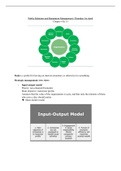
- Input-output model
Theory: neo-classical Economic
Main objective: maximize profits
Assumes that the value of the organization is a pie, and that only the interests of those
who own a slice should matter.
Share-holder model
, - Stakeholder model
Theory: socio-economic
Main objective: mediate between interests
Challenges in approaching stakeholders:
- As the networks of stakeholders behind organizations grows, it can become difficult to
understand who has more importance
, The Stakeholder Salience Model: Attributes
Power: How powerful is this group of stakeholders versus the organization?
Legitimacy: how legitimate are their claims?
Urgency: how urgent is action from the organization?
Low salience:
- All stakeholders groups that only have on attribute are considered latent; the least
important
- Dormant, discretionary and demanding stakeholders
Moderate salience:
- All stakeholder groups that have two attributes are considered expectant; moderately
important
- Dominant, dependent and dangerous stakeholders
High salience:
- The stakeholder group that has all three attributes is considered the most important
- Definitive stakeholder
The power-interest matrix
High power low
Minimal effort
Keep informed
Low level of interest high
, Keep satisfied Key players
Corporate Social Responsibility (CSR):
- The continuing commitment by business to contribute to economic development with
improving the quality of life of the workforce and their families as well as of the
community and society at large.
- Triple bottom line
1. People (social): all social and labour issues both inside and outside the
organization.
2. Planet (ecological): integrating environmental care into business
operations.
3. Profit (financial): generating financial returns for the organization and
shareholders.
Baseline before an organization can even start considering meeting its
social (people) and ecological (planet) responsibilities.
- Objectives:
Social acceptance resulting from the adherence of a company to regulation but also
to community norms and expectations.
- The emergence of CSR
o From protection of the brand to opportunity to innovate
Community Relations Programs
- Philanthropy (give money)(low level of commitment)
- Volunteering (relatively high level of commitment)
- Partnership (highest level of commitment)
Stakeholder Communication Strategies:
- Informational: one-way symmetrical model of communication
Attempts to inform someone about something
- Persuasive: two-way asymmetrical model of communication
Attempts to change and tune the knowledge, attitude and behaviour of stakeholders in
a way that is favourable to the organization.
Stakeholders are asked for feedback on CSR activities
- Dialogue: two-way symmetrical model of communication
Organizations and stakeholders mutually engage in an exchange of ideas and opinions
How CSR is communicated:
- Reporting (for interested people)
o Set clear objectives
o Set progressive objectives
Chapter 4 & 13
Stake: a symbol for having an interest (monetary or otherwise) in something
Strategic management: two views
- Input-output model
Theory: neo-classical Economic
Main objective: maximize profits
Assumes that the value of the organization is a pie, and that only the interests of those
who own a slice should matter.
Share-holder model
, - Stakeholder model
Theory: socio-economic
Main objective: mediate between interests
Challenges in approaching stakeholders:
- As the networks of stakeholders behind organizations grows, it can become difficult to
understand who has more importance
, The Stakeholder Salience Model: Attributes
Power: How powerful is this group of stakeholders versus the organization?
Legitimacy: how legitimate are their claims?
Urgency: how urgent is action from the organization?
Low salience:
- All stakeholders groups that only have on attribute are considered latent; the least
important
- Dormant, discretionary and demanding stakeholders
Moderate salience:
- All stakeholder groups that have two attributes are considered expectant; moderately
important
- Dominant, dependent and dangerous stakeholders
High salience:
- The stakeholder group that has all three attributes is considered the most important
- Definitive stakeholder
The power-interest matrix
High power low
Minimal effort
Keep informed
Low level of interest high
, Keep satisfied Key players
Corporate Social Responsibility (CSR):
- The continuing commitment by business to contribute to economic development with
improving the quality of life of the workforce and their families as well as of the
community and society at large.
- Triple bottom line
1. People (social): all social and labour issues both inside and outside the
organization.
2. Planet (ecological): integrating environmental care into business
operations.
3. Profit (financial): generating financial returns for the organization and
shareholders.
Baseline before an organization can even start considering meeting its
social (people) and ecological (planet) responsibilities.
- Objectives:
Social acceptance resulting from the adherence of a company to regulation but also
to community norms and expectations.
- The emergence of CSR
o From protection of the brand to opportunity to innovate
Community Relations Programs
- Philanthropy (give money)(low level of commitment)
- Volunteering (relatively high level of commitment)
- Partnership (highest level of commitment)
Stakeholder Communication Strategies:
- Informational: one-way symmetrical model of communication
Attempts to inform someone about something
- Persuasive: two-way asymmetrical model of communication
Attempts to change and tune the knowledge, attitude and behaviour of stakeholders in
a way that is favourable to the organization.
Stakeholders are asked for feedback on CSR activities
- Dialogue: two-way symmetrical model of communication
Organizations and stakeholders mutually engage in an exchange of ideas and opinions
How CSR is communicated:
- Reporting (for interested people)
o Set clear objectives
o Set progressive objectives