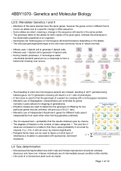
4BBY1070- Genetics and Molecular Biology
L2/3: Mendelian Genetics I and II
• Members of the same species have the same genes, however the genes come in different forms
known as alleles due to a specific change in DNA sequence.
• Some alleles are silent, meaning a change in the sequence still results in the same protein.
• The genotype refers to the alleles for both copies of the given gene, whereas the phenotype is
the observable properties of an organism.
• Genotypes can heterozygous or homozygous dominant/recessive depending on the alleles.
• The wild type genotype/phenotype is the one most commonly found in nature (normal).
• Mitosis uses 1 diploid cell to generate 2 diploid cells.
• Meiosis uses 1 diploid cell to generate 4 haploid cells.
• During meiotic prophase I, 2 homologous sister
chromatids (bivalent pairs) join by a chiasmata to form a
tetrad and crossing over occurs.
• True breeding is when two homozygous parents are crossed, resulting in all F1 gametes being
heterozygous. An F2 generation crossing will result in a 3:1 ratio of phenotype.
• A test cross is used to find the genotype of a parent by crossing with a homozygous recessive.
• Mendel’s Law of Segregation: characteristics are controlled by genes
normally in pairs (allows for skipping of generations).
• Dihybrid crosses are used to determine the genotype of offspring for two
particular genes that are unlinked, will give you a 9:3:3:1 ratio.
• Mendel’s Law of Independent Assortment: genes for different traits assort
independently from each other when forming gametes (unlinked).
• The chi-squared test = probability that the results obtained were by chance.
• The degrees of freedom is the number of data categories-1. This and the x2
value are compared on a table to find the p-value (probability it occurred by
chance). If p < 5%, it did not occur by chance (significant).
• Pedigree family trees can be used to figure out what type of (oberser ved − expected )2
x2 =
inheritance a mutation is associated with (autosomal, dominant/ ∑ expected
recessive).
L4: Sex determination
• Monoecious/hermaphrodites have both male and female reproductive structures whereas
dioecious only have one. Intersex individuals are of intermediate sexual condition (often sterile).
• Life cycle of a monoecious plant such as maize:
Page 1 of 12
, 1. In the stamen, male gametes (pollen) are made when a diploid microspore mother cell (2n)
undergoes meiosis and forms 4 haploid microspores (n). These then undergo one round of
mitosis to form a pollen grain with 2 haploid nuclei (microgametophyte).
2. In the pistil, a diploid microspore mother cell (2n) undergoes meiosis to form megaspores
(containing 4 haploid nuclei). 3/4 of these nuclei then degenerate, forming a
megagametophyte. It undergoes mitosis 3 times to form an embryo sac of 8 haploid
nuclei (names show on the right).
3. Pollen is transferred from the stamen to the stigma and a pollen tube grows towards
the embryo sac.
4. 1 sperm nuclei unites with the 2 endosperm nuclei to form a triploid endosperm nucleus and
the other unites with the haploid oocyte nucleus to form a diploid zygote nucleus.
5. This then matures into a seed, the triploid endosperm nucleus becomes endosperm to provide
nutrition the the embryo which has developed for the diploid zygote nucleus. Germination
gives rise to a new plant (sporophyte).
• Females are homogametic as they only produce one type of gamete (X) whereas males are
heterogametic (X and Y).
• The Y chromosomes determines maleness. Klinefelter syndrome (XXY) and XXY result in a male
whereas Turner syndrome (X) results in a female. Aneuploidies are caused by non-disjunction.
• Only a small part of the Y chromosome confers maleness. If crossing over occurs at the SRY
(sex determining region of Y) then someone with XX* could develop as a male and XY* could
develop as female.
• SRY encodes for the testis determining factor (TDF) which will lead to
development of the testes in week 6 of development. The testes produce anti-
Mullerian hormone which leads to Mullerian duct degeneration and testosterone,
which causes the Wollffian duct to develop into the epididymis, vas deferens and
seminal vesicle.
• If SRY is not present it undergoes the default pathway and the gonads develop
into ovaries, the Wollffian duct degenerates and the mullerian duct forms the oviduct, uterus and
upper portion of vagina.
• This is primary sexual differentiation (differentiation by SRY gene).
• Secondary sexual differentiation refers to all sex development which is controlled by hormones.
• In Drosophila, Y does not determine maleness. Instead, the ratio of X chromosomes:diploid sets
(normally 2n) determines the sex. If the ratio is > 0.5, a female develops.
• Females have twice as many X chromosomes, so dosage compensation is achieved by making
one of the X’s transcriptionally silent by the Xist gene on Xic transcribing heterochromatin. This
spreads along the chromosome causing ultra-condensation (forming Barr bodies).
• X inactivation occurs early in embryogenesis. All cells descended from the initial cell will
inactivate the same chromosome, meaning all females are mosaics for all X-linked alleles.
• Bilateral gynandromorphs appear male on one side female on the other. Occurs when the
zygote divides but one X is lost in from one of the cells.
• Non-genetic sex determination includes environmental factors (e.g temp of egg incubation) and
social factors.
L5/6: Gene Interaction I and II
• Amorphic (null) = produce no protein at all, or protein completely lacks function (recessive).
• Hypomorphic (leaky) = protein function reduced: less activity or less protein made (recessive).
• Hypermorphic = increase in activity of protein or more protein made (dominant).
• Antimorphic (dominant negative) = disturbance in function interferes with normal protein.
Page 2 of 12
L2/3: Mendelian Genetics I and II
• Members of the same species have the same genes, however the genes come in different forms
known as alleles due to a specific change in DNA sequence.
• Some alleles are silent, meaning a change in the sequence still results in the same protein.
• The genotype refers to the alleles for both copies of the given gene, whereas the phenotype is
the observable properties of an organism.
• Genotypes can heterozygous or homozygous dominant/recessive depending on the alleles.
• The wild type genotype/phenotype is the one most commonly found in nature (normal).
• Mitosis uses 1 diploid cell to generate 2 diploid cells.
• Meiosis uses 1 diploid cell to generate 4 haploid cells.
• During meiotic prophase I, 2 homologous sister
chromatids (bivalent pairs) join by a chiasmata to form a
tetrad and crossing over occurs.
• True breeding is when two homozygous parents are crossed, resulting in all F1 gametes being
heterozygous. An F2 generation crossing will result in a 3:1 ratio of phenotype.
• A test cross is used to find the genotype of a parent by crossing with a homozygous recessive.
• Mendel’s Law of Segregation: characteristics are controlled by genes
normally in pairs (allows for skipping of generations).
• Dihybrid crosses are used to determine the genotype of offspring for two
particular genes that are unlinked, will give you a 9:3:3:1 ratio.
• Mendel’s Law of Independent Assortment: genes for different traits assort
independently from each other when forming gametes (unlinked).
• The chi-squared test = probability that the results obtained were by chance.
• The degrees of freedom is the number of data categories-1. This and the x2
value are compared on a table to find the p-value (probability it occurred by
chance). If p < 5%, it did not occur by chance (significant).
• Pedigree family trees can be used to figure out what type of (oberser ved − expected )2
x2 =
inheritance a mutation is associated with (autosomal, dominant/ ∑ expected
recessive).
L4: Sex determination
• Monoecious/hermaphrodites have both male and female reproductive structures whereas
dioecious only have one. Intersex individuals are of intermediate sexual condition (often sterile).
• Life cycle of a monoecious plant such as maize:
Page 1 of 12
, 1. In the stamen, male gametes (pollen) are made when a diploid microspore mother cell (2n)
undergoes meiosis and forms 4 haploid microspores (n). These then undergo one round of
mitosis to form a pollen grain with 2 haploid nuclei (microgametophyte).
2. In the pistil, a diploid microspore mother cell (2n) undergoes meiosis to form megaspores
(containing 4 haploid nuclei). 3/4 of these nuclei then degenerate, forming a
megagametophyte. It undergoes mitosis 3 times to form an embryo sac of 8 haploid
nuclei (names show on the right).
3. Pollen is transferred from the stamen to the stigma and a pollen tube grows towards
the embryo sac.
4. 1 sperm nuclei unites with the 2 endosperm nuclei to form a triploid endosperm nucleus and
the other unites with the haploid oocyte nucleus to form a diploid zygote nucleus.
5. This then matures into a seed, the triploid endosperm nucleus becomes endosperm to provide
nutrition the the embryo which has developed for the diploid zygote nucleus. Germination
gives rise to a new plant (sporophyte).
• Females are homogametic as they only produce one type of gamete (X) whereas males are
heterogametic (X and Y).
• The Y chromosomes determines maleness. Klinefelter syndrome (XXY) and XXY result in a male
whereas Turner syndrome (X) results in a female. Aneuploidies are caused by non-disjunction.
• Only a small part of the Y chromosome confers maleness. If crossing over occurs at the SRY
(sex determining region of Y) then someone with XX* could develop as a male and XY* could
develop as female.
• SRY encodes for the testis determining factor (TDF) which will lead to
development of the testes in week 6 of development. The testes produce anti-
Mullerian hormone which leads to Mullerian duct degeneration and testosterone,
which causes the Wollffian duct to develop into the epididymis, vas deferens and
seminal vesicle.
• If SRY is not present it undergoes the default pathway and the gonads develop
into ovaries, the Wollffian duct degenerates and the mullerian duct forms the oviduct, uterus and
upper portion of vagina.
• This is primary sexual differentiation (differentiation by SRY gene).
• Secondary sexual differentiation refers to all sex development which is controlled by hormones.
• In Drosophila, Y does not determine maleness. Instead, the ratio of X chromosomes:diploid sets
(normally 2n) determines the sex. If the ratio is > 0.5, a female develops.
• Females have twice as many X chromosomes, so dosage compensation is achieved by making
one of the X’s transcriptionally silent by the Xist gene on Xic transcribing heterochromatin. This
spreads along the chromosome causing ultra-condensation (forming Barr bodies).
• X inactivation occurs early in embryogenesis. All cells descended from the initial cell will
inactivate the same chromosome, meaning all females are mosaics for all X-linked alleles.
• Bilateral gynandromorphs appear male on one side female on the other. Occurs when the
zygote divides but one X is lost in from one of the cells.
• Non-genetic sex determination includes environmental factors (e.g temp of egg incubation) and
social factors.
L5/6: Gene Interaction I and II
• Amorphic (null) = produce no protein at all, or protein completely lacks function (recessive).
• Hypomorphic (leaky) = protein function reduced: less activity or less protein made (recessive).
• Hypermorphic = increase in activity of protein or more protein made (dominant).
• Antimorphic (dominant negative) = disturbance in function interferes with normal protein.
Page 2 of 12