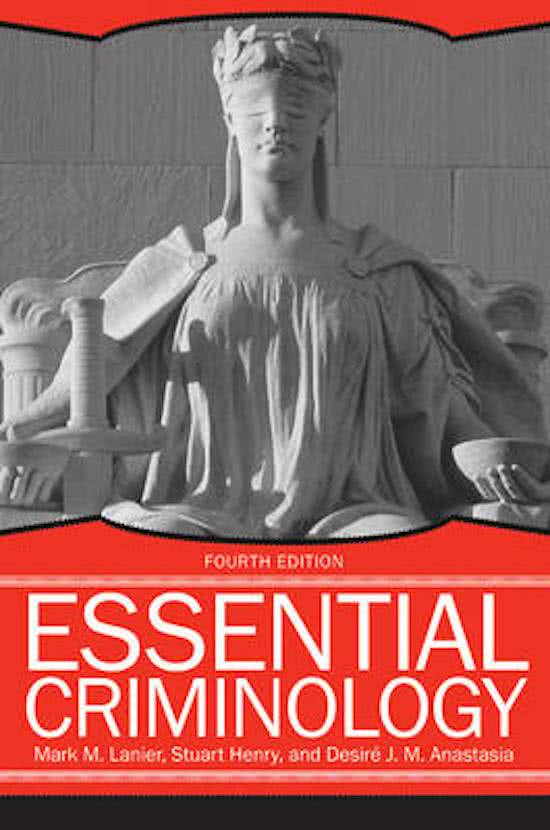
Advanced Criminology (RGBUSTR011)
Overview
Week 1: Classical criminology
Week 2: Bio- and psychological perspective on criminology
Week 3: Social ecology and cultural theories of crime
Week 4: Social learning and control theories
Week 5: Strain and subculture theories
Week 6: Conflict and radical theories of crime
Week 7: Critical criminology and the psychedelic prohibition
Week 8: Cultural criminology
Chapters Lanier, Henry & Anastasia
Chapter one: What is criminology?
↳ The study of crime, criminals, and victims in a global context
↳ Six fundamental changes that renewed discussion of crime and its causes:
(1) globalization
(2) the communications revolution
(3) privatization and individualization
(4) the global spread of disease
(5) changing perceptions of conflict and national security
(6) the internalization of terrorism
Globalization: the process whereby people react to issues in terms of reference points that transcend
their own locality, society or region
→ material, political, social and cultural concerns that affect the planet (E. global
warming, overpopulation, McDonaldization across the world)
↳ Globalization relates to an international universalism, whereby events happening in one part of
the world affect those in another (E. collapse of world financial markets) = single world/global society
↳ Globalization has brought new crimes: digital crimes (E. fraud and identity theft, drug
smuggling, bomb making, hacking etc)
Criminology = the systematic study of the nature, extent, cause and control of law-breaking behavior
↳ The categorical core:
(1) the definition and nature of crime as harm-causing behavior
(2) different types of criminal activity, ranging from individual spontaneous offending to collective
organized criminal enterprise
, (3) profiles of typical offenders and victims, including organizational and corporate law violators
(4) statistical analysis of the extent, incidence, patterning and cost of crimes
(5) analysis of crime causation
Comparative criminology = the systematic study of crime, law and social control of two or more
cultures
↳ cross-cultural & cross-nation study of both crime and crime control
Victimology = the scientific study of the physical, emotional and financial harm people suffer because of
criminal activities
↳ Who becomes a victim?
↳ How victims are victimized?
↳ How much harm they suffer and their role in the criminal act
↳ Looks at victims’ rights and their role in the criminal justice system
Chapter three: Classical, Neoclassical and Rational Choice theories
The Preclassical Era
↳ People are born into wealth and power → positions that they claimed as their natural right
↳ The law was the will of the powerful
↳ The administration of justice was based on extracting pain, humiliation and disgrace to those accused of
offenses
↳ Poor were seen as the dangerous class
↳ had to roam town in search for food and shelter
↳ Respectable poor: those suffering from sickness and contagious diseases, wounded soldiers,
curable cripples, the blind, fatherless and pauper children and the aged poor
↳ seen as the responsibility of the more fortunate
↳ Unrespectable poor: vagabonds, tramps, rogues and dissolute women
↳ seen as worthless and had to be punished with imprisonment or whipping
The classical reaction
↳ Rising landowning middle class + escalating crime rate → philosophical leaders of the classical
movement to demand double security for their newfound wealth
↳ wanting protection against dangerous classes & against the aristocratic high class
↳ Utilitarian philosophers recognized the gross injustice of the legal and political system
↳ justice was arbitray: rulers used torture and corporal punishments as they desired
,↳ Radical notion: people are individuals possessing equal rights
↳ wanting rights and liberties + the chance to move up the class hierarchy
→ primary focus = to transform arbitrary criminal justice system into a fair, equal and
humanitarian system
Classical theory
Cesare Beccaria
↳ ideas shaped by milanese political activist brothers (Pietro and Alessandro Verri)
↳ challenged the prevailing idea that humans are predestined to fill particular social statuses
↳ he claimed humans are born free, equal and rational
↳ Natural rights: the right to own property
↳ Natural qualities: freedom to reason and the ability to choose actions that are in their own best
interest
↳ Government is not the automatic right of the rich → created through a social contract in
which free, rational individuals sacrificed part of their freedom to the state to maintain peace and
security on behalf of the common good
↳ government needs to protect individuals against those who will put their own interest above
others
↳ punish those who do by removing them from society to remain in peace
= individual sovereignty: individual rights have priority over the interest of society or state
↳ laws needs to be designed so that the greatest happiness can be shared by the greatest number
↳ crime = wrongdoing against other humans and thus society itself (instead of only against the powerful)
↳ the principle of ‘the presumption of innocence’: protect the innocent from conviction and to
convict the guilty → the only basis for conviction being the facts of the case
↳ designed to protect individual rights against excessive state power
↳ laws and punishment should be only as restrictive as necessary to just deter those who would break
them by calculating that it would not be in their interest to do so
↳ Principle of ‘just deserts’: the severity of harm determines the level of punishment
↳ the severity of the punishment should outweigh the benefit derived from the crime
Jeremy Bentham
↳ expanded on Beccaria’s ideas
↳ the notion of the ‘hedonistic, or felicity, calculus’ as an explanation for people’s actions
, ↳ this states that people act to increase positive results through their pursuit of pleasure and to
reduce negative outcomes through the avoidance of pain
↳ believed people break the law because they desire to obtain money, sex, esxcitement or revenge
↳ laws purpose is to increase the total happiness of the community by excluding ‘mischief’ and promoting
pleasure and security
↳ laws should ban harmful behavior, provided there is a victim involved
↳ crimes without victims, consensual crimes and acts of self-defense should not be subject to
criminal law, because they produce more good than evil
↳ laws should not set specific punishment (pain) for specific crimes in order to motivate people
to act one way rather than another
↳ In contrast to Beccaria: Bentham believed that it might be necessary to increase the punishment, in the
case of repeated offense, to outweigh the profit from offenders likely to be committed
↳ He also prefered fines and prison
Limitations of Classical Theory
↳ The assumption that people are equal: however would individuals be treated equally based on
intelligence, age, mental capacity and gender at that time?
↳ The system is designed to allow some people to create more wealth than others. Therefore to become
materially unequal. How can the law maintain all persons to formally remain equal? + How could there be
equal punishment for equal crimes without taking into account differences in wealth?
↳ Why do some people commit more crimes than others, if they are all equally endowed with reason?
Neoclassical Revisions
↳ recognizing age, mental condition and extenuating circumstances
↳ basis underlying assumption: humans are rational, calculating and hedonistic -> remained the
cornerstone of criminal justice policy
↳ take into account both individual and social differences, especially in sentencing practices
↳ scientific evidence justified disparate sentences based on offender ‘needs’
↳ offenders diagnosed as having specific problems and were deemed to need sentences
(treatment) based on their diagnosed problems = rehabilitative justice
Outcome: convicted offenders received different sentences for similar crimes and different treatments
depending on the diagnosis of cause
Limitations of Neoclassical Theory
↳ Does all this effort of rehabilitation prevent recidivism or reoffending?
Redefining Rational Choice
Overview
Week 1: Classical criminology
Week 2: Bio- and psychological perspective on criminology
Week 3: Social ecology and cultural theories of crime
Week 4: Social learning and control theories
Week 5: Strain and subculture theories
Week 6: Conflict and radical theories of crime
Week 7: Critical criminology and the psychedelic prohibition
Week 8: Cultural criminology
Chapters Lanier, Henry & Anastasia
Chapter one: What is criminology?
↳ The study of crime, criminals, and victims in a global context
↳ Six fundamental changes that renewed discussion of crime and its causes:
(1) globalization
(2) the communications revolution
(3) privatization and individualization
(4) the global spread of disease
(5) changing perceptions of conflict and national security
(6) the internalization of terrorism
Globalization: the process whereby people react to issues in terms of reference points that transcend
their own locality, society or region
→ material, political, social and cultural concerns that affect the planet (E. global
warming, overpopulation, McDonaldization across the world)
↳ Globalization relates to an international universalism, whereby events happening in one part of
the world affect those in another (E. collapse of world financial markets) = single world/global society
↳ Globalization has brought new crimes: digital crimes (E. fraud and identity theft, drug
smuggling, bomb making, hacking etc)
Criminology = the systematic study of the nature, extent, cause and control of law-breaking behavior
↳ The categorical core:
(1) the definition and nature of crime as harm-causing behavior
(2) different types of criminal activity, ranging from individual spontaneous offending to collective
organized criminal enterprise
, (3) profiles of typical offenders and victims, including organizational and corporate law violators
(4) statistical analysis of the extent, incidence, patterning and cost of crimes
(5) analysis of crime causation
Comparative criminology = the systematic study of crime, law and social control of two or more
cultures
↳ cross-cultural & cross-nation study of both crime and crime control
Victimology = the scientific study of the physical, emotional and financial harm people suffer because of
criminal activities
↳ Who becomes a victim?
↳ How victims are victimized?
↳ How much harm they suffer and their role in the criminal act
↳ Looks at victims’ rights and their role in the criminal justice system
Chapter three: Classical, Neoclassical and Rational Choice theories
The Preclassical Era
↳ People are born into wealth and power → positions that they claimed as their natural right
↳ The law was the will of the powerful
↳ The administration of justice was based on extracting pain, humiliation and disgrace to those accused of
offenses
↳ Poor were seen as the dangerous class
↳ had to roam town in search for food and shelter
↳ Respectable poor: those suffering from sickness and contagious diseases, wounded soldiers,
curable cripples, the blind, fatherless and pauper children and the aged poor
↳ seen as the responsibility of the more fortunate
↳ Unrespectable poor: vagabonds, tramps, rogues and dissolute women
↳ seen as worthless and had to be punished with imprisonment or whipping
The classical reaction
↳ Rising landowning middle class + escalating crime rate → philosophical leaders of the classical
movement to demand double security for their newfound wealth
↳ wanting protection against dangerous classes & against the aristocratic high class
↳ Utilitarian philosophers recognized the gross injustice of the legal and political system
↳ justice was arbitray: rulers used torture and corporal punishments as they desired
,↳ Radical notion: people are individuals possessing equal rights
↳ wanting rights and liberties + the chance to move up the class hierarchy
→ primary focus = to transform arbitrary criminal justice system into a fair, equal and
humanitarian system
Classical theory
Cesare Beccaria
↳ ideas shaped by milanese political activist brothers (Pietro and Alessandro Verri)
↳ challenged the prevailing idea that humans are predestined to fill particular social statuses
↳ he claimed humans are born free, equal and rational
↳ Natural rights: the right to own property
↳ Natural qualities: freedom to reason and the ability to choose actions that are in their own best
interest
↳ Government is not the automatic right of the rich → created through a social contract in
which free, rational individuals sacrificed part of their freedom to the state to maintain peace and
security on behalf of the common good
↳ government needs to protect individuals against those who will put their own interest above
others
↳ punish those who do by removing them from society to remain in peace
= individual sovereignty: individual rights have priority over the interest of society or state
↳ laws needs to be designed so that the greatest happiness can be shared by the greatest number
↳ crime = wrongdoing against other humans and thus society itself (instead of only against the powerful)
↳ the principle of ‘the presumption of innocence’: protect the innocent from conviction and to
convict the guilty → the only basis for conviction being the facts of the case
↳ designed to protect individual rights against excessive state power
↳ laws and punishment should be only as restrictive as necessary to just deter those who would break
them by calculating that it would not be in their interest to do so
↳ Principle of ‘just deserts’: the severity of harm determines the level of punishment
↳ the severity of the punishment should outweigh the benefit derived from the crime
Jeremy Bentham
↳ expanded on Beccaria’s ideas
↳ the notion of the ‘hedonistic, or felicity, calculus’ as an explanation for people’s actions
, ↳ this states that people act to increase positive results through their pursuit of pleasure and to
reduce negative outcomes through the avoidance of pain
↳ believed people break the law because they desire to obtain money, sex, esxcitement or revenge
↳ laws purpose is to increase the total happiness of the community by excluding ‘mischief’ and promoting
pleasure and security
↳ laws should ban harmful behavior, provided there is a victim involved
↳ crimes without victims, consensual crimes and acts of self-defense should not be subject to
criminal law, because they produce more good than evil
↳ laws should not set specific punishment (pain) for specific crimes in order to motivate people
to act one way rather than another
↳ In contrast to Beccaria: Bentham believed that it might be necessary to increase the punishment, in the
case of repeated offense, to outweigh the profit from offenders likely to be committed
↳ He also prefered fines and prison
Limitations of Classical Theory
↳ The assumption that people are equal: however would individuals be treated equally based on
intelligence, age, mental capacity and gender at that time?
↳ The system is designed to allow some people to create more wealth than others. Therefore to become
materially unequal. How can the law maintain all persons to formally remain equal? + How could there be
equal punishment for equal crimes without taking into account differences in wealth?
↳ Why do some people commit more crimes than others, if they are all equally endowed with reason?
Neoclassical Revisions
↳ recognizing age, mental condition and extenuating circumstances
↳ basis underlying assumption: humans are rational, calculating and hedonistic -> remained the
cornerstone of criminal justice policy
↳ take into account both individual and social differences, especially in sentencing practices
↳ scientific evidence justified disparate sentences based on offender ‘needs’
↳ offenders diagnosed as having specific problems and were deemed to need sentences
(treatment) based on their diagnosed problems = rehabilitative justice
Outcome: convicted offenders received different sentences for similar crimes and different treatments
depending on the diagnosis of cause
Limitations of Neoclassical Theory
↳ Does all this effort of rehabilitation prevent recidivism or reoffending?
Redefining Rational Choice