
Isabel Vijver, Global Climate Change
2.1. Radiation Balance
2.1.1 Radiation
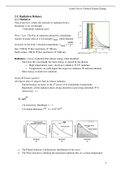
Planck function: relates the intensity of radiation from a
blackbody to its wavelength
> blackbody radiation curve
Wien’s Law: The flux of radiation emitted by a blackbody
reaches its peak value at a wavelength λmax, which depends
2898
inversely on the body’s absolute temperature: max
𝑇
Sun: 5780 K → flux maximizes @ 500 nm
Earth surface: 288 K → flux maximizes @ 1000 nm
Radiation = waves of photons that release energy when absorbed
- The lower the wavelength, the more energy is carried by the photon
o High temperatures (sun), shortwave radiation → UV radiation
o Temperatures on earth higher but longwave radiation → infrared radiation
- More energy in shortwave radiation
Stefan-Bolzman equation:
All objects above 0 degrees Kelvin release radiation
- Emitted energy increases to the 4th power of its (blackbody) temperature
- Blackbody: all the radiation that is being absorbed is also being reemitted → E
(emissivity) = 1
4
E= εT
- ε Is emissivity, blackbody ε = 1
- Is Stefan-Bolzman cste, = 5.67*10-8
a. The Planck function is defining the distribution of the curve
b. The Wien function is defining the maximum radiation flux at a certain temperature
1
, Isabel Vijver, Global Climate Change
- The higher the temperature the lower the wavelength
c. The area below the curve defined by the Planck function is total energy that is being
emitted defined by Stephan Bolzman equation.
2.1.2. Radiation Balance
Shortwave radiation (yellow)
- Coming from the sun → high temperature →
high radiation with short wavelength (uv,
visible)
- Penetrates through space to outer edge of
atmosphere with no disturbance (solar constant)
- Penetrate through atmosphere → decreases due to absorption (20%) and reflection
(clouds)
o Reflection is depended on albedo: amount of shortwave radiation that is
reflected (snow = 0,8, asphalt = 0,04)
- Can reach ground as direct radiation and diffuse radiation
Longwave radiation (orange)
- Coming from land surface → low temperature → low radiation with long wavelength
(infrared)
- Longwave radiation is being absorbed and reemitted, while shortwave radiation is
being absorbed and reemitted as longwave radiation and reflected.
- Earth’s surface emits longwave radiation (infrared)
- Gases of atmosphere are good absorbers of longwave radiation → greenhouse gases:
o Different gases absorb different wavelength
- Troposphere has decreasing temperature at height → lower temperatures at upper part
atmosphere → less reemission
Energy balance
- More energy entering the surface than leaving the surface → does the surface gets
warmer and warmer and the atmosphere cooler and cooler?
o No, because there are two fluxes that makes sure that temperature in
atmosphere are well mixed: latent (80%) and sensible (20%) heat
o This mixture is influenced by the tropopause on top of troposphere: net
incoming radiation, outgoing longwave radiation → in balance → nothing
changing in the system. But an increase in GHGs will lead to even shortwave
going in but fewer longwave going out → system will heat up.
2
, Isabel Vijver, Global Climate Change
Latent heat: radiative energy is used to evaporate water rather than raising the surface
temperature. Water vapor condenses in the atmosphere which is causing the atmosphere to
heat up
Sensible heat: radiative energy used for rising warm air and sinking cold air.
2.1.3. Radiation factors
Amount of radiation depends on:
- Inverse square law (spuitbus):
- Radiation under an angle (different intensity)
- Earth's axis: seasons
- Distance to the sun
- Solar variability
2.2. Greenhouse effect
2.2.1. Physics of greenhouse effect
Energy emitted is defined by the Stephan-Bolzmann constant.
- Emissivity is 1 (assuming this is a blackbody)
In the atmosphere is a part absorbed (𝜀𝑎 ) and a part is transmitted (1 − 𝜀𝑎 ).
Emitted by atmosphere → Ta because what is being absorbed is reemitted
by atmosphere.
- In all directions, thus not only upward but also downward so these
equations are the same.
Total emission to stratosphere is: transmitted + emitted:
→ →
Because Ta < (always) Ts: reduces emission to space: greenhouse effect:
- Difference Ta and Ts
- Emissivity atmosphere (dependent on GHGs: the more GHGs → more emissivity →
more radiation left)
Green House Gases: H2O, CO2, CH4, O3
3
, Isabel Vijver, Global Climate Change
2.2.2. Radiative forcing
Radiative forcing (RF) is the difference between:
- Incoming solar radiation
- Outgoing longwave radiation
- Incoming longwave radiation from stratosphere
At the tropopause!
- Instantaneous Radiative Forcing:
Without temperature adjustment of the stratosphere
- (adjusted) Radiative Forcing:
Including temperature adjustment of the stratosphere > Makes the radiative forcing
smaller (because smaller longwave flux from stratosphere to troposphere)
2.3. Atmosphere in action
2.3.1. Radiation balance
- around equator: more incoming radiation than outgoing
- around poles: more outgoing radiation than outgoing
o are the poles cooling and equators heating up?
▪ No, because of atmospheric circulation
2.3.2. Vapor Pressure Gradient
- Latent heat rising and compensating in atmosphere → clouds and air
- Air is rising → moves to north and south
- Energy imbalance: energy transfer towards poles
Different forces:
- Pressure difference
- Earth rotation
- Friction
Result:
- Acceleration
- Deceleration
- Change of direction
Forces: pressure gradient:
o Air parcel forces
o Upward: air pressure
o Downward: gravity
o Horizontal: low/high pressure
o Pressure gradient force
Isobars:
- Lines of equal pressure
- Air moves from high to low pressure
- Speed depends on density
Stable gradients lead to extreme wind speeds? No, Coriolis effect
4
2.1. Radiation Balance
2.1.1 Radiation
Planck function: relates the intensity of radiation from a
blackbody to its wavelength
> blackbody radiation curve
Wien’s Law: The flux of radiation emitted by a blackbody
reaches its peak value at a wavelength λmax, which depends
2898
inversely on the body’s absolute temperature: max
𝑇
Sun: 5780 K → flux maximizes @ 500 nm
Earth surface: 288 K → flux maximizes @ 1000 nm
Radiation = waves of photons that release energy when absorbed
- The lower the wavelength, the more energy is carried by the photon
o High temperatures (sun), shortwave radiation → UV radiation
o Temperatures on earth higher but longwave radiation → infrared radiation
- More energy in shortwave radiation
Stefan-Bolzman equation:
All objects above 0 degrees Kelvin release radiation
- Emitted energy increases to the 4th power of its (blackbody) temperature
- Blackbody: all the radiation that is being absorbed is also being reemitted → E
(emissivity) = 1
4
E= εT
- ε Is emissivity, blackbody ε = 1
- Is Stefan-Bolzman cste, = 5.67*10-8
a. The Planck function is defining the distribution of the curve
b. The Wien function is defining the maximum radiation flux at a certain temperature
1
, Isabel Vijver, Global Climate Change
- The higher the temperature the lower the wavelength
c. The area below the curve defined by the Planck function is total energy that is being
emitted defined by Stephan Bolzman equation.
2.1.2. Radiation Balance
Shortwave radiation (yellow)
- Coming from the sun → high temperature →
high radiation with short wavelength (uv,
visible)
- Penetrates through space to outer edge of
atmosphere with no disturbance (solar constant)
- Penetrate through atmosphere → decreases due to absorption (20%) and reflection
(clouds)
o Reflection is depended on albedo: amount of shortwave radiation that is
reflected (snow = 0,8, asphalt = 0,04)
- Can reach ground as direct radiation and diffuse radiation
Longwave radiation (orange)
- Coming from land surface → low temperature → low radiation with long wavelength
(infrared)
- Longwave radiation is being absorbed and reemitted, while shortwave radiation is
being absorbed and reemitted as longwave radiation and reflected.
- Earth’s surface emits longwave radiation (infrared)
- Gases of atmosphere are good absorbers of longwave radiation → greenhouse gases:
o Different gases absorb different wavelength
- Troposphere has decreasing temperature at height → lower temperatures at upper part
atmosphere → less reemission
Energy balance
- More energy entering the surface than leaving the surface → does the surface gets
warmer and warmer and the atmosphere cooler and cooler?
o No, because there are two fluxes that makes sure that temperature in
atmosphere are well mixed: latent (80%) and sensible (20%) heat
o This mixture is influenced by the tropopause on top of troposphere: net
incoming radiation, outgoing longwave radiation → in balance → nothing
changing in the system. But an increase in GHGs will lead to even shortwave
going in but fewer longwave going out → system will heat up.
2
, Isabel Vijver, Global Climate Change
Latent heat: radiative energy is used to evaporate water rather than raising the surface
temperature. Water vapor condenses in the atmosphere which is causing the atmosphere to
heat up
Sensible heat: radiative energy used for rising warm air and sinking cold air.
2.1.3. Radiation factors
Amount of radiation depends on:
- Inverse square law (spuitbus):
- Radiation under an angle (different intensity)
- Earth's axis: seasons
- Distance to the sun
- Solar variability
2.2. Greenhouse effect
2.2.1. Physics of greenhouse effect
Energy emitted is defined by the Stephan-Bolzmann constant.
- Emissivity is 1 (assuming this is a blackbody)
In the atmosphere is a part absorbed (𝜀𝑎 ) and a part is transmitted (1 − 𝜀𝑎 ).
Emitted by atmosphere → Ta because what is being absorbed is reemitted
by atmosphere.
- In all directions, thus not only upward but also downward so these
equations are the same.
Total emission to stratosphere is: transmitted + emitted:
→ →
Because Ta < (always) Ts: reduces emission to space: greenhouse effect:
- Difference Ta and Ts
- Emissivity atmosphere (dependent on GHGs: the more GHGs → more emissivity →
more radiation left)
Green House Gases: H2O, CO2, CH4, O3
3
, Isabel Vijver, Global Climate Change
2.2.2. Radiative forcing
Radiative forcing (RF) is the difference between:
- Incoming solar radiation
- Outgoing longwave radiation
- Incoming longwave radiation from stratosphere
At the tropopause!
- Instantaneous Radiative Forcing:
Without temperature adjustment of the stratosphere
- (adjusted) Radiative Forcing:
Including temperature adjustment of the stratosphere > Makes the radiative forcing
smaller (because smaller longwave flux from stratosphere to troposphere)
2.3. Atmosphere in action
2.3.1. Radiation balance
- around equator: more incoming radiation than outgoing
- around poles: more outgoing radiation than outgoing
o are the poles cooling and equators heating up?
▪ No, because of atmospheric circulation
2.3.2. Vapor Pressure Gradient
- Latent heat rising and compensating in atmosphere → clouds and air
- Air is rising → moves to north and south
- Energy imbalance: energy transfer towards poles
Different forces:
- Pressure difference
- Earth rotation
- Friction
Result:
- Acceleration
- Deceleration
- Change of direction
Forces: pressure gradient:
o Air parcel forces
o Upward: air pressure
o Downward: gravity
o Horizontal: low/high pressure
o Pressure gradient force
Isobars:
- Lines of equal pressure
- Air moves from high to low pressure
- Speed depends on density
Stable gradients lead to extreme wind speeds? No, Coriolis effect
4



