
31.08.2021- Lecture 1
Why do we need probability theory?
- We use inferential statistics to answer questions about how representative our data
are of the population
- The core of the science
- Probabilities form the basis for statistical inference.
Probability Distributions
- Elementary events – For a given observation, there outcome will be one and only one
of these events
- Sample space – the set of total possible events
- P(X) = 0-1
- Sum of all probabilities is 1
Binomial distribution
- Based on success probability
- E.g., number of successful tails in a coin flip, number
during a dice roll
- N = number of observations or size parameter
- X is a generated randomly from the distribution
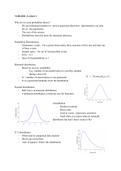
Normal Distribution
- Bell Curve of Gaussian distribution
- Continuous distribution vs discrete case for binomial
t distribution
- Similar to normal
- Heavy tails
- Used in t-tests, regression, and more
- Used when you expect data are normally
distributed, but don’t know mean or SD
X^2 distribution
- Often used in categorical data analysis
- Shows up everywhere
- ‘sum of squares’ follow this distribution
,F Distribution
- When you need to compare two chi square distributions
- comparing two sums of squares
Week 2- Sampling Theory
- We’re trying to run inferential statistics and the important thing we’re thinking about
is “what is a population we might be interested in?”
- it’s really important as you conduct your research project you begin to think
about what kind of data you’re going to collect and who is the target
population you’re trying to understand
- Population is the entire collection of units that we define
- Sample is a smaller collection of units from a population
- we hope it’s representative our population
- we try to define our population by things we discovered about our sample
- Typically the goal of empirical work: we’re trying to use a sample and our knowledge
about that sample to draw an inference about the target population
Sampling Methods:
- Simple random sampling
- In reality it’s really difficult to get a real random sample
- In most case we have pseudo random
- eg. when we run a random generator in R, this processes are arguably
random
check canvas for the R exercise for the biased sample
- Oftentimes in practice the samples we use for our research are not simple random
samples. We often aim to have random sampling where every member of the
population has the equal chance to be selected but it can be quite time consuming and
difficult to access.
- Stratified Sampling
- this is where we divide our population into different types of categories and
we try to make sure our sample accurately reflects these categories
- Volunteer sampling
- eg. Sona Studies
- Opportunity Sampling
, - going to people who wait in a cafe/airport etc and asking them to fill in a
survey or participate in a study
- often biased and very unrepresentative samples
- Convenience Sampling
- Researchers at the uni are typically tended to use convenience samples-- they
have access to students and they can make requirements to participate in
studies
- aren’t always representative
- Snowball Sampling
- advantage of this one is you can get access to harder to reach populations
based on certain features
- eg. to study pregnancy you need pregnant people and usually they are
available in groups
Does your sampling method matter?
- it depends on
- What's your target population and Is your sample biased?
- often it’s essential to measure and report diversity in your sample
- you should be transparent about your sample and how it’s recruited
Sampling methods examples
- Stratified sampling for the perceptions of different aged populations of a virtual agent
helping with health issues
- Snowball sampling for how children with autism spectrum disorder learn social skills
from a robot
- Convenience sample of uni students for what cognitive capacities are associated with
better problem solving performance-- you might wanna consider different age groups
or study levels
- Opportunity sampling for people’s levels of stress after arriving to work after taking
public transit --this could be biased bc peoples stress level might vary depending on
whether they are willing to participate in your study
Sample statistics vs. Population parameters
- Sample
- something we calculate in our sample- descriptive statistics like Mean and SD
describe only the sample from which they were calculated
- Population has a true mean and SD are but it’s very rare that we know it in Cogsci
- Sample to Population
- We use the mean and SD that are obtained from the sample to estimate the
mean and SD of the population. It’s very common in cog sci
Why do we need probability theory?
- We use inferential statistics to answer questions about how representative our data
are of the population
- The core of the science
- Probabilities form the basis for statistical inference.
Probability Distributions
- Elementary events – For a given observation, there outcome will be one and only one
of these events
- Sample space – the set of total possible events
- P(X) = 0-1
- Sum of all probabilities is 1
Binomial distribution
- Based on success probability
- E.g., number of successful tails in a coin flip, number
during a dice roll
- N = number of observations or size parameter
- X is a generated randomly from the distribution
Normal Distribution
- Bell Curve of Gaussian distribution
- Continuous distribution vs discrete case for binomial
t distribution
- Similar to normal
- Heavy tails
- Used in t-tests, regression, and more
- Used when you expect data are normally
distributed, but don’t know mean or SD
X^2 distribution
- Often used in categorical data analysis
- Shows up everywhere
- ‘sum of squares’ follow this distribution
,F Distribution
- When you need to compare two chi square distributions
- comparing two sums of squares
Week 2- Sampling Theory
- We’re trying to run inferential statistics and the important thing we’re thinking about
is “what is a population we might be interested in?”
- it’s really important as you conduct your research project you begin to think
about what kind of data you’re going to collect and who is the target
population you’re trying to understand
- Population is the entire collection of units that we define
- Sample is a smaller collection of units from a population
- we hope it’s representative our population
- we try to define our population by things we discovered about our sample
- Typically the goal of empirical work: we’re trying to use a sample and our knowledge
about that sample to draw an inference about the target population
Sampling Methods:
- Simple random sampling
- In reality it’s really difficult to get a real random sample
- In most case we have pseudo random
- eg. when we run a random generator in R, this processes are arguably
random
check canvas for the R exercise for the biased sample
- Oftentimes in practice the samples we use for our research are not simple random
samples. We often aim to have random sampling where every member of the
population has the equal chance to be selected but it can be quite time consuming and
difficult to access.
- Stratified Sampling
- this is where we divide our population into different types of categories and
we try to make sure our sample accurately reflects these categories
- Volunteer sampling
- eg. Sona Studies
- Opportunity Sampling
, - going to people who wait in a cafe/airport etc and asking them to fill in a
survey or participate in a study
- often biased and very unrepresentative samples
- Convenience Sampling
- Researchers at the uni are typically tended to use convenience samples-- they
have access to students and they can make requirements to participate in
studies
- aren’t always representative
- Snowball Sampling
- advantage of this one is you can get access to harder to reach populations
based on certain features
- eg. to study pregnancy you need pregnant people and usually they are
available in groups
Does your sampling method matter?
- it depends on
- What's your target population and Is your sample biased?
- often it’s essential to measure and report diversity in your sample
- you should be transparent about your sample and how it’s recruited
Sampling methods examples
- Stratified sampling for the perceptions of different aged populations of a virtual agent
helping with health issues
- Snowball sampling for how children with autism spectrum disorder learn social skills
from a robot
- Convenience sample of uni students for what cognitive capacities are associated with
better problem solving performance-- you might wanna consider different age groups
or study levels
- Opportunity sampling for people’s levels of stress after arriving to work after taking
public transit --this could be biased bc peoples stress level might vary depending on
whether they are willing to participate in your study
Sample statistics vs. Population parameters
- Sample
- something we calculate in our sample- descriptive statistics like Mean and SD
describe only the sample from which they were calculated
- Population has a true mean and SD are but it’s very rare that we know it in Cogsci
- Sample to Population
- We use the mean and SD that are obtained from the sample to estimate the
mean and SD of the population. It’s very common in cog sci



