
Power repeat neurophysiology
Active and passive signals.
Passive signal decays overtime.
Active current driving by ionic
flux and can stay constant over
long distances.
Action potential requires active
and passive currents. Passive
current flow along the axon and
active current flow over the
membrane through ion channels.
How can you speed up the action
potential? Increase diameter of
the axon (less resistance,
maximise passive conductance),
increase myelination (isolate the
membrane, it is
critical for the active
signal) (myelin
prevents leaking out)
(minimise active
conductance).
Active and passive
signals are deviations
from the resting
membrane potential.
What determines the
resting membrane potential?
Equilibrium potential, reverse potential; situation where the
net flux is zero. Equilibrium of the electrochemical gradient.
Diffusion force is same as electrical force. Balance between
diffusion force and electrical force. Need the equilibrium
potential of ions to know the resting membrane potential.
Calculate the equilibrium potential mV with Nernst equation.
The equilibrium of sodium is +70 mV, the membrane potential of the cell is -70 mV. Sodium is
flowing out of the cell. Is this mediated by sodium channels or sodium transporters? Sodium typically
flows into the cell. But here its going out, with use of sodium transporters (consume ATP, export ions
against electrochemical gradient) (channel only with gradient). Na+/K+ pump, Ca2+ pump.
Potassium in ear (scala media) can cause depolarization, cause outside a really high concentration of
potassium.
, Active transporters; move ions against electrochemical gradient. Ion channels; allow ions to diffuse
down their electrochemical gradient.
Antiporters, co-transporters, do not require ATP directly, but use the potential energy from the
concentration gradient of other ions as an energy source. One or more ions are take up their
electrical gradient, simultaneously taken another ion down its gradient.
Resting membrane potential is the
combined electrochemical affect of
different ions (Na, K, Cl, Ca) at different
concentrations inside and outside of the
cell. For each ion, channels exist in the
membrane that selectively conduct that
ion. Goldman equation (monovalent
ions); Concentrations don’t really
change that much only permeability of the membrane for ion is really changing. Don’t need to be
able to use the formula.
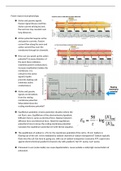
Action potential:
rapid changes in
membrane
permeability
(typically driven by
channels).
Hodgkin-Huxley
model for action
potential generation.
Sodium channels has
two gates. Potassium
channels has one
gate.
Potassium goes out
(exception of ear) cell
becomes more
negative. Sodium is important for depolarization to reach the threshold to generate an action
potential.
Refractory period, Na channels still inactivated need time to recover (de-inactivate). As long as gate
is closed you cannot drive a new action potential in the axons. Also why the action potential only
moves in one way.
Understand difference voltage-clamp and current-clamp
Two types of neurotransmitter receptors; ionotropic
neurotransmitter receptor and metabotropic neurotransmitter
receptor. Study calculation question test EXAM, he always asked
Active and passive signals.
Passive signal decays overtime.
Active current driving by ionic
flux and can stay constant over
long distances.
Action potential requires active
and passive currents. Passive
current flow along the axon and
active current flow over the
membrane through ion channels.
How can you speed up the action
potential? Increase diameter of
the axon (less resistance,
maximise passive conductance),
increase myelination (isolate the
membrane, it is
critical for the active
signal) (myelin
prevents leaking out)
(minimise active
conductance).
Active and passive
signals are deviations
from the resting
membrane potential.
What determines the
resting membrane potential?
Equilibrium potential, reverse potential; situation where the
net flux is zero. Equilibrium of the electrochemical gradient.
Diffusion force is same as electrical force. Balance between
diffusion force and electrical force. Need the equilibrium
potential of ions to know the resting membrane potential.
Calculate the equilibrium potential mV with Nernst equation.
The equilibrium of sodium is +70 mV, the membrane potential of the cell is -70 mV. Sodium is
flowing out of the cell. Is this mediated by sodium channels or sodium transporters? Sodium typically
flows into the cell. But here its going out, with use of sodium transporters (consume ATP, export ions
against electrochemical gradient) (channel only with gradient). Na+/K+ pump, Ca2+ pump.
Potassium in ear (scala media) can cause depolarization, cause outside a really high concentration of
potassium.
, Active transporters; move ions against electrochemical gradient. Ion channels; allow ions to diffuse
down their electrochemical gradient.
Antiporters, co-transporters, do not require ATP directly, but use the potential energy from the
concentration gradient of other ions as an energy source. One or more ions are take up their
electrical gradient, simultaneously taken another ion down its gradient.
Resting membrane potential is the
combined electrochemical affect of
different ions (Na, K, Cl, Ca) at different
concentrations inside and outside of the
cell. For each ion, channels exist in the
membrane that selectively conduct that
ion. Goldman equation (monovalent
ions); Concentrations don’t really
change that much only permeability of the membrane for ion is really changing. Don’t need to be
able to use the formula.
Action potential:
rapid changes in
membrane
permeability
(typically driven by
channels).
Hodgkin-Huxley
model for action
potential generation.
Sodium channels has
two gates. Potassium
channels has one
gate.
Potassium goes out
(exception of ear) cell
becomes more
negative. Sodium is important for depolarization to reach the threshold to generate an action
potential.
Refractory period, Na channels still inactivated need time to recover (de-inactivate). As long as gate
is closed you cannot drive a new action potential in the axons. Also why the action potential only
moves in one way.
Understand difference voltage-clamp and current-clamp
Two types of neurotransmitter receptors; ionotropic
neurotransmitter receptor and metabotropic neurotransmitter
receptor. Study calculation question test EXAM, he always asked



