INTERNATIONAL SALES AND
MARKETING
01 JUNE 2021
Module 3: Market Entry Strategies
What does (international) market entry mean?
Definition:
“An international market entry mode is an institutional arrangement necessary for the
entry of a company’s products, technology and human capital into a foreign
country/market.”
ENTRY MODES
There are 3 different entry modes:
1. Export modes
2. Intermediate modes
3. Hierarchical modes
Before being able to choose the correct market entry mode, you have to take into
consideration certain factors, such as:
● Timing in market entry
● Profitability
● Large scale or small scale entry
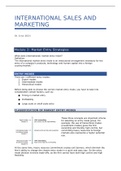
CLASSIFICATION OF MARKET ENTRY MODES
These three concepts are important criteria
for selecting on entry mode group. For
example, the use of hierarchical modes
(investment modes) gives the firm
ownership and thereby high control, but
committing heavy resources to foreign
markets also represents a higher potential
risk.
At the same time, heavy resource commitment creates exit barriers, which diminish the
firm’s ability to change the chosen entry mode in a quick and easy way. So the entry
mode decision involves trade-offs, as the firm cannot have both high control and high
flexibility.
,EXPORT ENTRY MODE (EXTERNALISE)
Export modes are a really good place to start, since they provide immediate short-term
benefits. In the image above you can see that an export entry mode involves low
control, low risk and high flexibility.
With export entry modes a firm’s products are manufactured in the domestic market or a
third country and then transferred either directly or indirectly to the host market.
There are 2 types of export mode:
● Indirect export mode
● Direct export mode
No matter which of the 2 export modes the manufacturers uses in a market, it is import
to think about what level of ‘mindshare’ the manufacturer occupies in the mind of the
export partner.
PARTNER MINDSHARE
Definition:
“Partner mindshare is a measurement of the strength of a relationship in terms of trust,
commitment and cooperation.”
🡪 Correlation between mindshare levels and how willing an export intermediary is to place
one company brand in front of another.
🡪 Mindshare expresses itself clearly in sales performance
Mindshare in 4 levels:
● Commitment and trust
● Collaboration
Measures how good the manufacturer is at cooperating on sales + ability to
cooperate on marketing
● Mutuality of interest and common purpose
● Product, brand and profit
This group measures the perceived attractiveness of the supplier’s product
offering to the intermediary.
🡪 The performance of the manufacturer needs to be as good as the competition on order
to garner the full benefit from strong mindshare.
INDIRECT EXPORT MODE
This is when the manufacturing firm does not take direct care of export- ing activities.
Instead, another domestic company, such as an export house or trading company,
performs these activities, often without the manufacturing firm’s involvement in the
foreign sales of its products.
There are 5 main entry modes of indirect exporting:
● Export buying agent
, ● Broker
● Export Management Company (EMC)
● Trading companies
● Piggyback
EXPORT BUYING AGENT
Definition:
“The export buying agent is a representative of foreign buyers who resides in the
exporter’s home country.”
The agent offers services to foreign buyers, such as identifying potential sellers and
negotiating prices.
This export method is good for small firms because:
● Easiest method
● Short-term benefits
But:
● Totally dependent on purchaser
● Unaware of change in consumer behavior
● Unaware of competitor activity
● Not suited for longer-term viability
BROKER
Definition:
“The main function of a broker is to bring a buyer and a seller together.”
The broker is a specialist in performing the contractual function, and does not actually
handle the products sold or bought.
Broker commonly specializes in:
● Particular products
● Classes of product
● Deals primarily in basic commodities
🡪 A broker may act as an agent for a seller OR a buyer.
EXPORT MANAGEMENT COMPANY (EMC)
Definition:
“Export houses or export management companies (EMCs) are specialist companies set
up to act as the ‘export department’ for a range of non-competing companies.”
🡪 Conducts business in the name of each manufacturer it represents
The use of EMC’s allows individual companies to gain:
, ● Wider exposure of their products (in foreign markets)
● Lower overall cost
Some disadvantages:
● The export house may specialize by geographical area, product or customer
type
● EMC’s are paid by commission (might be tempted to concentrate upon products
with immediate sales potential)
● Tempted to carry too many product ranges
● May carry competitive products
TRADING COMPANIES
Definition:
“The essential role of the trading company is to find a buyer quickly for the prod- ucts
that have been taken in exchange.”
Trading companies play a role in diverse areas such as:
● Shipping
● Warehousing
● Finance
● Technology transfer
● Planning resource development
● Construction
● Regional development
● Insurance
● Real-estate
They also have to manage counter-trade activities (barter). Barter is a principle in which
sales into one market are paid for by taking other products from that market in
exchange.
PIGGYBACK
Definition:
“In piggybacking the export-inexperienced SME, the ‘rider’, deals with a larger company
(the carrier) which already operates in certain foreign markets and is willing to act on
behalf of the rider that wishes to export to those markets.
🡪 Piggyback marketing is typically used for products from unrelated companies that are
non-competitive and complimentary.
MARKETING
01 JUNE 2021
Module 3: Market Entry Strategies
What does (international) market entry mean?
Definition:
“An international market entry mode is an institutional arrangement necessary for the
entry of a company’s products, technology and human capital into a foreign
country/market.”
ENTRY MODES
There are 3 different entry modes:
1. Export modes
2. Intermediate modes
3. Hierarchical modes
Before being able to choose the correct market entry mode, you have to take into
consideration certain factors, such as:
● Timing in market entry
● Profitability
● Large scale or small scale entry
CLASSIFICATION OF MARKET ENTRY MODES
These three concepts are important criteria
for selecting on entry mode group. For
example, the use of hierarchical modes
(investment modes) gives the firm
ownership and thereby high control, but
committing heavy resources to foreign
markets also represents a higher potential
risk.
At the same time, heavy resource commitment creates exit barriers, which diminish the
firm’s ability to change the chosen entry mode in a quick and easy way. So the entry
mode decision involves trade-offs, as the firm cannot have both high control and high
flexibility.
,EXPORT ENTRY MODE (EXTERNALISE)
Export modes are a really good place to start, since they provide immediate short-term
benefits. In the image above you can see that an export entry mode involves low
control, low risk and high flexibility.
With export entry modes a firm’s products are manufactured in the domestic market or a
third country and then transferred either directly or indirectly to the host market.
There are 2 types of export mode:
● Indirect export mode
● Direct export mode
No matter which of the 2 export modes the manufacturers uses in a market, it is import
to think about what level of ‘mindshare’ the manufacturer occupies in the mind of the
export partner.
PARTNER MINDSHARE
Definition:
“Partner mindshare is a measurement of the strength of a relationship in terms of trust,
commitment and cooperation.”
🡪 Correlation between mindshare levels and how willing an export intermediary is to place
one company brand in front of another.
🡪 Mindshare expresses itself clearly in sales performance
Mindshare in 4 levels:
● Commitment and trust
● Collaboration
Measures how good the manufacturer is at cooperating on sales + ability to
cooperate on marketing
● Mutuality of interest and common purpose
● Product, brand and profit
This group measures the perceived attractiveness of the supplier’s product
offering to the intermediary.
🡪 The performance of the manufacturer needs to be as good as the competition on order
to garner the full benefit from strong mindshare.
INDIRECT EXPORT MODE
This is when the manufacturing firm does not take direct care of export- ing activities.
Instead, another domestic company, such as an export house or trading company,
performs these activities, often without the manufacturing firm’s involvement in the
foreign sales of its products.
There are 5 main entry modes of indirect exporting:
● Export buying agent
, ● Broker
● Export Management Company (EMC)
● Trading companies
● Piggyback
EXPORT BUYING AGENT
Definition:
“The export buying agent is a representative of foreign buyers who resides in the
exporter’s home country.”
The agent offers services to foreign buyers, such as identifying potential sellers and
negotiating prices.
This export method is good for small firms because:
● Easiest method
● Short-term benefits
But:
● Totally dependent on purchaser
● Unaware of change in consumer behavior
● Unaware of competitor activity
● Not suited for longer-term viability
BROKER
Definition:
“The main function of a broker is to bring a buyer and a seller together.”
The broker is a specialist in performing the contractual function, and does not actually
handle the products sold or bought.
Broker commonly specializes in:
● Particular products
● Classes of product
● Deals primarily in basic commodities
🡪 A broker may act as an agent for a seller OR a buyer.
EXPORT MANAGEMENT COMPANY (EMC)
Definition:
“Export houses or export management companies (EMCs) are specialist companies set
up to act as the ‘export department’ for a range of non-competing companies.”
🡪 Conducts business in the name of each manufacturer it represents
The use of EMC’s allows individual companies to gain:
, ● Wider exposure of their products (in foreign markets)
● Lower overall cost
Some disadvantages:
● The export house may specialize by geographical area, product or customer
type
● EMC’s are paid by commission (might be tempted to concentrate upon products
with immediate sales potential)
● Tempted to carry too many product ranges
● May carry competitive products
TRADING COMPANIES
Definition:
“The essential role of the trading company is to find a buyer quickly for the prod- ucts
that have been taken in exchange.”
Trading companies play a role in diverse areas such as:
● Shipping
● Warehousing
● Finance
● Technology transfer
● Planning resource development
● Construction
● Regional development
● Insurance
● Real-estate
They also have to manage counter-trade activities (barter). Barter is a principle in which
sales into one market are paid for by taking other products from that market in
exchange.
PIGGYBACK
Definition:
“In piggybacking the export-inexperienced SME, the ‘rider’, deals with a larger company
(the carrier) which already operates in certain foreign markets and is willing to act on
behalf of the rider that wishes to export to those markets.
🡪 Piggyback marketing is typically used for products from unrelated companies that are
non-competitive and complimentary.