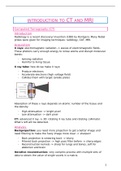
INTRODUCTION TO CT AND MRI
Computed Tomography (CT)
Introduction
Radiology is a recent discovery/ invention (1895 by Rontgen). Many Nobel
prizes were given for imaging techniques: radiology, CAT, MRI.
Acquisition
X rays: electromagnetic radiation -> waves of electromagnetic fields.
These photons carry enough energy to ionise atoms and disrupt molecular
bonds:
- Ionising radiation
- Harmful to living tissue
X ray tube: how do we make X rays:
- Produce electrons
- Accelerate electrons (high voltage field)
- Collides them with target (anode plate)
Absorption of these x rays depends on atomic number of the tissue and
the density.
- High attenuation -> bright pixel
- Low attenuation -> dark pixel
CT: advanced X ray -> 3D: rotating X ray tube and rotating collimator.
What’s left will be detected.
Analysis
Backprojection: you need more projection to get a better image and
need filtering to make the fuzzy image more clear -> sharpen!
- Back projection is smearing back -> blurry
- Filtered back projection -> high pass filter before -> sharp edges
- Reconstruction kernels -> sharp for lungs and bones, soft for
abdomen and brain
Iterative reconstruction: very complex process with multiple sets of
data to obtain the value of single voxels in a matrix.
1
, Water is taken as the standard -> calibrate linearly with water and air!
Important: grey matter is brighter on CT than white matter. Blood contains
iron -> higher atomic number.
Magnetic Resoncance Imaging (MRI)
Synonyms are NMR, MR, MRI, KST, MRB.
Acquisition
The imaging is based on:
- Protons that are unpaired
- Strong magnetic field
- Changing magnetic fields
- Radiofrequent waves
(See Marleen Verhoye)
Advantages:
- No ionizing radiation
- No known harmful effects but: heating, noise, EM field, Gd
- Superior image quality
- Anatomic and functional information
Disadvantages:
- Longer imaging time (CT is just a few seconds)
2
Computed Tomography (CT)
Introduction
Radiology is a recent discovery/ invention (1895 by Rontgen). Many Nobel
prizes were given for imaging techniques: radiology, CAT, MRI.
Acquisition
X rays: electromagnetic radiation -> waves of electromagnetic fields.
These photons carry enough energy to ionise atoms and disrupt molecular
bonds:
- Ionising radiation
- Harmful to living tissue
X ray tube: how do we make X rays:
- Produce electrons
- Accelerate electrons (high voltage field)
- Collides them with target (anode plate)
Absorption of these x rays depends on atomic number of the tissue and
the density.
- High attenuation -> bright pixel
- Low attenuation -> dark pixel
CT: advanced X ray -> 3D: rotating X ray tube and rotating collimator.
What’s left will be detected.
Analysis
Backprojection: you need more projection to get a better image and
need filtering to make the fuzzy image more clear -> sharpen!
- Back projection is smearing back -> blurry
- Filtered back projection -> high pass filter before -> sharp edges
- Reconstruction kernels -> sharp for lungs and bones, soft for
abdomen and brain
Iterative reconstruction: very complex process with multiple sets of
data to obtain the value of single voxels in a matrix.
1
, Water is taken as the standard -> calibrate linearly with water and air!
Important: grey matter is brighter on CT than white matter. Blood contains
iron -> higher atomic number.
Magnetic Resoncance Imaging (MRI)
Synonyms are NMR, MR, MRI, KST, MRB.
Acquisition
The imaging is based on:
- Protons that are unpaired
- Strong magnetic field
- Changing magnetic fields
- Radiofrequent waves
(See Marleen Verhoye)
Advantages:
- No ionizing radiation
- No known harmful effects but: heating, noise, EM field, Gd
- Superior image quality
- Anatomic and functional information
Disadvantages:
- Longer imaging time (CT is just a few seconds)
2