GIZMOS Student Exploration
Calorimetry Lab
Name: Ryan Villani Date: 02/15/2017
Student Exploration: Calorimetry Lab
Vocabulary: calorie, calorimeter, joule, specific heat capacity
Prior Knowledge Questions (Do these BEFORE using the Gizmo.)
word calor means “heat,”
1. The Latin and m
eter comes from the Greek word meaning “to
alorimeter does? M
measure.” What do you think a c easures heat.
2. Where have you heard the word calorie before? What do you think a calorie is? W
ith food,
the amount of energy it takes to heat up one ml of water.
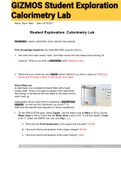
Gizmo Warm-up
A calorimeter is an insulated container filled with a liquid,
usually water. When a hot object is placed in the calorimeter,
heat energy is transferred from the object to the water and the
water heats up.
Calorimeters can be used to find a substance’s specific heat
use the Calorimetry Lab Gizmo™ to
capacity. You will
determine the specific heat capacities of various substances.
1. On the SIMULATION pane, select C opper. Use the slider to set its Mass t o 200 g. Set the
Water mass to 200 g. Check that the Water temp is set to 30.0 °C and the copper’s Temp
lay (
is 90 °C. Select the GRAPH tab, and click P ).
A. What was the Final temperature of the copper and the water? 3
4.96C
B. How much did the temperature of the copper change? 55.04C
C. How much did the temperature of the water change? 4.96C
, 2. Specific heat capacity can be described as a substance’s resistance to temperature
changes. Which substance has a greater specific heat capacity, copper or water? Explain.
Water, the temperature of the water changed the least amount, therefore its resistance is
greater.
Calorimetry Lab
Name: Ryan Villani Date: 02/15/2017
Student Exploration: Calorimetry Lab
Vocabulary: calorie, calorimeter, joule, specific heat capacity
Prior Knowledge Questions (Do these BEFORE using the Gizmo.)
word calor means “heat,”
1. The Latin and m
eter comes from the Greek word meaning “to
alorimeter does? M
measure.” What do you think a c easures heat.
2. Where have you heard the word calorie before? What do you think a calorie is? W
ith food,
the amount of energy it takes to heat up one ml of water.
Gizmo Warm-up
A calorimeter is an insulated container filled with a liquid,
usually water. When a hot object is placed in the calorimeter,
heat energy is transferred from the object to the water and the
water heats up.
Calorimeters can be used to find a substance’s specific heat
use the Calorimetry Lab Gizmo™ to
capacity. You will
determine the specific heat capacities of various substances.
1. On the SIMULATION pane, select C opper. Use the slider to set its Mass t o 200 g. Set the
Water mass to 200 g. Check that the Water temp is set to 30.0 °C and the copper’s Temp
lay (
is 90 °C. Select the GRAPH tab, and click P ).
A. What was the Final temperature of the copper and the water? 3
4.96C
B. How much did the temperature of the copper change? 55.04C
C. How much did the temperature of the water change? 4.96C
, 2. Specific heat capacity can be described as a substance’s resistance to temperature
changes. Which substance has a greater specific heat capacity, copper or water? Explain.
Water, the temperature of the water changed the least amount, therefore its resistance is
greater.