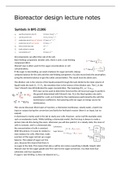
Bioreactor design lecture notes
All components can affect the rate of the cell.
Rate-limiting component: besides cells, there is only 1 rate-limiting
component (RLC).
Monod’s law is often used for the sugar concentrations or cell
concentrations.
If the sugar is rate-limiting, we need a balance for sugar and cells. Always
compose balance for the cells and the rate-limiting component. You also must check the assumption,
using the ammonia balance to get the outlet concentration. This result must be above zero.
The dilution rate is the volume of the liquid pumped through the tank divide by the total volume of
liquid inside the tank: DL = FL/VL, the retention time is the inverse of the dilution rate. The C S in the
‘new’ Monod’s law still indicates the sugar concentration. The meaning of K s: μ = ½ μmax.
Pirt’s law can be used to determine how fast the cell must eat sugar to perform
the growth determined with Monod’s law. M s is the fixed uptake rate and is
essential for a cell, as it stands for the maintenance performed by the cell (the
maintenance coefficient). Non-growing cells eat sugar as energy source for
maintenance.
This course discusses three types of reactors; a chemostat (continuous, steady state), a batch (no
input or output during the conversion) and lastly the fed-batch reactor (there is an input, but no
output).
A chemostat is mainly used in the lab to study your cells. However, some real-life examples exist,
such as wastewater tanks. While building a chemostat model, the first step is always to make a
picture (also do this during the exam, otherwise you will lose points!). In a steady state, the mass of
cells is constant, and in a chemostat also
the concentration of cells is constant.
With this picture, it is easy to conduct a
mass balance for cells. After that, make
a picture of the sugar and set up a sugar
balance. The output of sugar can’t be
zero, because this means that there is
no sugar in the tank. This means that also μ will be zero (since everything is ideally mixed). Add
Monod’s law for the sugar uptake and Pirt’s law for the sugar conversion. You than have four
unknowns and four equations.
If sugar is rate-limiting, Cs does not depend on Csin.
, For a batch reactor, much more assumptions must be made. The
balances for cells and sugar differ from the chemostat reactor since
there is no continuous flow. Each balance has 3 variables, so no
separation is possible. If you investigate literature, Monod’s constant (K s)
is often very low (for all components). The sugar concentration (C s) is
usually very high. This gives the possibility to neglect Monod’s constant and therefore μ = μmax. So,
with these assumptions, the balance can be simplified, separated, and solved.
There are two models for maintenance. Pirt’s law describes that sugar is the carbon and energy
source for growth. Extra is added as the energy source for maintenance (plus luxury products).
Herbert’s law describes that sugar is the carbon and energy source for growth. It also describes that
cell mass is the energy source for maintenance.
Pirt’s law is good in biotechnology because we
stop when sugar is depleted. Herbert’s law is
used in environmental technology.
A fed-batch reactor is only partially filled with
liquid and has only an input flow of sugar (no output flow, liquid level gets higher over time).
Figure 1, bubble column
Figure 2, stirred tank reactor
All components can affect the rate of the cell.
Rate-limiting component: besides cells, there is only 1 rate-limiting
component (RLC).
Monod’s law is often used for the sugar concentrations or cell
concentrations.
If the sugar is rate-limiting, we need a balance for sugar and cells. Always
compose balance for the cells and the rate-limiting component. You also must check the assumption,
using the ammonia balance to get the outlet concentration. This result must be above zero.
The dilution rate is the volume of the liquid pumped through the tank divide by the total volume of
liquid inside the tank: DL = FL/VL, the retention time is the inverse of the dilution rate. The C S in the
‘new’ Monod’s law still indicates the sugar concentration. The meaning of K s: μ = ½ μmax.
Pirt’s law can be used to determine how fast the cell must eat sugar to perform
the growth determined with Monod’s law. M s is the fixed uptake rate and is
essential for a cell, as it stands for the maintenance performed by the cell (the
maintenance coefficient). Non-growing cells eat sugar as energy source for
maintenance.
This course discusses three types of reactors; a chemostat (continuous, steady state), a batch (no
input or output during the conversion) and lastly the fed-batch reactor (there is an input, but no
output).
A chemostat is mainly used in the lab to study your cells. However, some real-life examples exist,
such as wastewater tanks. While building a chemostat model, the first step is always to make a
picture (also do this during the exam, otherwise you will lose points!). In a steady state, the mass of
cells is constant, and in a chemostat also
the concentration of cells is constant.
With this picture, it is easy to conduct a
mass balance for cells. After that, make
a picture of the sugar and set up a sugar
balance. The output of sugar can’t be
zero, because this means that there is
no sugar in the tank. This means that also μ will be zero (since everything is ideally mixed). Add
Monod’s law for the sugar uptake and Pirt’s law for the sugar conversion. You than have four
unknowns and four equations.
If sugar is rate-limiting, Cs does not depend on Csin.
, For a batch reactor, much more assumptions must be made. The
balances for cells and sugar differ from the chemostat reactor since
there is no continuous flow. Each balance has 3 variables, so no
separation is possible. If you investigate literature, Monod’s constant (K s)
is often very low (for all components). The sugar concentration (C s) is
usually very high. This gives the possibility to neglect Monod’s constant and therefore μ = μmax. So,
with these assumptions, the balance can be simplified, separated, and solved.
There are two models for maintenance. Pirt’s law describes that sugar is the carbon and energy
source for growth. Extra is added as the energy source for maintenance (plus luxury products).
Herbert’s law describes that sugar is the carbon and energy source for growth. It also describes that
cell mass is the energy source for maintenance.
Pirt’s law is good in biotechnology because we
stop when sugar is depleted. Herbert’s law is
used in environmental technology.
A fed-batch reactor is only partially filled with
liquid and has only an input flow of sugar (no output flow, liquid level gets higher over time).
Figure 1, bubble column
Figure 2, stirred tank reactor