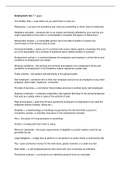
Employment law (17 gaps)
The Golden Rule = treat others as you want them to treat you
Reciprocity = you give me something and I give you something in return (law of reciprocity)
Neighbour principle = someone who is so closely and directly affected by your act that you
ought reasonably to have them in contemplation (example: Donoghue vs Stevenson)
Reasonably foresee = a reasonable person has to be able to predict or expect any
harmfulness of their actions (duty of care)
Contractual liability = arises out of a contract and covers claims against a business that arise
out of its assumption via a contract of someone else's liability (breach of contract)
Employment contract = a contract between the employee and employer in which terms and
conditions of employment are stated
Working conditions = the working environment and aspects of an employee's terms and
conditions of employment in the Collective Labour Agreement (public law)
Public interest = the welfare and well-being of the general public
Self-employed = someone who is their own employer and are not an employee of any other
employer (sole trader, freelancer, contractor)
Provider of services = a contractor that provides services to another party (self-employed)
Statutory protection = a statutory proprietary right against dismissal of the worker/employee
that acts as a safety valve in case of the contract of sale
Paid annual leave = paid time off work granted by employers to employees to be used the
employee wishes (holiday, illness etc.)
Disability = a disadvantage or handicap recognized by the law that limits a person’s
movement, senses, or activities (insurance in the employment contract)
Hire = the action of hiring someone or something
Protect = to keep safe from harm or injury
Minimum standards = the basic requirements of eligibility to protect workers and that are
permitted by law
Legal obligation = a legal duty to perform or not perform an action which is enforced by law
Pay = give (someone) money for the work done, goods received, or a debt incurred
Sole trader = a self-employed person who owns and runs a business as individual
Permanent contract = a contract for an indefinite period of time (no end date)
,Obligatory provision = requirements that should be included and are required to be obtained
in an employment contract (term (duration), trial period (< 2 months), position (job title),
working hours, salary, place of work, and personal details of the employee)
Trial period = a period of time during which someone is supervised (one of the requirements
of an obligatory provision)
Salary = a fixed regular payment made by an employer to an employee (one of the
requirements of an obligatory provision)
Holistic approach = the nature of the working relationship viewed as a whole (all
circumstances of the case)
At will (common law) = terminating an employment contract at any time and for any reason
that is not illegal (at the end of the contract period, with the consent of both parties)
0/1/2 months = the maximum duration a trial period can be (depends on the duration of the
employment contract)
• 0 months: employment contact up to 6 months
• 1 month: employment contract that lasts longer than 6 months (no end date)
• 2 months: fixed-term contract that lasts longer than 2 years or a permanent contract
Carry out = to fulfill or perform a task, instruction, duty etc. (disposal)
Peripatetic (workers) = employees without fixed places of work (door-to-door salesmen,
plumbers, and care workers)
Remuneration = a payment of another financial compensation provided for the employee
(example: remuneration for travel time)
Immediately = right away/as soon as (stand-by duty)
Liability for unlawful acts = liability based on fault (you do something wrong yourself and
another person suffers) or strict liability based on risk (responsible for other persons,
premises, products, animals)
Strict liability/vicarious = the legal responsibility for damage or injury, which does not depend
on actual negligence or intent to harm (example: employment law/employer liability)
Intent = intentional/on purpose mean to cause harm
Collective Labour Agreement (CLA) = a collection of agreements/arrangements about
working conditions in particular organisations/industries (an employment contract contains
references to these collective agreements)
Minimum CLA = the minimum requirements of a CLA (the employer may deviate from the
collective labour agreement to the employees’ advantage if the collective labour agreement
is a minimum collective agreement)
Consent = permission for something to happen or agreement to do something (‘with the
consent of both parties’
, Initiative = suggests certain plans for an organisation (one of the rights of works council)
Transferring = contracting out business processes to another party (transferring an
undertaking, or a part of it, to another undertaking)
Successive employment rule (3x3x6) = if an employee is on his/her third fixed-term contract
within a period of 3 years (with no more than 6 months between each two contracts), the next
contract must be permanent (applies with on-call contract)
On-call contract = an employment contract with a flexible scope of work (the employment
contract states that the number of hours an employee can be deployed in a certain period of
time may vary): zero-hours contract, one-hour contract, min-max contract
Features: the employee is free to refuse when he/she is called up, the employee will be paid
for the hours worked, every time the employee accepts to work, a new employment contact
starts, and the successive employment rule applies (3x3x6)
Three hours’ pay = a feature of a zero-hours contract, which states that the employee must
show up for work once he/she is called up and the employee is entitled to at least three
hours’ pay when he/she is called up to work
4 days (zero-hours contract) = the employee must show up for work once the employee is
called up 4 days before (collective agreement may mention one day), otherwise the
employee may refuse to work (payment: when the employee’s work is cancelled within these
4 days)
Legal presumption = presumptions that are made by a jury, or presumptions of law and fact.
Treat = behave towards or deal with in a certain way
Quid pro quo = something for something (The Golden Rule/reciprocity)
Duty of care = take reasonable care to avoid injuring and those that you can reasonably
foresee are likely to be affected by your actions
Avoid injuring = avoid hurting someone (prevention)
Tort of negligence = harm caused by failing to act careless (the court case of Donoghue vs
Stevenson was brought to court where it became a big part of the road to develop the
concept of duty of care in the tort of negligence)
Private parties = private parties serve to protect everyone's personal information from the
public and are owned and controlled by an individual person or a commercial company
(private law)
Health and safety conditions = regulations and procedures intended to ensure healthy and
safe working conditions in workplaces or public environments (public law)
Employee = an individual who works under the supervision or control of an employer and
who is employed by an employer for salary.
The Golden Rule = treat others as you want them to treat you
Reciprocity = you give me something and I give you something in return (law of reciprocity)
Neighbour principle = someone who is so closely and directly affected by your act that you
ought reasonably to have them in contemplation (example: Donoghue vs Stevenson)
Reasonably foresee = a reasonable person has to be able to predict or expect any
harmfulness of their actions (duty of care)
Contractual liability = arises out of a contract and covers claims against a business that arise
out of its assumption via a contract of someone else's liability (breach of contract)
Employment contract = a contract between the employee and employer in which terms and
conditions of employment are stated
Working conditions = the working environment and aspects of an employee's terms and
conditions of employment in the Collective Labour Agreement (public law)
Public interest = the welfare and well-being of the general public
Self-employed = someone who is their own employer and are not an employee of any other
employer (sole trader, freelancer, contractor)
Provider of services = a contractor that provides services to another party (self-employed)
Statutory protection = a statutory proprietary right against dismissal of the worker/employee
that acts as a safety valve in case of the contract of sale
Paid annual leave = paid time off work granted by employers to employees to be used the
employee wishes (holiday, illness etc.)
Disability = a disadvantage or handicap recognized by the law that limits a person’s
movement, senses, or activities (insurance in the employment contract)
Hire = the action of hiring someone or something
Protect = to keep safe from harm or injury
Minimum standards = the basic requirements of eligibility to protect workers and that are
permitted by law
Legal obligation = a legal duty to perform or not perform an action which is enforced by law
Pay = give (someone) money for the work done, goods received, or a debt incurred
Sole trader = a self-employed person who owns and runs a business as individual
Permanent contract = a contract for an indefinite period of time (no end date)
,Obligatory provision = requirements that should be included and are required to be obtained
in an employment contract (term (duration), trial period (< 2 months), position (job title),
working hours, salary, place of work, and personal details of the employee)
Trial period = a period of time during which someone is supervised (one of the requirements
of an obligatory provision)
Salary = a fixed regular payment made by an employer to an employee (one of the
requirements of an obligatory provision)
Holistic approach = the nature of the working relationship viewed as a whole (all
circumstances of the case)
At will (common law) = terminating an employment contract at any time and for any reason
that is not illegal (at the end of the contract period, with the consent of both parties)
0/1/2 months = the maximum duration a trial period can be (depends on the duration of the
employment contract)
• 0 months: employment contact up to 6 months
• 1 month: employment contract that lasts longer than 6 months (no end date)
• 2 months: fixed-term contract that lasts longer than 2 years or a permanent contract
Carry out = to fulfill or perform a task, instruction, duty etc. (disposal)
Peripatetic (workers) = employees without fixed places of work (door-to-door salesmen,
plumbers, and care workers)
Remuneration = a payment of another financial compensation provided for the employee
(example: remuneration for travel time)
Immediately = right away/as soon as (stand-by duty)
Liability for unlawful acts = liability based on fault (you do something wrong yourself and
another person suffers) or strict liability based on risk (responsible for other persons,
premises, products, animals)
Strict liability/vicarious = the legal responsibility for damage or injury, which does not depend
on actual negligence or intent to harm (example: employment law/employer liability)
Intent = intentional/on purpose mean to cause harm
Collective Labour Agreement (CLA) = a collection of agreements/arrangements about
working conditions in particular organisations/industries (an employment contract contains
references to these collective agreements)
Minimum CLA = the minimum requirements of a CLA (the employer may deviate from the
collective labour agreement to the employees’ advantage if the collective labour agreement
is a minimum collective agreement)
Consent = permission for something to happen or agreement to do something (‘with the
consent of both parties’
, Initiative = suggests certain plans for an organisation (one of the rights of works council)
Transferring = contracting out business processes to another party (transferring an
undertaking, or a part of it, to another undertaking)
Successive employment rule (3x3x6) = if an employee is on his/her third fixed-term contract
within a period of 3 years (with no more than 6 months between each two contracts), the next
contract must be permanent (applies with on-call contract)
On-call contract = an employment contract with a flexible scope of work (the employment
contract states that the number of hours an employee can be deployed in a certain period of
time may vary): zero-hours contract, one-hour contract, min-max contract
Features: the employee is free to refuse when he/she is called up, the employee will be paid
for the hours worked, every time the employee accepts to work, a new employment contact
starts, and the successive employment rule applies (3x3x6)
Three hours’ pay = a feature of a zero-hours contract, which states that the employee must
show up for work once he/she is called up and the employee is entitled to at least three
hours’ pay when he/she is called up to work
4 days (zero-hours contract) = the employee must show up for work once the employee is
called up 4 days before (collective agreement may mention one day), otherwise the
employee may refuse to work (payment: when the employee’s work is cancelled within these
4 days)
Legal presumption = presumptions that are made by a jury, or presumptions of law and fact.
Treat = behave towards or deal with in a certain way
Quid pro quo = something for something (The Golden Rule/reciprocity)
Duty of care = take reasonable care to avoid injuring and those that you can reasonably
foresee are likely to be affected by your actions
Avoid injuring = avoid hurting someone (prevention)
Tort of negligence = harm caused by failing to act careless (the court case of Donoghue vs
Stevenson was brought to court where it became a big part of the road to develop the
concept of duty of care in the tort of negligence)
Private parties = private parties serve to protect everyone's personal information from the
public and are owned and controlled by an individual person or a commercial company
(private law)
Health and safety conditions = regulations and procedures intended to ensure healthy and
safe working conditions in workplaces or public environments (public law)
Employee = an individual who works under the supervision or control of an employer and
who is employed by an employer for salary.