

Statistics 1
Chapter 01 – Introduction and basic concepts
§1.1 What is statistics?
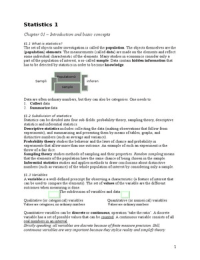
The set of objects under investigation is called the population. The objects themselves are the
(population) elements. The measurements (called data) are made on the elements and reflect
some individual characteristic of the elements. Many studies in economics consider only a
part of the population of interest, a so-called sample. Data contain hidden information that
has to be detected by statistics in order to become knowledge.
Populationo
Sampli n inferen
ng ce
sample
Data are often ordinary numbers, but they can also be categories. One needs to:
1. Collect data
2. Summarize data
§1.2 Subdivision of statistics
Statistics can be divided into four sub-fields: probability theory, sampling theory, descriptive
statistics and inferential statistics.
Descriptive statistics includes collecting the data (making observations that follow from
experiments), and summarizing and presenting them by means of tables, graphs, and
distinctive numbers (such as average and variance).
Probability theory studies the behavior and the laws of chance and probability in
experiments that allow more than one outcome. An example of such an experiment is the
throw of a fair dice.
Sampling theory studies methods of sampling and their properties. Random sampling means
that the elements of the population have the same chance of being chosen in the sample.
Inferential statistics studies and applies methods to draw conclusions about distinctive
numbers (such as variance) of the whole population of interest by considering only a sample.
§1.3 Variables
A variable is a well-defined prescript for observing a characteristic (a feature of interest that
can be used to compare the elements). The set of values of the variable are the different
outcomes when measuring is done.
The subdivision of variables and data:
Qualitative (or categorical) variables Quantitative (or numerical) variables
Values are categories, no ordinary numbers Values are ordinary numbers
Quantitative variables can be discrete or continuous, operation ‘take the ratio’. A discrete
variable has a set of possible values that can be counted. A continuous variable consists of all
real numbers in an interval.
Strictly speaking, all variables are discrete because of finite measure precision. Still,
continuous variables are very important because they stylize reality and simplify theory.
1
,Qualitative variables can be nominal or ordinal, the arithmetic operation ‘ordering’.
Ordinal Values can be ordered.
e.g.: performance of an instructor
values: poor (1), average (2),
excellent (3)
Nominal Values cannot be ordered in a natural way.
e.g.: marital status
values: single (1), married (2),
divorced (3), widowed (4)
When qualitative variables can take only two values, they are called alternative or
dichotomous variables. If one of the two values is coded as 1 and the other as 0, the variable
is called a dummy variable. The difference between qualitative and quantitative variables
can be described by subjecting the values of variables ‘take the difference’. For a
quantitative variable, differences between its values make sense. For a qualitative variable,
such differences are meaningless.
2
, §2.2 Ordinal Variables
It is possible to create an overview of the different values in the dataset jointly with their
(relative) frequencies. This (relative) frequency distribution can again be presented in a table,
bar chart and pie chart. Since the different values can now be put in increasing order, the
frequencies up to and including certain values can also be considered. Such frequencies are
called cumulative frequencies. The overview of all different values combined with the
respective cumulative (relative) frequencies is called cumulative (relative) frequency
distribution.
Take a look at example 2.2 at page 22/24
The type of scaling used in the example is commonly found in questionnaires; the scale is
then called a Likert scale. Respondents specify their level of agreement to each of the
statements choosing one of the five options of the five-point scale.
Combined and stacked Bar charts
In general, the distribution of A lies at the
right-hand side of the distribution of B.
The distribution of instructor A is more
concentrated on the higher values than
the distribution of B.
In cases where the variable is discrete, each different value forms a class if there are not too
many. But if the variable is considered continuous, the classes are usually adjoining intervals.
2.3 Quantitative Variables - Original Observations
Some charts visualize the original observations of a dataset of a quantitative variable Since
the observations are ordinary numbers, they can be situated along the horizontal line of real
numbers by marking a dot or a small vertical stroke. The resulting chart is called a dot plot.
Take a look at example 2.3 at page 25/26
3
Chapter 01 – Introduction and basic concepts
§1.1 What is statistics?
The set of objects under investigation is called the population. The objects themselves are the
(population) elements. The measurements (called data) are made on the elements and reflect
some individual characteristic of the elements. Many studies in economics consider only a
part of the population of interest, a so-called sample. Data contain hidden information that
has to be detected by statistics in order to become knowledge.
Populationo
Sampli n inferen
ng ce
sample
Data are often ordinary numbers, but they can also be categories. One needs to:
1. Collect data
2. Summarize data
§1.2 Subdivision of statistics
Statistics can be divided into four sub-fields: probability theory, sampling theory, descriptive
statistics and inferential statistics.
Descriptive statistics includes collecting the data (making observations that follow from
experiments), and summarizing and presenting them by means of tables, graphs, and
distinctive numbers (such as average and variance).
Probability theory studies the behavior and the laws of chance and probability in
experiments that allow more than one outcome. An example of such an experiment is the
throw of a fair dice.
Sampling theory studies methods of sampling and their properties. Random sampling means
that the elements of the population have the same chance of being chosen in the sample.
Inferential statistics studies and applies methods to draw conclusions about distinctive
numbers (such as variance) of the whole population of interest by considering only a sample.
§1.3 Variables
A variable is a well-defined prescript for observing a characteristic (a feature of interest that
can be used to compare the elements). The set of values of the variable are the different
outcomes when measuring is done.
The subdivision of variables and data:
Qualitative (or categorical) variables Quantitative (or numerical) variables
Values are categories, no ordinary numbers Values are ordinary numbers
Quantitative variables can be discrete or continuous, operation ‘take the ratio’. A discrete
variable has a set of possible values that can be counted. A continuous variable consists of all
real numbers in an interval.
Strictly speaking, all variables are discrete because of finite measure precision. Still,
continuous variables are very important because they stylize reality and simplify theory.
1
,Qualitative variables can be nominal or ordinal, the arithmetic operation ‘ordering’.
Ordinal Values can be ordered.
e.g.: performance of an instructor
values: poor (1), average (2),
excellent (3)
Nominal Values cannot be ordered in a natural way.
e.g.: marital status
values: single (1), married (2),
divorced (3), widowed (4)
When qualitative variables can take only two values, they are called alternative or
dichotomous variables. If one of the two values is coded as 1 and the other as 0, the variable
is called a dummy variable. The difference between qualitative and quantitative variables
can be described by subjecting the values of variables ‘take the difference’. For a
quantitative variable, differences between its values make sense. For a qualitative variable,
such differences are meaningless.
2
, §2.2 Ordinal Variables
It is possible to create an overview of the different values in the dataset jointly with their
(relative) frequencies. This (relative) frequency distribution can again be presented in a table,
bar chart and pie chart. Since the different values can now be put in increasing order, the
frequencies up to and including certain values can also be considered. Such frequencies are
called cumulative frequencies. The overview of all different values combined with the
respective cumulative (relative) frequencies is called cumulative (relative) frequency
distribution.
Take a look at example 2.2 at page 22/24
The type of scaling used in the example is commonly found in questionnaires; the scale is
then called a Likert scale. Respondents specify their level of agreement to each of the
statements choosing one of the five options of the five-point scale.
Combined and stacked Bar charts
In general, the distribution of A lies at the
right-hand side of the distribution of B.
The distribution of instructor A is more
concentrated on the higher values than
the distribution of B.
In cases where the variable is discrete, each different value forms a class if there are not too
many. But if the variable is considered continuous, the classes are usually adjoining intervals.
2.3 Quantitative Variables - Original Observations
Some charts visualize the original observations of a dataset of a quantitative variable Since
the observations are ordinary numbers, they can be situated along the horizontal line of real
numbers by marking a dot or a small vertical stroke. The resulting chart is called a dot plot.
Take a look at example 2.3 at page 25/26
3



