1|Page UNIT-3 DS
UNIT-3 Linked list
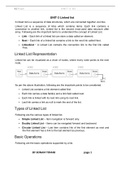
A linked list is a sequence of data structures, which are connected together via links.
Linked List is a sequence of links which contains items. Each link contains a
connection to another link. Linked list is the second most-used data structure after
array. Following are the important terms to understand the concept of Linked List.
Link − Each link of a linked list can store a data called an element.
Next − Each link of a linked list contains a link to the next link called Next.
LinkedList − A Linked List contains the connection link to the first link called
First.
Linked List Representation
Linked list can be visualized as a chain of nodes, where every node points to the next
node.
As per the above illustration, following are the important points to be considered.
Linked List contains a link element called first.
Each link carries a data field(s) and a link field called next.
Each link is linked with its next link using its next link.
Last link carries a link as null to mark the end of the list.
Types of Linked List
Following are the various types of linked list.
Simple Linked List − Item navigation is forward only.
Doubly Linked List − Items can be navigated forward and backward.
Circular Linked List − Last item contains link of the first element as next and
the first element has a link to the last element as previous.
Basic Operations
Following are the basic operations supported by a list.
BY-SONAM TOMAR page-1
,2|Page UNIT-3 DS
Insertion − Adds an element at the beginning of the list.
Deletion − Deletes an element at the beginning of the list.
Display − Displays the complete list.
Search − Searches an element using the given key.
Delete − Deletes an element using the given key.
Insertion Operation
Adding a new node in linked list is a more than one step activity. We shall learn this
with diagrams here. First, create a node using the same structure and find the location
where it has to be inserted.
Imagine that we are inserting a node B (NewNode), between A (LeftNode)
and C (RightNode). Then point B.next to C −
NewNode.next −> RightNode;
It should look like this −
Now, the next node at the left should point to the new node.
LeftNode.next −> NewNode;
Algorithm:insertion at given Location:-
o STEP 1: IF PTR = NULL
BY-SONAM TOMAR page-1
, 3|Page UNIT-3 DS
WRITE OVERFLOW
GOTO STEP 12
END OF IF
o STEP 2: SET NEW_NODE = PTR
o STEP 3: NEW_NODE → DATA = VAL
o STEP 4: SET TEMP = HEAD
o STEP 5: SET I = 0
o STEP 6: REPEAT STEP 5 AND 6 UNTIL I<loc< li=""></loc<>
o STEP 7: TEMP = TEMP → NEXT
STEP 8: IF TEMP = NULLWRITE "DESIRED NODE NOT PRESENT"
GOTO STEP 12
END OF IF
END OF LOOP
o STEP 9: PTR → NEXT = TEMP → NEXT
o STEP 10: TEMP → NEXT = PTR
o STEP 11: SET PTR = NEW_NODE
o STEP 12: EXIT
o
o
o #include<stdio.h>
o #include<stdlib.h>
o void randominsert(int);
BY-SONAM TOMAR page-1
UNIT-3 Linked list
A linked list is a sequence of data structures, which are connected together via links.
Linked List is a sequence of links which contains items. Each link contains a
connection to another link. Linked list is the second most-used data structure after
array. Following are the important terms to understand the concept of Linked List.
Link − Each link of a linked list can store a data called an element.
Next − Each link of a linked list contains a link to the next link called Next.
LinkedList − A Linked List contains the connection link to the first link called
First.
Linked List Representation
Linked list can be visualized as a chain of nodes, where every node points to the next
node.
As per the above illustration, following are the important points to be considered.
Linked List contains a link element called first.
Each link carries a data field(s) and a link field called next.
Each link is linked with its next link using its next link.
Last link carries a link as null to mark the end of the list.
Types of Linked List
Following are the various types of linked list.
Simple Linked List − Item navigation is forward only.
Doubly Linked List − Items can be navigated forward and backward.
Circular Linked List − Last item contains link of the first element as next and
the first element has a link to the last element as previous.
Basic Operations
Following are the basic operations supported by a list.
BY-SONAM TOMAR page-1
,2|Page UNIT-3 DS
Insertion − Adds an element at the beginning of the list.
Deletion − Deletes an element at the beginning of the list.
Display − Displays the complete list.
Search − Searches an element using the given key.
Delete − Deletes an element using the given key.
Insertion Operation
Adding a new node in linked list is a more than one step activity. We shall learn this
with diagrams here. First, create a node using the same structure and find the location
where it has to be inserted.
Imagine that we are inserting a node B (NewNode), between A (LeftNode)
and C (RightNode). Then point B.next to C −
NewNode.next −> RightNode;
It should look like this −
Now, the next node at the left should point to the new node.
LeftNode.next −> NewNode;
Algorithm:insertion at given Location:-
o STEP 1: IF PTR = NULL
BY-SONAM TOMAR page-1
, 3|Page UNIT-3 DS
WRITE OVERFLOW
GOTO STEP 12
END OF IF
o STEP 2: SET NEW_NODE = PTR
o STEP 3: NEW_NODE → DATA = VAL
o STEP 4: SET TEMP = HEAD
o STEP 5: SET I = 0
o STEP 6: REPEAT STEP 5 AND 6 UNTIL I<loc< li=""></loc<>
o STEP 7: TEMP = TEMP → NEXT
STEP 8: IF TEMP = NULLWRITE "DESIRED NODE NOT PRESENT"
GOTO STEP 12
END OF IF
END OF LOOP
o STEP 9: PTR → NEXT = TEMP → NEXT
o STEP 10: TEMP → NEXT = PTR
o STEP 11: SET PTR = NEW_NODE
o STEP 12: EXIT
o
o
o #include<stdio.h>
o #include<stdlib.h>
o void randominsert(int);
BY-SONAM TOMAR page-1