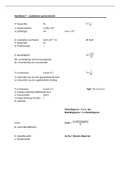
Hoofdstuk 7 – analytische spectrometrie
c
f= frequentie Hz f=
Y
c= (licht)snelheid 2,998 x 108
y= golflengte nm nm= x 10-9
h= constante van Planck 6,63 x 10⁻³⁴ J/s E= h x f
f= frequentie Hz
E= fotonenergie J
∆X
S= gevoeligheid S=
∆c
∆X= verandering van het meetsignaal
∆c= verandering van concentratie
I
T= transmissie tussen 0-1 T=
Io
I= intensiteit van het niet geadsorbeerde licht
I0= intensiteit van de ongehinderde straling
T= transmissie tussen 0-1 -logT = E = ε x c x l
ε= molaire extinctiecoëfficiënt(L/mol
c= concentratie mol/L
l= lengte lichtweg monster 1
E= extinctie
Detectiegrens = 3 x st. dev.
Bepalingsgrens = 3 x detectiegrens
3 x detectiegrens
Cmin= Cmin =
K
K= extinctiecoëfficiënt
S= spleetbreedte ∆s/∆y = lineaire dispersie
y= bandbreedte
c
f= frequentie Hz f=
Y
c= (licht)snelheid 2,998 x 108
y= golflengte nm nm= x 10-9
h= constante van Planck 6,63 x 10⁻³⁴ J/s E= h x f
f= frequentie Hz
E= fotonenergie J
∆X
S= gevoeligheid S=
∆c
∆X= verandering van het meetsignaal
∆c= verandering van concentratie
I
T= transmissie tussen 0-1 T=
Io
I= intensiteit van het niet geadsorbeerde licht
I0= intensiteit van de ongehinderde straling
T= transmissie tussen 0-1 -logT = E = ε x c x l
ε= molaire extinctiecoëfficiënt(L/mol
c= concentratie mol/L
l= lengte lichtweg monster 1
E= extinctie
Detectiegrens = 3 x st. dev.
Bepalingsgrens = 3 x detectiegrens
3 x detectiegrens
Cmin= Cmin =
K
K= extinctiecoëfficiënt
S= spleetbreedte ∆s/∆y = lineaire dispersie
y= bandbreedte