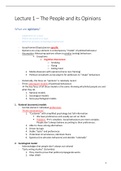
Lecture 1 – The People and its Opinions
What are opinions?
- Judgement on a issue
- Where we stand on a topic
- Based on previous knowledge/experiences
- Issue/moment/topic/person specific
- Opinions are a key element in contemporary “model” of political behaviour
- Assumption: Measuring opinions allows to predict (voting) behaviours
§ Exceptions:
• Cognitive dissonance:
o Smoking
o Flying
o Eating meat
• Media obsession with opinions (horse race framing)
• Political consultants as key players for politicians to “shape” behaviours
- Historically, the focus on “opinions” is relatively recent
- Three subsequent models of (political) behaviours
à The key focus of all these models is the same: Knowing who/what people are and
what they do.
1. Rational models
2. Sociological models
3. Socio-psychological models
1. Rational (economic) models
- Central element: individual preferences
- “Homo oeconomicus”
1. “Customer” with simplified psychology but full information
§ We have preferences and usually we act on them.
§ Problem: à It’s simplistic. Social behaviours are more complex.
People don’t always behave according to their preferences.
2. Able to chose among alternatives
3. Driven by logic
4. Stable “taste” and preferences
5. If identical circumstances, identical choice
6. Egoistical (no altruistic behaviors) and decides “rationally”
2. Sociological model
- Acknowledges that people don’t always act rational
- “Early voting studies” (Columbia)
1. They tried to prove that political propaganda works
2. After WWII
1
, § Something is missing:
à Historical importance of political persuasion
à Individuals do not necessary behave rationally
3. Lazasfeld et al. (1944). The People’s Choice: How the Voter Makes Up His
Mind in a Presidential Campaign
4. First systematic effort to study electoral behaviour and campaigns (1940
election, Roosevolt vs. Willkie)
5. First survey to representative sample (600 voters, Ohio), longitudinal
approach (panel), 7 waves
6. Goal: Show that propaganda works, beyond voters’ preferences
7. Surprising results:
§ Reinformed the importance of preferences
§ Preferences almost stable in time, very little (“minimal”) effect of
political communication
§ Key factor: individual values (“brand loyalties”), stable in time
• Social class (socio-economic level)
• Religious affiliation (and religiosity)
• Residence (urban vs. rural)!
o Just like with the referendum in Switzerland
8. Probable that results would be different now (in 2021), since there was no
priming back then (in 1944)
- Puzzle:
1. If preferences (values) are stable in time, how to explain fluctuations in
voting choices (aggregated, individuals)?
à Need for a more encompassing model, that considers:
§ The “stable” component of preferences (long term effects)
§ The “fluctuating” component of preferences (opinions) (short term
effects)
§ The effect of a changing account (this links the first two)
¯
3. Socio-psychological model / Michigan model (Campbell et al., 1960; The American
Voter)
- Builds on the premises of the Columbia model (importance of stable preferences to
shape behaviors)
- Adds a psychological perspective to account for short-term fluctuations
- Focus on three “behavioral dispositions” (building blocks)
1. Values (stable)
§ Stable forces that anchor and guide our vision of the world and
participate to who we are as individuals
§ (Columbia’s “brand loyalties”)
§ E.g. (Schwartz, 1992):
• Hedonism
• Conformism
• Spirituality
• Nationalism
• Feminism
2
, • Traditionalism
• Altruism
• (Minimalism)
2. Attitudes (stable-ish)
§ Preferences about important aspects of our life
§ Deep affect towards X, like/dislike, beliefs
§ E.g.
• Liking horror movies
• Climate activism
• Ideological position
o Left vs. right
o Free market
• Party identification
• Movies/music preferences
• Social attitudes
3. Opinions (unstable)
§ Ideas and perceptions about specific “objects”
§ Potentially unstable, fluctuations
§ Importance of contextual influences
§ E.g.
• Disliking one specific horror movie, even though you have a
positive attitude towards horror movies in general
Do opinions matter?
The “funnel of causality”
3
What are opinions?
- Judgement on a issue
- Where we stand on a topic
- Based on previous knowledge/experiences
- Issue/moment/topic/person specific
- Opinions are a key element in contemporary “model” of political behaviour
- Assumption: Measuring opinions allows to predict (voting) behaviours
§ Exceptions:
• Cognitive dissonance:
o Smoking
o Flying
o Eating meat
• Media obsession with opinions (horse race framing)
• Political consultants as key players for politicians to “shape” behaviours
- Historically, the focus on “opinions” is relatively recent
- Three subsequent models of (political) behaviours
à The key focus of all these models is the same: Knowing who/what people are and
what they do.
1. Rational models
2. Sociological models
3. Socio-psychological models
1. Rational (economic) models
- Central element: individual preferences
- “Homo oeconomicus”
1. “Customer” with simplified psychology but full information
§ We have preferences and usually we act on them.
§ Problem: à It’s simplistic. Social behaviours are more complex.
People don’t always behave according to their preferences.
2. Able to chose among alternatives
3. Driven by logic
4. Stable “taste” and preferences
5. If identical circumstances, identical choice
6. Egoistical (no altruistic behaviors) and decides “rationally”
2. Sociological model
- Acknowledges that people don’t always act rational
- “Early voting studies” (Columbia)
1. They tried to prove that political propaganda works
2. After WWII
1
, § Something is missing:
à Historical importance of political persuasion
à Individuals do not necessary behave rationally
3. Lazasfeld et al. (1944). The People’s Choice: How the Voter Makes Up His
Mind in a Presidential Campaign
4. First systematic effort to study electoral behaviour and campaigns (1940
election, Roosevolt vs. Willkie)
5. First survey to representative sample (600 voters, Ohio), longitudinal
approach (panel), 7 waves
6. Goal: Show that propaganda works, beyond voters’ preferences
7. Surprising results:
§ Reinformed the importance of preferences
§ Preferences almost stable in time, very little (“minimal”) effect of
political communication
§ Key factor: individual values (“brand loyalties”), stable in time
• Social class (socio-economic level)
• Religious affiliation (and religiosity)
• Residence (urban vs. rural)!
o Just like with the referendum in Switzerland
8. Probable that results would be different now (in 2021), since there was no
priming back then (in 1944)
- Puzzle:
1. If preferences (values) are stable in time, how to explain fluctuations in
voting choices (aggregated, individuals)?
à Need for a more encompassing model, that considers:
§ The “stable” component of preferences (long term effects)
§ The “fluctuating” component of preferences (opinions) (short term
effects)
§ The effect of a changing account (this links the first two)
¯
3. Socio-psychological model / Michigan model (Campbell et al., 1960; The American
Voter)
- Builds on the premises of the Columbia model (importance of stable preferences to
shape behaviors)
- Adds a psychological perspective to account for short-term fluctuations
- Focus on three “behavioral dispositions” (building blocks)
1. Values (stable)
§ Stable forces that anchor and guide our vision of the world and
participate to who we are as individuals
§ (Columbia’s “brand loyalties”)
§ E.g. (Schwartz, 1992):
• Hedonism
• Conformism
• Spirituality
• Nationalism
• Feminism
2
, • Traditionalism
• Altruism
• (Minimalism)
2. Attitudes (stable-ish)
§ Preferences about important aspects of our life
§ Deep affect towards X, like/dislike, beliefs
§ E.g.
• Liking horror movies
• Climate activism
• Ideological position
o Left vs. right
o Free market
• Party identification
• Movies/music preferences
• Social attitudes
3. Opinions (unstable)
§ Ideas and perceptions about specific “objects”
§ Potentially unstable, fluctuations
§ Importance of contextual influences
§ E.g.
• Disliking one specific horror movie, even though you have a
positive attitude towards horror movies in general
Do opinions matter?
The “funnel of causality”
3