

TDC Elferink – lecture 6
Multidisciplinary Longitudinal Studies: A Perspective from the Field of Sports
• development of performance can be analyzed through an observational longitudinal study
◦ give less information about causal relationship than with experiment
◦ higher relevance and power than cross-sectional observational studies
◦ advantage: possible to detect developments or changes in the characteristics of the target
population at both the group and the individual level → same variables are observed
repeatedly over long periods of time and can be correlated to an individual’s current
level of performance but also prospectively with expert level of performance in the
future
◦ disadvantage: take a long time, costly → not very feasible; hard to replicate
First Challenge: Define Expertise
• expert performance in sports defined as consistent superior athletic performance over an
extended period
• youth athlete’s performance improves with age which is related to improvement of
multidimensional performance characteristics (anthropocentric, physiological, technical,
tactical and psychological skills) → influenced by maturation, learning and training
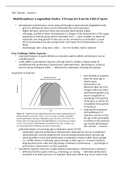
Acquisition of Expertise
• Not all fields of expertise
share the same age at
which expert
performances are
delivered, there are even
changes within one field
and between genders (e.g.
senior competition in
swimming 16 for girls &
18 for boys, in soccer 18,
in handball 20 for girls &
21 for boys)
• studying the acquisition
and maintenance of
expertise, one has to take
the age of the participants
in relation to the expected
age of peak performance
into account → trend of
peak performance at increasing age in endurance sports (20-39)
◦ explanation: physical performance characteristics important for success in endurance
sports generally increase progressively with increasing training history and thus age
◦ seems possible to reach peak performance in endurance events at either much younger
(i.e. middle distance swimming, speed skating) or older ages (i.e. ironman triathlon),
implying that factors other than physiology contribute to performance → psychological
performance characteristics are also important
• hard define expertise when not a single objective performance criterion (time or distance)
◦ difference between sports with (e.g. swimming, ice skating → individual performance
measured in seconds and task is to minimize time) and without (e.g. soccer where team
, TDC Elferink – lecture 6
performance measured in number of goals and is influenced by opponent →
performance rated subjectively by others) objective criterion for each participant
Maintaining Expertise
• differs how long athletes perform at expert level → consequence for choice of study
population & consequences for study design
• also at the top, an athlete continuously has to improve his performance to be able to compete
at the highest level of performance compared to other world-class athletes (e.g. Olympic
swimmer better than 4 years before when he won but now was only 5th place) → when
studying expertise, performance needs to be placed within context at all times
• inevitably performance will drop because of aging process → window to deliver expert
performance is limited
◦ not all performance characteristic decline at the same rate (e.g. in contrast to motor
performance, skilled perception appears resistant to age-related declines over time in
handball goalkeepers through the use of compensatory mechanisms)
◦ perceptual-motor task, relative age, playing position, and performance are suggested to
affect career length in professional sports
Second Challenge: Studying (the Development of) Performance and Performance
Characteristics
Specific Performance Characteristics
• recommended to include not only measures of performance in studies on acquiring
expertise, but variables underlying performance as well
◦ performance characteristics can be measured at specific moments in time (e.g. start and
end of soccer season)
• to a certain extent, compensation between performance characteristics is possible (e.g. found
in hockey study that skills of young players vary but they are still able to compensate for it
because for example, the speed of the game is lower compared to games with more
experienced players) → Longitudinal group studies showed that with increasing level of
performance, the group of athletes becomes more homogeneous in terms of their
performance characteristics, than all players need great motivation, interval endurance
capacity, and tactical skills in order to survive the selection
• retrospective study shows that hockey player rated multiple factors (psychological skills,
tactical, technical, physiological, anthropometric characteristics) as important to acquire and
maintain expertise, which highlights the relevance of considering the multidimensional
nature of expertise
• monitoring athletes over time seems inevitable when one aims to understand underlying
mechanisms related to acquiring and maintaining expertise
◦ development toward expert performance takes place during adolescence
◦ development of a sports career toward expert performance is not a linear process
◦ timing and tempo of maturation is related to an athlete’s performance development (e.g.
growth beneficial for hockey but not for gymnastics)
→ wise to measure and monitor an athlete’s multidimensional performance characteristics together
with his performance development over time
Studying General Performance Characteristics
• improvement of performance not only related to number of training hours but to large extent
to quality of it
• improvement of performance toward excellence starts with a young individual having some
ideas of the long-term goal to pursue (can also be vague)
Multidisciplinary Longitudinal Studies: A Perspective from the Field of Sports
• development of performance can be analyzed through an observational longitudinal study
◦ give less information about causal relationship than with experiment
◦ higher relevance and power than cross-sectional observational studies
◦ advantage: possible to detect developments or changes in the characteristics of the target
population at both the group and the individual level → same variables are observed
repeatedly over long periods of time and can be correlated to an individual’s current
level of performance but also prospectively with expert level of performance in the
future
◦ disadvantage: take a long time, costly → not very feasible; hard to replicate
First Challenge: Define Expertise
• expert performance in sports defined as consistent superior athletic performance over an
extended period
• youth athlete’s performance improves with age which is related to improvement of
multidimensional performance characteristics (anthropocentric, physiological, technical,
tactical and psychological skills) → influenced by maturation, learning and training
Acquisition of Expertise
• Not all fields of expertise
share the same age at
which expert
performances are
delivered, there are even
changes within one field
and between genders (e.g.
senior competition in
swimming 16 for girls &
18 for boys, in soccer 18,
in handball 20 for girls &
21 for boys)
• studying the acquisition
and maintenance of
expertise, one has to take
the age of the participants
in relation to the expected
age of peak performance
into account → trend of
peak performance at increasing age in endurance sports (20-39)
◦ explanation: physical performance characteristics important for success in endurance
sports generally increase progressively with increasing training history and thus age
◦ seems possible to reach peak performance in endurance events at either much younger
(i.e. middle distance swimming, speed skating) or older ages (i.e. ironman triathlon),
implying that factors other than physiology contribute to performance → psychological
performance characteristics are also important
• hard define expertise when not a single objective performance criterion (time or distance)
◦ difference between sports with (e.g. swimming, ice skating → individual performance
measured in seconds and task is to minimize time) and without (e.g. soccer where team
, TDC Elferink – lecture 6
performance measured in number of goals and is influenced by opponent →
performance rated subjectively by others) objective criterion for each participant
Maintaining Expertise
• differs how long athletes perform at expert level → consequence for choice of study
population & consequences for study design
• also at the top, an athlete continuously has to improve his performance to be able to compete
at the highest level of performance compared to other world-class athletes (e.g. Olympic
swimmer better than 4 years before when he won but now was only 5th place) → when
studying expertise, performance needs to be placed within context at all times
• inevitably performance will drop because of aging process → window to deliver expert
performance is limited
◦ not all performance characteristic decline at the same rate (e.g. in contrast to motor
performance, skilled perception appears resistant to age-related declines over time in
handball goalkeepers through the use of compensatory mechanisms)
◦ perceptual-motor task, relative age, playing position, and performance are suggested to
affect career length in professional sports
Second Challenge: Studying (the Development of) Performance and Performance
Characteristics
Specific Performance Characteristics
• recommended to include not only measures of performance in studies on acquiring
expertise, but variables underlying performance as well
◦ performance characteristics can be measured at specific moments in time (e.g. start and
end of soccer season)
• to a certain extent, compensation between performance characteristics is possible (e.g. found
in hockey study that skills of young players vary but they are still able to compensate for it
because for example, the speed of the game is lower compared to games with more
experienced players) → Longitudinal group studies showed that with increasing level of
performance, the group of athletes becomes more homogeneous in terms of their
performance characteristics, than all players need great motivation, interval endurance
capacity, and tactical skills in order to survive the selection
• retrospective study shows that hockey player rated multiple factors (psychological skills,
tactical, technical, physiological, anthropometric characteristics) as important to acquire and
maintain expertise, which highlights the relevance of considering the multidimensional
nature of expertise
• monitoring athletes over time seems inevitable when one aims to understand underlying
mechanisms related to acquiring and maintaining expertise
◦ development toward expert performance takes place during adolescence
◦ development of a sports career toward expert performance is not a linear process
◦ timing and tempo of maturation is related to an athlete’s performance development (e.g.
growth beneficial for hockey but not for gymnastics)
→ wise to measure and monitor an athlete’s multidimensional performance characteristics together
with his performance development over time
Studying General Performance Characteristics
• improvement of performance not only related to number of training hours but to large extent
to quality of it
• improvement of performance toward excellence starts with a young individual having some
ideas of the long-term goal to pursue (can also be vague)



