Lecture 1: Information
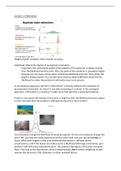
Height of peak: certainty. Place of peak: accuracy
Likelihood reflects the degree of perceptual uncertainty.
Important: the uncertainty (width of the graphs) of the posterior is always smaller
than the likelihood and the prior. Also, the peak of the posterior is somewhat higher
because you are more certain when combining likelihood and prior. Area under the
graph is always equal). You can add more sensory inputs (different senses) to the
likelihood to make the posterior (=estimate) even more precise.
In the Bayesian approach, the term “information” is directly linked to the reduction of
(perceptual) uncertainty. So, here it’s not about meaning or content. In the ecological
approach, information is a structure in optic array that specifies a particular property.
If there is erroneous information in the prior, it might be that the likelihood (sensory input)
is more accurate than the posterior. Although wrong, this is more certain!
Circumstances change the likelihood of visual perception. Do the circumstances change the
prior? No, you have the same experience of that same road, and your pre-knowledge is
equal. What does happen is that your likelihood distribution is affected by the
circumstances, and if the heavy rain makes up for a likelihood with large uncertainty, your
posterior will shift more towards the prior. The relative importance of the prior increases.
Note: only look at the distribution curves (mathematical), don’t involve weighting of both
systems (by the brain), CNS, attention, or other involved factors.
,The brain resolves ambiguities. Take the Ames Room, where the mind has prior “knowledge”
that the walls are at 90 degrees angles with each other. Your mind tries to make a 3D image
from a 2D picture/peephole. Apparently, the prior affects your perception, even though you
know that people can’t change size.
Bayesian approach: the illusion occurs because the prior affects the perception
Stimuli → information processing → perception
Ecological approach: there is no information processing needed for perception
How would they explain the optical illusion? → only the prior knowledge/expectation yields
this optical illusion. Your information is impoverished (limited through peephole), so what
you can see is not considered the full natural information, e.g. because you can’t change
your optic array to the how the information changes.
They say you should not stress this example too much, because it is not the natural
way of information gathering. It can only be used for information like occlusion, but
no 3D image.
Ecological: Information is in the ‘optic array’, the nervous system needs to pick up this
information by being sensitive to the structure of the light. No processing. The structure is
the way in which the environment reflects the light, which then falls into your eye. The
reflection patterns specify e.g. size, shade, colour, structure etc, which all carry information
towards the eye in a different way.
Affordance → based on what you can see, you decide what possibilities the environment
offer. Think of: this object is reachable, I can reach this lamp, I can sit on this chair, I can
catch that flying ball.
, Lecture 2: Sensorimotor loop
Re-afferent information → sensory information that stems from your own movement.
Efference copy → duplicate of the motor commands are sent to the brain (cerebellum). This
creates a forward dynamic model. The copy of the motor commands generate a prediction
of the resulting motor consequences.
Corollary discharge → Result of the forward sensory model which can be compared to the
real-world feedback (re-afferent information) to see difference between intended motor
action and actual sensory feedback. Motor commands are adjusted for the error.
Watch sensorimotor clip from 36:02 onwards
Inverse models have a desired outcome (e.g. movement, force, etc.) and from that point,
you generate the required motor command. Forward models have a motor command, and
don’t know yet what the outcome will be.
The feedforward error correction can compare desired outcome to predicted motor
results. This allows for quick adjustments (continuously tweaks the motor commands
while they are produced), without needing the sensory input and feedback.
Height of peak: certainty. Place of peak: accuracy
Likelihood reflects the degree of perceptual uncertainty.
Important: the uncertainty (width of the graphs) of the posterior is always smaller
than the likelihood and the prior. Also, the peak of the posterior is somewhat higher
because you are more certain when combining likelihood and prior. Area under the
graph is always equal). You can add more sensory inputs (different senses) to the
likelihood to make the posterior (=estimate) even more precise.
In the Bayesian approach, the term “information” is directly linked to the reduction of
(perceptual) uncertainty. So, here it’s not about meaning or content. In the ecological
approach, information is a structure in optic array that specifies a particular property.
If there is erroneous information in the prior, it might be that the likelihood (sensory input)
is more accurate than the posterior. Although wrong, this is more certain!
Circumstances change the likelihood of visual perception. Do the circumstances change the
prior? No, you have the same experience of that same road, and your pre-knowledge is
equal. What does happen is that your likelihood distribution is affected by the
circumstances, and if the heavy rain makes up for a likelihood with large uncertainty, your
posterior will shift more towards the prior. The relative importance of the prior increases.
Note: only look at the distribution curves (mathematical), don’t involve weighting of both
systems (by the brain), CNS, attention, or other involved factors.
,The brain resolves ambiguities. Take the Ames Room, where the mind has prior “knowledge”
that the walls are at 90 degrees angles with each other. Your mind tries to make a 3D image
from a 2D picture/peephole. Apparently, the prior affects your perception, even though you
know that people can’t change size.
Bayesian approach: the illusion occurs because the prior affects the perception
Stimuli → information processing → perception
Ecological approach: there is no information processing needed for perception
How would they explain the optical illusion? → only the prior knowledge/expectation yields
this optical illusion. Your information is impoverished (limited through peephole), so what
you can see is not considered the full natural information, e.g. because you can’t change
your optic array to the how the information changes.
They say you should not stress this example too much, because it is not the natural
way of information gathering. It can only be used for information like occlusion, but
no 3D image.
Ecological: Information is in the ‘optic array’, the nervous system needs to pick up this
information by being sensitive to the structure of the light. No processing. The structure is
the way in which the environment reflects the light, which then falls into your eye. The
reflection patterns specify e.g. size, shade, colour, structure etc, which all carry information
towards the eye in a different way.
Affordance → based on what you can see, you decide what possibilities the environment
offer. Think of: this object is reachable, I can reach this lamp, I can sit on this chair, I can
catch that flying ball.
, Lecture 2: Sensorimotor loop
Re-afferent information → sensory information that stems from your own movement.
Efference copy → duplicate of the motor commands are sent to the brain (cerebellum). This
creates a forward dynamic model. The copy of the motor commands generate a prediction
of the resulting motor consequences.
Corollary discharge → Result of the forward sensory model which can be compared to the
real-world feedback (re-afferent information) to see difference between intended motor
action and actual sensory feedback. Motor commands are adjusted for the error.
Watch sensorimotor clip from 36:02 onwards
Inverse models have a desired outcome (e.g. movement, force, etc.) and from that point,
you generate the required motor command. Forward models have a motor command, and
don’t know yet what the outcome will be.
The feedforward error correction can compare desired outcome to predicted motor
results. This allows for quick adjustments (continuously tweaks the motor commands
while they are produced), without needing the sensory input and feedback.