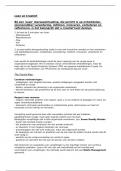
INTRODUCTION MAZA
Maza: History is what the present needs to know about the past.
Reason of studying Maza. You have been studying histography and getting an overview of the Academic of
History. Now you have an idea of approaches, topics, questions to be asked. Opened your eyes for all kinds of
topics and approaches that you did not think of. That you can study all kinds of topics. It gives you an idea what
you want to study in history.
Special about history as a discipline:
Less clear/sharp commonalities (=corresponding characteristics) than many other scientific disciplines.
Research object: history studies the past, but so do other disciplines.
No fixed set of skills.
No highly developed proprietary jargon (specialized language)
No fixed historical method (method depends on specialism)
Hybrid field (uses methods of social sciences & humanities, also crosses from academic to public)
History changes al the time (driven by concerns of the present)
Difference between past/history and historiography
Past can never be changed, but history is the ongoing discussion to explain the past and is open to change and
revision.
History is what we know of the past, it relies on the available evidence.
History as a discipline is about the study of the past.
Historiography is the study of how history is written.
History is about what happened and why.
Historiography is how what happened is curated and presented.
Historiography is how we decide what becomes history.
Is history an empirical science
Empirical science focusses on observing reality. This is not possible for historians, since historians study the
past and the past is gone. Historians may be able to observe the sources, but that is not the same. The work of
historians is therefore (re) construction work. Theory is rarely foregrounded in history. So in short:
Yes, it is an empirical science in the sense that is non-theoretical.
No, because the past no longer exists and can no longer be perceived or experienced.
(example: photo album is the past, no longer exists, holiday itself is history)
Conclusion: Is History an empirical science? Mwah, at best … according to Pieter Huistra, our teacher.
,History is ‘what the present needs to know about the past’ – what does Maza mean?
History is not fixed, it will change all the time. As the present changes, the questions we ask of the past change,
and so do answers. Examples:
Democracy leads to more social history
Second wave of feminism leads to women’s history
Women’s history leads to gender history
The explanation of her argument can be found in the article of Pieter Geyl, ‘The argument without end’, 1940.
(p15-16). Pieter Geyl explains in his book that we need to understand that when comparing a number of
representations of Napoleon as given by leading French historians striking differences will emerge. The greater
the political importance of an historical character the more impossible it is to see the past in a single,
communicable picture except from a personal point of view. When comparing the work of two historians,
especially living in different periods, it is hardly surprising that they will see any historical personality in the
same light. To the opinion of Geyl it is, that the nature of History is misunderstood when final conclusions are
expected, such are more likely to expect of other disciplines.
The use of Historiography:
1. To position your place in the discipline (when start a subject, you first need to know the work of other
historians, the historiography about the subject, in order to find your position)
2. Inspiration & Modesty (take examples learn from it, imitate, disapprove, find new ways)
3. A view on past cultures (a cultural element, acts as a mirror)
Historiography is coloured, why?
Historians are specialist in a certain area of history. Maza is a specialist in French history and is educated and
works in the US. So this colours her approach, by using examples she is familiar with (EU and N America), not
much examples of historians with an Asian, African or South American background in her book.
,CHAPTER 1 – THE HISTORY OF WHOM
History of great men
Focus on what great men do: war and politics.
Carries implicit assumptions
Expansion of the historical actors.
Qualitative change: ‘the practise of history itself and the questions historians ask are transformed and renewed
everytime a new set of actors lays claim to its past.
Whos history is written → Historical actors
Who is writing history → Historians
History of whom: The who has been enlarged. No longer the history of great men, but of all kinds of groups.
These new groups challenge the classic approach.
Classic approach: History of leaders(Kings, Military and Intellectual geniuses), Politic elites and state related
activity. The exceptional individuals are the ones who changed this
The History of Great men- traditional history is challenged by:
HISTORY OF…. The new fields of history, such as:
SOCIAL-WORKING CLASS-SLAVES- HISTORY OF REBELLIONS-GENDER-WOMEN-GAY&LESBIAN-SEXUALITY
Gamechangers:
EP Thompson – The Making of the English working class, 1963 (new social history, agency, a class for itself)
Harriet Beecher Stow – Uncle Tom’s cabin, 1852 (major influence on public view of slavery)
Eugene Genovese – Roll, Jordan, Roll: The world the slaves made, 1974 (landmark on agency of slaves)
Adam Smith In 1776, Adam Smith published The Wealth of Nations, probably the most influential book on
market economics ever written. Smith argued that by giving everyone freedom to produce and exchange goods
as they pleased (free trade) and opening the markets up to domestic and foreign competition, people's natural
self-interest would promote greater prosperity than with stringent government regulations.
Steve Jobs – non-traditional, creative innovator
Gerda Lerner – The creation of patriarchy,1986 (male dominance over women&children) (founders of women’s
history. In 1963 she taught ‘great women in American History’, first college course on wh)
Joan Scott – ‘Gender: A useful category of Historical Analysis’, 1988 (male and female histories are intertwined,
and cannot be reduced to stable biological sex differences. She is the first scholar to draw distinction between
biological sex and sociocultural gender. Gender is defined as the socially constructed roles and behaviours that
a society typically associates with males and females. ... One's identity as female or male or as neither entirely
female nor entirely male.)
Stonewall riots – 1969 Patrons of the Stonewall NYC, other Village lesbian and gay bars, and neighbourhood
street people fought back when the police became violent. The riots are widely considered a watershed event
that transformed the gay liberation movement and the twentieth-century fight for LGBT rights in the USA.
, Social History
History of the labour movement
Quantitative Social History
New Social History (EP Thomson)
New Social History:
- Class as a social cultural category
- The losers of history
- Enlargement of politics
E.P. Thompson – 1963, The making of the English working class
Edward Palmer Thompson 1924 – 1993) was an English historian, writer, socialist and peace campaigner. He is
probably best known today for his historical work on the radical movements in the late 18th and early 19th
centuries, in particular The Making of the English Working Class (1963).
His work is considered by some to have been among the most important contributions to labour history and
social history in the 20th century, with a global impact. Although Thompson left the Communist Party of Great
Britain, he remained committed to Marxist ideals.
E.P. Thompson was one of the most visionary and influential historians of the last century, acclaimed as the
innovator of “history from below”—the immersion in the many details of everyday life, particularly among the
working class, as a vital means of understanding the past and the patterns of history itself.
Agency:
Minorities did not suffer passively but people being able to take action against their circumstances. Freedom to
act upon their own will. Master of own faith.
Resistance & Agency
- Focus on the oppressed (riots, destroy harvest caused by to high prices for the pour)
- Returning dignity (groups who weren’t heard in the past and not found in history writing)
- Restoring agency (the room to manage their lives in their own way, micro resistance)
Restoring agency (not a neutral initiative, more about liberal individualism)
- Implications agency (acting individuals, social structures)
History in the private sphere
As Maza writes P35: The notion that the family is an arena free of power struggles may strike anyone who has
ever been a child, parent, or spouse as, at best, darkly hilarious. Indeed this assumption provoked rage in an
early generation of feminist historians whose work revolved around uncovering the origins of ‘patriarchy’.
History in the private sphere
- Women’s and gender history (gendered spheres, both are there)
- History of Sexuality
Maza: History is what the present needs to know about the past.
Reason of studying Maza. You have been studying histography and getting an overview of the Academic of
History. Now you have an idea of approaches, topics, questions to be asked. Opened your eyes for all kinds of
topics and approaches that you did not think of. That you can study all kinds of topics. It gives you an idea what
you want to study in history.
Special about history as a discipline:
Less clear/sharp commonalities (=corresponding characteristics) than many other scientific disciplines.
Research object: history studies the past, but so do other disciplines.
No fixed set of skills.
No highly developed proprietary jargon (specialized language)
No fixed historical method (method depends on specialism)
Hybrid field (uses methods of social sciences & humanities, also crosses from academic to public)
History changes al the time (driven by concerns of the present)
Difference between past/history and historiography
Past can never be changed, but history is the ongoing discussion to explain the past and is open to change and
revision.
History is what we know of the past, it relies on the available evidence.
History as a discipline is about the study of the past.
Historiography is the study of how history is written.
History is about what happened and why.
Historiography is how what happened is curated and presented.
Historiography is how we decide what becomes history.
Is history an empirical science
Empirical science focusses on observing reality. This is not possible for historians, since historians study the
past and the past is gone. Historians may be able to observe the sources, but that is not the same. The work of
historians is therefore (re) construction work. Theory is rarely foregrounded in history. So in short:
Yes, it is an empirical science in the sense that is non-theoretical.
No, because the past no longer exists and can no longer be perceived or experienced.
(example: photo album is the past, no longer exists, holiday itself is history)
Conclusion: Is History an empirical science? Mwah, at best … according to Pieter Huistra, our teacher.
,History is ‘what the present needs to know about the past’ – what does Maza mean?
History is not fixed, it will change all the time. As the present changes, the questions we ask of the past change,
and so do answers. Examples:
Democracy leads to more social history
Second wave of feminism leads to women’s history
Women’s history leads to gender history
The explanation of her argument can be found in the article of Pieter Geyl, ‘The argument without end’, 1940.
(p15-16). Pieter Geyl explains in his book that we need to understand that when comparing a number of
representations of Napoleon as given by leading French historians striking differences will emerge. The greater
the political importance of an historical character the more impossible it is to see the past in a single,
communicable picture except from a personal point of view. When comparing the work of two historians,
especially living in different periods, it is hardly surprising that they will see any historical personality in the
same light. To the opinion of Geyl it is, that the nature of History is misunderstood when final conclusions are
expected, such are more likely to expect of other disciplines.
The use of Historiography:
1. To position your place in the discipline (when start a subject, you first need to know the work of other
historians, the historiography about the subject, in order to find your position)
2. Inspiration & Modesty (take examples learn from it, imitate, disapprove, find new ways)
3. A view on past cultures (a cultural element, acts as a mirror)
Historiography is coloured, why?
Historians are specialist in a certain area of history. Maza is a specialist in French history and is educated and
works in the US. So this colours her approach, by using examples she is familiar with (EU and N America), not
much examples of historians with an Asian, African or South American background in her book.
,CHAPTER 1 – THE HISTORY OF WHOM
History of great men
Focus on what great men do: war and politics.
Carries implicit assumptions
Expansion of the historical actors.
Qualitative change: ‘the practise of history itself and the questions historians ask are transformed and renewed
everytime a new set of actors lays claim to its past.
Whos history is written → Historical actors
Who is writing history → Historians
History of whom: The who has been enlarged. No longer the history of great men, but of all kinds of groups.
These new groups challenge the classic approach.
Classic approach: History of leaders(Kings, Military and Intellectual geniuses), Politic elites and state related
activity. The exceptional individuals are the ones who changed this
The History of Great men- traditional history is challenged by:
HISTORY OF…. The new fields of history, such as:
SOCIAL-WORKING CLASS-SLAVES- HISTORY OF REBELLIONS-GENDER-WOMEN-GAY&LESBIAN-SEXUALITY
Gamechangers:
EP Thompson – The Making of the English working class, 1963 (new social history, agency, a class for itself)
Harriet Beecher Stow – Uncle Tom’s cabin, 1852 (major influence on public view of slavery)
Eugene Genovese – Roll, Jordan, Roll: The world the slaves made, 1974 (landmark on agency of slaves)
Adam Smith In 1776, Adam Smith published The Wealth of Nations, probably the most influential book on
market economics ever written. Smith argued that by giving everyone freedom to produce and exchange goods
as they pleased (free trade) and opening the markets up to domestic and foreign competition, people's natural
self-interest would promote greater prosperity than with stringent government regulations.
Steve Jobs – non-traditional, creative innovator
Gerda Lerner – The creation of patriarchy,1986 (male dominance over women&children) (founders of women’s
history. In 1963 she taught ‘great women in American History’, first college course on wh)
Joan Scott – ‘Gender: A useful category of Historical Analysis’, 1988 (male and female histories are intertwined,
and cannot be reduced to stable biological sex differences. She is the first scholar to draw distinction between
biological sex and sociocultural gender. Gender is defined as the socially constructed roles and behaviours that
a society typically associates with males and females. ... One's identity as female or male or as neither entirely
female nor entirely male.)
Stonewall riots – 1969 Patrons of the Stonewall NYC, other Village lesbian and gay bars, and neighbourhood
street people fought back when the police became violent. The riots are widely considered a watershed event
that transformed the gay liberation movement and the twentieth-century fight for LGBT rights in the USA.
, Social History
History of the labour movement
Quantitative Social History
New Social History (EP Thomson)
New Social History:
- Class as a social cultural category
- The losers of history
- Enlargement of politics
E.P. Thompson – 1963, The making of the English working class
Edward Palmer Thompson 1924 – 1993) was an English historian, writer, socialist and peace campaigner. He is
probably best known today for his historical work on the radical movements in the late 18th and early 19th
centuries, in particular The Making of the English Working Class (1963).
His work is considered by some to have been among the most important contributions to labour history and
social history in the 20th century, with a global impact. Although Thompson left the Communist Party of Great
Britain, he remained committed to Marxist ideals.
E.P. Thompson was one of the most visionary and influential historians of the last century, acclaimed as the
innovator of “history from below”—the immersion in the many details of everyday life, particularly among the
working class, as a vital means of understanding the past and the patterns of history itself.
Agency:
Minorities did not suffer passively but people being able to take action against their circumstances. Freedom to
act upon their own will. Master of own faith.
Resistance & Agency
- Focus on the oppressed (riots, destroy harvest caused by to high prices for the pour)
- Returning dignity (groups who weren’t heard in the past and not found in history writing)
- Restoring agency (the room to manage their lives in their own way, micro resistance)
Restoring agency (not a neutral initiative, more about liberal individualism)
- Implications agency (acting individuals, social structures)
History in the private sphere
As Maza writes P35: The notion that the family is an arena free of power struggles may strike anyone who has
ever been a child, parent, or spouse as, at best, darkly hilarious. Indeed this assumption provoked rage in an
early generation of feminist historians whose work revolved around uncovering the origins of ‘patriarchy’.
History in the private sphere
- Women’s and gender history (gendered spheres, both are there)
- History of Sexuality