P=PLATO
Plato- Socrates Pupil- was a rationalist- means we gain knowledge primarily
through reason
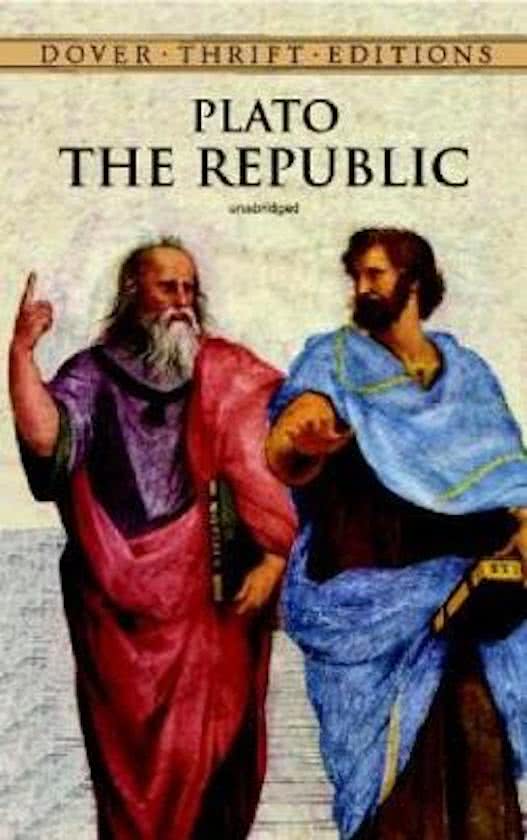
• Rapheael's ‘The School of Athens’ Painting 1509- Plato is gesturing upwards
showing he believes this world is an illusion - true reality belongs to the perfect idea
of the Good,Justice and so on which exist above the material world. He was a
dualist(believed in a higher and lower reality-everything is not as it seems).
Ultimate reality lies beyond the world of experience. In his book ‘Timaeus’ it
indicates his view of seeking beyond the day to day concerns of life to a heavenly
realm that would be achieved after death. (GOOD INTRODUCTION)
• His feet are in motion, one is in front of the other indicating how this world is
constantly in motion (flux) and changing. In contrast to unchanging, timeless and
eternal Forms which are outside time and space , representing perfection-
knowledge of the forms will have a lasting certainty
• Believed that empirical knowledge flawed- need to escape artificial world of sense
and use only a priori knowledge to know the truth.
• Forms for Plato are unchanging, timeless and eternal.
• A.N. Whitehead - ‘Modern Philosophy is a series of footnotes to Plato’- shows all
philosophy originated from Plato- v influential
Plato’s Theory of the Forms (definition of Forms= the essential nature of a
species or thing)
• For P, there is a crucial distinction between ideas and ideas expressed in reality
(i.e you recognize a cat because you know what a cat is)
1)P suggests that the knowledge of what a cat is precedes you actually seeing a cat
2) The world we live in is a world of appearances but the real world is a world of
ideas
• A Form is unchanging because it is a concept which is everlasting and so exists in
a different reality, serving as an archetype (example) from which later ideas and
models of the same thing are derived.
• P concern was understanding concepts such as beauty, truth, good etc. While a
person and a flower may reveal what beauty is, they are clearly not the whole
definition. Thus underlying these examples of beauty is the real Form of Beauty.
Plato believed that our knowledge if concepts such as beauty is innate, we possess
within our souls all knowledge already.
• Diotima’s ladder- the “ladder” represents the rung to contemplation of the Form of
Beauty itself. Diotima tells Socrates that if he ever reached the highest rung on the
ladder and contemplated the Form of Beauty, he would never again be seduced by
the physical attractions of beautiful youths. Nothing could make life more worth
living than enjoying this sort of vision. Because the Form of Beauty is perfect, it will
inspire perfect virtue in those who contemplate it. Evokes usefulness of forms in
everyday life.
• P argued it was through our immortal soul that we have a dim recollection of
observing these transcendent Forms, giving us a basic understanding of concepts
like truth or beauty without being taught it.
• Education is therefore a matter of recalling the world of Forms and is within us,
hidden by the incarnation of the soul in the body. Ppl do not learn new things,
rather learning is a process of understanding the reality of how things are. (When
acknowledging that lying is wrong, you are remembering the Form of truth that you
, soul knew before incarnation) When we are born we have a dim recollection of
what Forms are, because P argues that we have an immortal soul that observed
the Forms before being incarnated in a body. BUT Is learning really a matter of
remembering? For many learning concerns acquiring new knowledge- Peter
Geach argues this (see below)
• Most important Form is the Form of the Good. In this world of appearances we can
label things as good, but this does not tell us all that goodness is. In his analogy of
the sun P says that the FOTG makes things knowable and that is the source of
other Forms. HOWEVER ARISTOTLE CRITIQUE (see below)
• P believes society should be ruled by Philosopher Kings (they are the ones with
knowledge of the Forms), not democracy- argued in Book 6 of the republic that
need someone with expertise- ruling is a skill- deeper knowledge of reality than
others- elitist!!
Analogy of the Cave - uses the analogy to illustrate his theory of the Forms
and it is often said to be an allegorical story
• He appreciated the importance of explaining often-difficult concepts in a way that
could be readily understood. Plato represents the human epistemic condition and
the development of the philosopher by outlining a simile involving prisoners in a
cave looking at shadows on a wall and one of the prisoners, representing the
philosopher, is freed.
• P outlines his argument for 2 separate worlds in The Republic and other books. He
uses the AOTC to suggest that this world is one of shadows and darkness, of
APPEARANCES and things that we can see and touch,hear,smell etc are not
‘real.’ The real world is where the ideas, or the Forms of things exist. We see many
examples of things like chairs in this world, but we only know that they are chairs
because they resemble the Form a chair that exists in the realm of the Forms.
• Our world= material, illusion, opinions,perceived by senses,changeable,imperfect,
contingent,dependent on the sun
• World of the Forms= Spiritual, reality, knowledge, known by reason,unchanging,
Perfect, Universal Forms, Necessary, Dependent on the Form of the Good.
• Symbols- Prisoners chained in cave facing wall -Ppl trapped in a physical illusory
world imprisoned by temptations, desires etc and do not understand true
knowledge of the forms. Prisoners think the shadows are reality but they are only
appearances. There is also echoes and they take the voice of the people passing
to be coming from the shadows. Plato says situation is similar to ours, in that ppl do
not see the forms clearly but just an illusory world. Physical world imprisons ppl
from seeing the Forms and just like the prisoners in the cave we need to be set
free.
• PPl holding up statues behind the trapped prisoners; hold these above fire and the
fire casts shadows of these on the back wall-Ppl seeing shadows mistake them as
real things. Images are just copies of the true reality of the Forms. These ppl shape
the prisoners views because they can only see the shadows, unaware of events
taking place behind them. Ppl holding up the objects are also stuck in this world
and misleading ppl into accepting this world as the place of reality (this could be P
criticizing the philosophers and politicians who do not pay attention to the realm of
the Forms)In addition Robin Waterfield suggests that the prisoners being attracted
to the shadows from the fire- light rather than the real world above represent the
way in which culture, tradition and upbringing limit people’s ability to see the world
in a way other than how they were brought up.
Plato- Socrates Pupil- was a rationalist- means we gain knowledge primarily
through reason
• Rapheael's ‘The School of Athens’ Painting 1509- Plato is gesturing upwards
showing he believes this world is an illusion - true reality belongs to the perfect idea
of the Good,Justice and so on which exist above the material world. He was a
dualist(believed in a higher and lower reality-everything is not as it seems).
Ultimate reality lies beyond the world of experience. In his book ‘Timaeus’ it
indicates his view of seeking beyond the day to day concerns of life to a heavenly
realm that would be achieved after death. (GOOD INTRODUCTION)
• His feet are in motion, one is in front of the other indicating how this world is
constantly in motion (flux) and changing. In contrast to unchanging, timeless and
eternal Forms which are outside time and space , representing perfection-
knowledge of the forms will have a lasting certainty
• Believed that empirical knowledge flawed- need to escape artificial world of sense
and use only a priori knowledge to know the truth.
• Forms for Plato are unchanging, timeless and eternal.
• A.N. Whitehead - ‘Modern Philosophy is a series of footnotes to Plato’- shows all
philosophy originated from Plato- v influential
Plato’s Theory of the Forms (definition of Forms= the essential nature of a
species or thing)
• For P, there is a crucial distinction between ideas and ideas expressed in reality
(i.e you recognize a cat because you know what a cat is)
1)P suggests that the knowledge of what a cat is precedes you actually seeing a cat
2) The world we live in is a world of appearances but the real world is a world of
ideas
• A Form is unchanging because it is a concept which is everlasting and so exists in
a different reality, serving as an archetype (example) from which later ideas and
models of the same thing are derived.
• P concern was understanding concepts such as beauty, truth, good etc. While a
person and a flower may reveal what beauty is, they are clearly not the whole
definition. Thus underlying these examples of beauty is the real Form of Beauty.
Plato believed that our knowledge if concepts such as beauty is innate, we possess
within our souls all knowledge already.
• Diotima’s ladder- the “ladder” represents the rung to contemplation of the Form of
Beauty itself. Diotima tells Socrates that if he ever reached the highest rung on the
ladder and contemplated the Form of Beauty, he would never again be seduced by
the physical attractions of beautiful youths. Nothing could make life more worth
living than enjoying this sort of vision. Because the Form of Beauty is perfect, it will
inspire perfect virtue in those who contemplate it. Evokes usefulness of forms in
everyday life.
• P argued it was through our immortal soul that we have a dim recollection of
observing these transcendent Forms, giving us a basic understanding of concepts
like truth or beauty without being taught it.
• Education is therefore a matter of recalling the world of Forms and is within us,
hidden by the incarnation of the soul in the body. Ppl do not learn new things,
rather learning is a process of understanding the reality of how things are. (When
acknowledging that lying is wrong, you are remembering the Form of truth that you
, soul knew before incarnation) When we are born we have a dim recollection of
what Forms are, because P argues that we have an immortal soul that observed
the Forms before being incarnated in a body. BUT Is learning really a matter of
remembering? For many learning concerns acquiring new knowledge- Peter
Geach argues this (see below)
• Most important Form is the Form of the Good. In this world of appearances we can
label things as good, but this does not tell us all that goodness is. In his analogy of
the sun P says that the FOTG makes things knowable and that is the source of
other Forms. HOWEVER ARISTOTLE CRITIQUE (see below)
• P believes society should be ruled by Philosopher Kings (they are the ones with
knowledge of the Forms), not democracy- argued in Book 6 of the republic that
need someone with expertise- ruling is a skill- deeper knowledge of reality than
others- elitist!!
Analogy of the Cave - uses the analogy to illustrate his theory of the Forms
and it is often said to be an allegorical story
• He appreciated the importance of explaining often-difficult concepts in a way that
could be readily understood. Plato represents the human epistemic condition and
the development of the philosopher by outlining a simile involving prisoners in a
cave looking at shadows on a wall and one of the prisoners, representing the
philosopher, is freed.
• P outlines his argument for 2 separate worlds in The Republic and other books. He
uses the AOTC to suggest that this world is one of shadows and darkness, of
APPEARANCES and things that we can see and touch,hear,smell etc are not
‘real.’ The real world is where the ideas, or the Forms of things exist. We see many
examples of things like chairs in this world, but we only know that they are chairs
because they resemble the Form a chair that exists in the realm of the Forms.
• Our world= material, illusion, opinions,perceived by senses,changeable,imperfect,
contingent,dependent on the sun
• World of the Forms= Spiritual, reality, knowledge, known by reason,unchanging,
Perfect, Universal Forms, Necessary, Dependent on the Form of the Good.
• Symbols- Prisoners chained in cave facing wall -Ppl trapped in a physical illusory
world imprisoned by temptations, desires etc and do not understand true
knowledge of the forms. Prisoners think the shadows are reality but they are only
appearances. There is also echoes and they take the voice of the people passing
to be coming from the shadows. Plato says situation is similar to ours, in that ppl do
not see the forms clearly but just an illusory world. Physical world imprisons ppl
from seeing the Forms and just like the prisoners in the cave we need to be set
free.
• PPl holding up statues behind the trapped prisoners; hold these above fire and the
fire casts shadows of these on the back wall-Ppl seeing shadows mistake them as
real things. Images are just copies of the true reality of the Forms. These ppl shape
the prisoners views because they can only see the shadows, unaware of events
taking place behind them. Ppl holding up the objects are also stuck in this world
and misleading ppl into accepting this world as the place of reality (this could be P
criticizing the philosophers and politicians who do not pay attention to the realm of
the Forms)In addition Robin Waterfield suggests that the prisoners being attracted
to the shadows from the fire- light rather than the real world above represent the
way in which culture, tradition and upbringing limit people’s ability to see the world
in a way other than how they were brought up.