Summary Organizational Theory, Design and Change
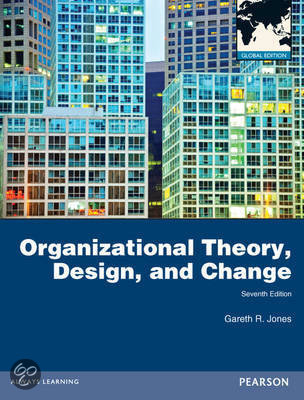
By Gareth R. Jones
The 7th Edition
Part 1: The Organization and Its Environment
• Chapter 1 Organizations and Organizational Effectiveness
• Chapter 2 Stakeholders, Managers and Ethics
• Chapter 3 Organizing in a Changing Global Environment
Part 2: Organizational Design
• Chapter 4 Basic Challenges of Organizational Design
• Chapter 5 Designing Organizational Structure: Authority and Control
• Chapter 6 Designing Organizational Structure: Specialization and Coordination
• Chapter 7 Creating and Managing Organizational Culture
• Chapter 8 Organizational Design and Strategy in Changing Global Environment
• Chapter 9 Organizational Design, Competences, and Technology
Part 3: Organizational Change
• Chapter 10 Types and Forms of Organizational Change
• Chapter 11 Organizational Transformations: Birth, Growth, Decline, and Death
• Chapter 12 Decision Making, Learning, Knowledge Management, and Information
Technology
• Chapter 13 Innovation, Intrapreneurship, and Creativity
• Chapter 14 Managing Conflict, Power and Politics
Page 1 of 91
,Part 1: The Organization and Its Environment
Chapter 1. Organizations and Organizational Effectiveness
What is an Organization?
Grouping people and other resources to produce goods and services is the essence of organ-
izing and of what an on organization does.
® Organization: A tool people use to coordinate their actions to obtain something they
desire or value.
An organization is a response to and a means of satisfying some human need. New organiza-
tions are spawned when new technologies become available and new needs are discovered
and organizations die or are transformed when the needs they satisfied are no longer important.
Sometimes an individual or a few people believe they possess the necessary skills and
knowledge and set up an organization to produce goods and services. Sometimes several peo-
ple form a group to respond to a perceived need by creating an organization.
® Entrepreneurship: The process by which people recognize opportunities to satisfy
needs and then gather and use resources to meet those needs.
Figure 1.1
How Does an Organizations Create Value?
The way in which an organization creates value is
depicted in Figure 1.1.
® Organizational Environment: The set of
forces and conditions that operate beyond
an organization’s boundaries but affect its
ability to acquire and use resources to cre-
ate value.
The way the organization uses human resources
and technology to transform inputs into outputs de-
termines how much value is created at the conver-
sion stage. The amount of value the organization
creates is a function of the quality of its skills, in-
cluding its ability to learn form and respond to the
environment.
Why Do Organizations Exist?
1. To Increase Specialization and the Division of
Labor
The collective nature of organizations allows individuals to focus on a narrow area of expertise,
which allows them to become more skilled or specialized at what they do.
2. To Use Large-Scale Technology
Organizations are able to take advantage of the economies of scale and scope that result from
the use of modern automated and computerized technology.
® Economies of scale: Cost savings that result when goods and services are produced in
large volume on automated production lines.
® Economies of scope: Cost savings that result when an organization is able to sue un-
derutilized resources more effectively because they can be shared across different
products or tasks.
Page 2 of 91
,3. To Manage the Organizational Environment
An organization’s environment is the source of valuable input resources and is the marketplace
into which it releases outputs. Managing complex environments is a task beyond the abilities of
most individuals, but an organization has the resources to develop specialists to anticipate or
attempt to influence the many pressures from the environment. This specialization allows the
organization to create more value for the organization, its members and its customers. There-
fore, the need to spot emerging trends and changes is high so that they can respond to chang-
ing customer needs, otherwise an organization will not survive.
4. To Economize on Transaction Costs
Organization’s ability to control the exchanges between people reduces the transaction costs
associated with these exchanges.
® Transactions costs: The costs associated with negotiating, monitoring, and governing
exchanges between people.
5. To Exert Power and Control
Organizations can exert great pressure on individuals to conform to task and production re-
quirements in order to increase production efficiency. In order to do so, organizations can use
employment, promotion, and increased rewards to exert power over individuals.
Organizational Theory, Design, and Change
® Organizational theory: The study of how organizations function and how they affect and
are affected by the environment in which they operate.
Figure 2.2
Page 3 of 91
, Organizational Structure
® Organizational structure: The formal system of task and authority relationships that con-
trol how people coordinate their actions and use resources to achieve organizational
goals.
For any organization, an appropriate structure is one that facilitates effective responses to prob-
lems of coordination and motivation – problems that can arise for any number of environmental,
technological, or human reasons. Organizational structure can be managed through the process
of organization design and change.
Organizational Culture
® Organizational Culture: The set of shared values and norms that controls organizational
members’ interactions with each other and with suppliers, customers, and other people
outside the organization.
An organization’s culture is shaped by the people inside the organization, by the ethics of the
organization, by the employment rights given to employees, and by the type of structure used
by the organization. The cultures of organizations that provide essentially the same goods and
services can be very different. Like organizational structure, organizational culture evolves and
can be managed through organizational design and change.
Organizational Design and Change
® Organizational design: The process by which managers select and manage aspects of
structure and culture so that an organization can control the activities necessary to
achieve its goals.
Organizational structure and culture are the means the organization uses to achieve its goals:
organizational design is about how and why various means are chosen.
® Organizational change: The process by which organizations redesign their structures
and cultures to move from their present state to some desired future state to increase
their effectiveness.
The goal of organizational change is to find new or improved ways of using resources and ca-
pabilities to increase an organization’s ability to create value, and hence its performance. As
organizations grow, their structure and culture are constantly evolving, changing, and becoming
more complex.
The Importance of Organizational Design and Change
Today, as never before, managers are searching for new and better ways to coordinate and
motivate their employees to increase the value their organizations can create. Organizational
design and change have important implications for a company’s ability to deal with (1) contin-
gencies, (2) achieve a competitive advantage, (3) manage diversity effectively, and (4) increase
its efficiency and ability to innovate.
1. Dealing with contingencies
® Contingency: An event that might occur and must be planned for (such as changing
environment pressures).
The design of an organizations determines how effectively an organization is able to respond
to various pressures in its environment and so obtains scarce resources. One part of the organ-
izational environment that is becoming more important and more complex is the global environ-
ment. Organizational design is important in a global context because to become a global com-
petitor, a company often needs to create a new structure and culture. Changing technology is
Page 4 of 91
By Gareth R. Jones
The 7th Edition
Part 1: The Organization and Its Environment
• Chapter 1 Organizations and Organizational Effectiveness
• Chapter 2 Stakeholders, Managers and Ethics
• Chapter 3 Organizing in a Changing Global Environment
Part 2: Organizational Design
• Chapter 4 Basic Challenges of Organizational Design
• Chapter 5 Designing Organizational Structure: Authority and Control
• Chapter 6 Designing Organizational Structure: Specialization and Coordination
• Chapter 7 Creating and Managing Organizational Culture
• Chapter 8 Organizational Design and Strategy in Changing Global Environment
• Chapter 9 Organizational Design, Competences, and Technology
Part 3: Organizational Change
• Chapter 10 Types and Forms of Organizational Change
• Chapter 11 Organizational Transformations: Birth, Growth, Decline, and Death
• Chapter 12 Decision Making, Learning, Knowledge Management, and Information
Technology
• Chapter 13 Innovation, Intrapreneurship, and Creativity
• Chapter 14 Managing Conflict, Power and Politics
Page 1 of 91
,Part 1: The Organization and Its Environment
Chapter 1. Organizations and Organizational Effectiveness
What is an Organization?
Grouping people and other resources to produce goods and services is the essence of organ-
izing and of what an on organization does.
® Organization: A tool people use to coordinate their actions to obtain something they
desire or value.
An organization is a response to and a means of satisfying some human need. New organiza-
tions are spawned when new technologies become available and new needs are discovered
and organizations die or are transformed when the needs they satisfied are no longer important.
Sometimes an individual or a few people believe they possess the necessary skills and
knowledge and set up an organization to produce goods and services. Sometimes several peo-
ple form a group to respond to a perceived need by creating an organization.
® Entrepreneurship: The process by which people recognize opportunities to satisfy
needs and then gather and use resources to meet those needs.
Figure 1.1
How Does an Organizations Create Value?
The way in which an organization creates value is
depicted in Figure 1.1.
® Organizational Environment: The set of
forces and conditions that operate beyond
an organization’s boundaries but affect its
ability to acquire and use resources to cre-
ate value.
The way the organization uses human resources
and technology to transform inputs into outputs de-
termines how much value is created at the conver-
sion stage. The amount of value the organization
creates is a function of the quality of its skills, in-
cluding its ability to learn form and respond to the
environment.
Why Do Organizations Exist?
1. To Increase Specialization and the Division of
Labor
The collective nature of organizations allows individuals to focus on a narrow area of expertise,
which allows them to become more skilled or specialized at what they do.
2. To Use Large-Scale Technology
Organizations are able to take advantage of the economies of scale and scope that result from
the use of modern automated and computerized technology.
® Economies of scale: Cost savings that result when goods and services are produced in
large volume on automated production lines.
® Economies of scope: Cost savings that result when an organization is able to sue un-
derutilized resources more effectively because they can be shared across different
products or tasks.
Page 2 of 91
,3. To Manage the Organizational Environment
An organization’s environment is the source of valuable input resources and is the marketplace
into which it releases outputs. Managing complex environments is a task beyond the abilities of
most individuals, but an organization has the resources to develop specialists to anticipate or
attempt to influence the many pressures from the environment. This specialization allows the
organization to create more value for the organization, its members and its customers. There-
fore, the need to spot emerging trends and changes is high so that they can respond to chang-
ing customer needs, otherwise an organization will not survive.
4. To Economize on Transaction Costs
Organization’s ability to control the exchanges between people reduces the transaction costs
associated with these exchanges.
® Transactions costs: The costs associated with negotiating, monitoring, and governing
exchanges between people.
5. To Exert Power and Control
Organizations can exert great pressure on individuals to conform to task and production re-
quirements in order to increase production efficiency. In order to do so, organizations can use
employment, promotion, and increased rewards to exert power over individuals.
Organizational Theory, Design, and Change
® Organizational theory: The study of how organizations function and how they affect and
are affected by the environment in which they operate.
Figure 2.2
Page 3 of 91
, Organizational Structure
® Organizational structure: The formal system of task and authority relationships that con-
trol how people coordinate their actions and use resources to achieve organizational
goals.
For any organization, an appropriate structure is one that facilitates effective responses to prob-
lems of coordination and motivation – problems that can arise for any number of environmental,
technological, or human reasons. Organizational structure can be managed through the process
of organization design and change.
Organizational Culture
® Organizational Culture: The set of shared values and norms that controls organizational
members’ interactions with each other and with suppliers, customers, and other people
outside the organization.
An organization’s culture is shaped by the people inside the organization, by the ethics of the
organization, by the employment rights given to employees, and by the type of structure used
by the organization. The cultures of organizations that provide essentially the same goods and
services can be very different. Like organizational structure, organizational culture evolves and
can be managed through organizational design and change.
Organizational Design and Change
® Organizational design: The process by which managers select and manage aspects of
structure and culture so that an organization can control the activities necessary to
achieve its goals.
Organizational structure and culture are the means the organization uses to achieve its goals:
organizational design is about how and why various means are chosen.
® Organizational change: The process by which organizations redesign their structures
and cultures to move from their present state to some desired future state to increase
their effectiveness.
The goal of organizational change is to find new or improved ways of using resources and ca-
pabilities to increase an organization’s ability to create value, and hence its performance. As
organizations grow, their structure and culture are constantly evolving, changing, and becoming
more complex.
The Importance of Organizational Design and Change
Today, as never before, managers are searching for new and better ways to coordinate and
motivate their employees to increase the value their organizations can create. Organizational
design and change have important implications for a company’s ability to deal with (1) contin-
gencies, (2) achieve a competitive advantage, (3) manage diversity effectively, and (4) increase
its efficiency and ability to innovate.
1. Dealing with contingencies
® Contingency: An event that might occur and must be planned for (such as changing
environment pressures).
The design of an organizations determines how effectively an organization is able to respond
to various pressures in its environment and so obtains scarce resources. One part of the organ-
izational environment that is becoming more important and more complex is the global environ-
ment. Organizational design is important in a global context because to become a global com-
petitor, a company often needs to create a new structure and culture. Changing technology is
Page 4 of 91