OPM H9 Inventory Management
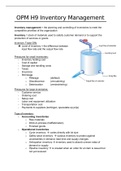
Inventory management = the planning and controlling of inventories to meet the
competitive priorities of the organization
Inventory = stock of materials used to satisfy customer demand or to support the
production of services or goods
Inventory Trade-Offs
Level of inventory = the difference between
input flow rate and the output flow rate
Pressures for small inventories:
- Inventory holding cost
- Cost of capital
- Storage and handling costs
- Taxes
- Insurance
- Shrinkage
o Pilferage (diefstal)
o Obsolescence (veroudering)
o Deterioration (verslechtering)
Pressures for large inventories:
- Customer service
- Ordering cost
- Setup cost
- Labor and equipment utilization
- Transportation cost
- Payments to suppliers (kortingen, speculatie op prijs)
Type of inventory:
- Accounting inventories
o Raw materials
o Work-in-process (halffabricaten)
o Finished goods
- Operational inventories
o Cycle inventory varies directly with lot size
o Safety stock inventory surplus inventory to protect against
uncertainties in demand, lead time and supply changes
o Anticipation inventory inventory used to absorb uneven rates of
demand or supply
o Pipeline inventory is created when an order for an item is issued but
not yet received
, Lot sizing principles:
- Cycle inventory
o The lot size Q, varies directly with the elapsed time between orders
o The longer the time between order for a given item, the greater the
cycle inventory must be
o At the beginning of the interval, the cycle inventory is at its maximum =
Q.
o At the end of the interval, just before new lots arrive, the inventory drop
to its minimum 0.
o Average cycle inventory = the average amount of inventory a
business needs to meet the customer demand between the time it
orders more inventory form its suppliers/ production
Average cycle inventory = Q + = Q / 2
- Pipeline inventory
o Average demand during lead time =
o Average demand for the items per period =
o Number of periods in the item’s lead time = L
Pipeline inventory =
Inventory reduction tactics:
- Cycle inventory
o Reduce lot size
Reduce ordering and setup cost and allow Q to be reduced
Increase repeatability to eliminate the need for changeovers
Repeatability = the degree to which the same work can
be done
- Safety stock inventory
o Place orders closer to the time when they must be received
Improve demand forecasts
Cut lead times
Reduce supply uncertainties
Rely more on equipment and labor buffers
- Anticipation inventory
o Match demand rate with production rates
Add new products with different demand cycles
Provide off-season promotional campaigns
Offer seasonal pricings plans
- Pipeline inventory
o Reduce lead times
Find more responsive suppliers and select new carriers
Change Q in those cases where the lead time depends on the lot
size
Inventory management = the planning and controlling of inventories to meet the
competitive priorities of the organization
Inventory = stock of materials used to satisfy customer demand or to support the
production of services or goods
Inventory Trade-Offs
Level of inventory = the difference between
input flow rate and the output flow rate
Pressures for small inventories:
- Inventory holding cost
- Cost of capital
- Storage and handling costs
- Taxes
- Insurance
- Shrinkage
o Pilferage (diefstal)
o Obsolescence (veroudering)
o Deterioration (verslechtering)
Pressures for large inventories:
- Customer service
- Ordering cost
- Setup cost
- Labor and equipment utilization
- Transportation cost
- Payments to suppliers (kortingen, speculatie op prijs)
Type of inventory:
- Accounting inventories
o Raw materials
o Work-in-process (halffabricaten)
o Finished goods
- Operational inventories
o Cycle inventory varies directly with lot size
o Safety stock inventory surplus inventory to protect against
uncertainties in demand, lead time and supply changes
o Anticipation inventory inventory used to absorb uneven rates of
demand or supply
o Pipeline inventory is created when an order for an item is issued but
not yet received
, Lot sizing principles:
- Cycle inventory
o The lot size Q, varies directly with the elapsed time between orders
o The longer the time between order for a given item, the greater the
cycle inventory must be
o At the beginning of the interval, the cycle inventory is at its maximum =
Q.
o At the end of the interval, just before new lots arrive, the inventory drop
to its minimum 0.
o Average cycle inventory = the average amount of inventory a
business needs to meet the customer demand between the time it
orders more inventory form its suppliers/ production
Average cycle inventory = Q + = Q / 2
- Pipeline inventory
o Average demand during lead time =
o Average demand for the items per period =
o Number of periods in the item’s lead time = L
Pipeline inventory =
Inventory reduction tactics:
- Cycle inventory
o Reduce lot size
Reduce ordering and setup cost and allow Q to be reduced
Increase repeatability to eliminate the need for changeovers
Repeatability = the degree to which the same work can
be done
- Safety stock inventory
o Place orders closer to the time when they must be received
Improve demand forecasts
Cut lead times
Reduce supply uncertainties
Rely more on equipment and labor buffers
- Anticipation inventory
o Match demand rate with production rates
Add new products with different demand cycles
Provide off-season promotional campaigns
Offer seasonal pricings plans
- Pipeline inventory
o Reduce lead times
Find more responsive suppliers and select new carriers
Change Q in those cases where the lead time depends on the lot
size