ECON0007: The World Economy Notes
Globalisation: Reduction in the costs of doing business internationally, including moving goods, firms, people and
capital across countries.
● 4 Aspects:
○ Goods (international trade)
○ Finance (movement of money over borders)
○ Firms (important driver of globalisation)
○ People (immigration)
1) First globalisation: Victorian globalisation
2) Decline between WW1 and WW2
3) Flexible globalisation
4) Hyper-globalisation (1980-Now): Huge acceleration of trade
integration between countries:
● Rise of outsourcing and global value chains
o Rise of global production chains
▪ E.g. each part of an iPhone is likely to have been produced
in a different country.
o Total GDP has doubled while total value of exports of goods
and services has increased fivefold.
▪ Indicates internationalisation of production
● Creation of WTO
● Liberalisation of trade:
o Countries have deliberately lowered tariffs
o Both in high and low- and middle-income countries
● Liberalisation of financial flows
o Countries more open to inflows of money
● Free movement of firms across borders
o Multinational firms have found it easier to move across
borders
● Restriction on migration
o While all other aspects have become more mobile, ‘People’ have not gained this increase in mobility
Consequences?
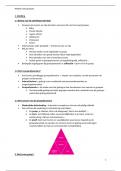
,Types of trade:
The most important factors in the increase in trade:
● Liberalisation of Trade
○ Formation of the World Trade Organisation and the global shift in manufacturing to newly emerging
economies.
● Technological Advancements
○ Internet – more and better information on consumption side, helps firms organise production
● Container Box
○ Greatly reduced the expense of international trade and increased its speed
, Theory of absolute advantage:
● Absolute advantage refers to a country’s ability to produce a good or service with fewer real resources or
inputs than another country. Free trade enables countries/firms to specialise in production of goods in which
they have an absolute price advantage/cost advantage
o Suppose we consider two countries V and J, and assume we have just one resource - labour. The amount
of labour used to produce a unit of rice in country V is x, and in Country J it is y. The principle of absolute
advantage states that if x < y, then Country V has an absolute advantage in the production of rice relative
to Country J.
▪ Therefore, Country V should export rice to Country J, and Country J should import rice from
Country V.
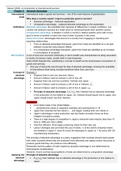
o Shown in a supply and demand model:
▪ Country V has better technology in producing
rice than Country J and thus uses less labour per
unit of output than Country J
▪ The two prices PV and PJ are autarky prices – a
situation of no trade.
▪ PW indicates the world price of rice which lies
between PV and PJ , at this price:
● EV is the amount by which quantity
supplied exceeds quantity demanded and constitutes Country Vs
exports of rice
● ZJ is the amount by which quantity demanded exceeds quantity supplied and
constitutes Country Js imports of rice
o Gains from Trade
▪ In Country V: Producers have gained A + B, while Consumers have lost Area A
● Net welfare increase of Area B
▪ In Country J: Consumers have gained C + D, while Producers have lost Area C
● Net welfare increase of Area D
Assumptions of the absolute advantage model
● The only factor of production is labour (no capital or land)
● Consumer preferences is the same in the two countries (composition of their consumption basket is the
same) - difference in price is not shaped by this, shown by same demand curve
● Perfect competition in the market (so constant returns to scale) - Prices are therefore based only on COP
● No transportation costs
● No transaction costs - These interfere with COP and would distort price advantages
● Exchange rates are stable and fixed
● No government interference in prices
● Complete factor mobility across sectors (labour can effortlessly go to the exporting sector with the same
efficiency)
Globalisation: Reduction in the costs of doing business internationally, including moving goods, firms, people and
capital across countries.
● 4 Aspects:
○ Goods (international trade)
○ Finance (movement of money over borders)
○ Firms (important driver of globalisation)
○ People (immigration)
1) First globalisation: Victorian globalisation
2) Decline between WW1 and WW2
3) Flexible globalisation
4) Hyper-globalisation (1980-Now): Huge acceleration of trade
integration between countries:
● Rise of outsourcing and global value chains
o Rise of global production chains
▪ E.g. each part of an iPhone is likely to have been produced
in a different country.
o Total GDP has doubled while total value of exports of goods
and services has increased fivefold.
▪ Indicates internationalisation of production
● Creation of WTO
● Liberalisation of trade:
o Countries have deliberately lowered tariffs
o Both in high and low- and middle-income countries
● Liberalisation of financial flows
o Countries more open to inflows of money
● Free movement of firms across borders
o Multinational firms have found it easier to move across
borders
● Restriction on migration
o While all other aspects have become more mobile, ‘People’ have not gained this increase in mobility
Consequences?
,Types of trade:
The most important factors in the increase in trade:
● Liberalisation of Trade
○ Formation of the World Trade Organisation and the global shift in manufacturing to newly emerging
economies.
● Technological Advancements
○ Internet – more and better information on consumption side, helps firms organise production
● Container Box
○ Greatly reduced the expense of international trade and increased its speed
, Theory of absolute advantage:
● Absolute advantage refers to a country’s ability to produce a good or service with fewer real resources or
inputs than another country. Free trade enables countries/firms to specialise in production of goods in which
they have an absolute price advantage/cost advantage
o Suppose we consider two countries V and J, and assume we have just one resource - labour. The amount
of labour used to produce a unit of rice in country V is x, and in Country J it is y. The principle of absolute
advantage states that if x < y, then Country V has an absolute advantage in the production of rice relative
to Country J.
▪ Therefore, Country V should export rice to Country J, and Country J should import rice from
Country V.
o Shown in a supply and demand model:
▪ Country V has better technology in producing
rice than Country J and thus uses less labour per
unit of output than Country J
▪ The two prices PV and PJ are autarky prices – a
situation of no trade.
▪ PW indicates the world price of rice which lies
between PV and PJ , at this price:
● EV is the amount by which quantity
supplied exceeds quantity demanded and constitutes Country Vs
exports of rice
● ZJ is the amount by which quantity demanded exceeds quantity supplied and
constitutes Country Js imports of rice
o Gains from Trade
▪ In Country V: Producers have gained A + B, while Consumers have lost Area A
● Net welfare increase of Area B
▪ In Country J: Consumers have gained C + D, while Producers have lost Area C
● Net welfare increase of Area D
Assumptions of the absolute advantage model
● The only factor of production is labour (no capital or land)
● Consumer preferences is the same in the two countries (composition of their consumption basket is the
same) - difference in price is not shaped by this, shown by same demand curve
● Perfect competition in the market (so constant returns to scale) - Prices are therefore based only on COP
● No transportation costs
● No transaction costs - These interfere with COP and would distort price advantages
● Exchange rates are stable and fixed
● No government interference in prices
● Complete factor mobility across sectors (labour can effortlessly go to the exporting sector with the same
efficiency)