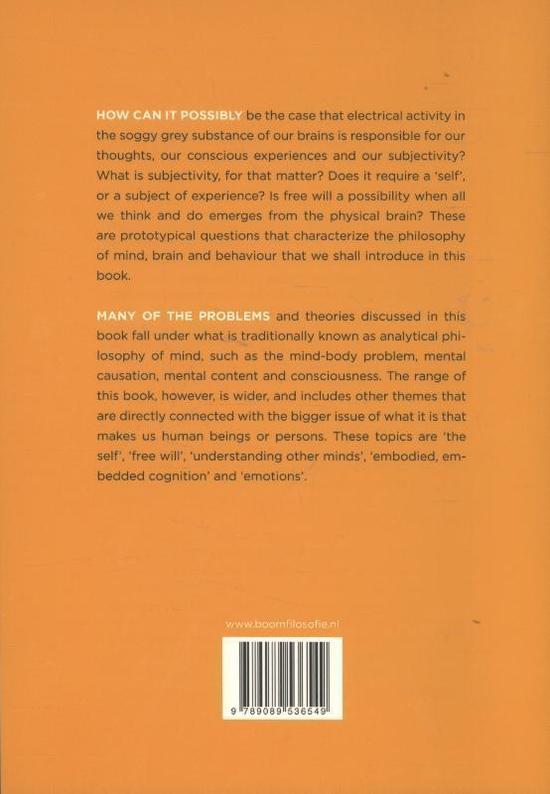
Summary textbook: Philosophy of Mind, Brain and Behaviour
Chapter 1-1.2
Standard topics in the philosophy of mind are the mind-body problem, mental
causation, mental content, and consciousness. Themes not included in the
philosophy of mind but closely related are the self, free will, understanding other
minds, ‘embodied, embedded cognition’ and emotions
Mind is an umbrella term referring to a range of processes and states that we
commonly call “mental”.
The mind-body problem: can we explain the mind as a natural phenomenon
without reference to immaterial souls or non-natural phenomena? If so, how?
Properties of mental state:
- Thoughts are about something
- Properties of mental states are hard to fit into the physical world of the
natural sciences
- Properties make it tempting to think that the mind must be a non-physical
entity
René Descartes is the most influential and consistent version of the idea that the
mind resides in an immaterial soul that is distinguishable from the body
substance dualism. All contemporary attempts are at abandoning the Cartesian
way of thinking about the mind, yet most theories still have some Cartesian
features in them.
1.1 Substance dualism (p. 19-25)
“Substance dualism is the theory according to which people consist of two
parts, a material body and immaterial soul” (p.19). “The term ‘substance’
means ‘something that can exist independently’”(p.19). In daily life, body
and soul form one unit, but in principle body and soul can exist as separate
entities, for example in our sleep. “Substance dualism is often associated
with religion, life after death, spiritism and paranormal phenomena” (p.19).
According to Descartes, the soul does not take space- it has no extension, in
philosophical jargon. Descartes thought that extensions defined matter. “The
essence of the material soul […] is what he called ‘thinking’” (p.19), this
term should, however, not been taken too narrowly. “In Descartes’ usage, it
encompasses not only intellectual mental processes but all conscious
processes.” (p.20)
Doubt as argument (p. 20-21)
, We find knowledge by doubting everything we know. “It does not matter
whether it is reasonable to doubt some presumed knowledge, all that matters
is if we can conceivably doubt it” (p.20). There is only one thing that we
cannot doubt on and that is that we are doubting. Descartes’ reason for
accepting dualism is based on the assumption that material objects cannot
think, cannot reason, and cannot be conscious according to him.
Others do see some proof in the cogito argument (“I think therefore I
exist”) such as Gottfried Leibniz. “Leibniz held that we can only say that x is
really the same thing as y, if x and y share all their properties” (p.20-21).
“Leibniz’ principle can be used to argue that Descartes’ thinking “I” cannot
be the same entity as a material body or brain” (p.21).
Two features of Cartesian dualism (p. 21-22)
“I” is an immaterial entity that interacts with the material body. The
immateriality of the soul is a prominent feature of the Cartesian view. The
second feature is the separation of the outside world and the inside mind, but it
does not necessarily presuppose the first. Anti-Cartesians are still, in a sense,
still Cartesians (despite their rejection of immaterial souls). “They trade to soul-
body world dualism for a new brain-body dualism” (p.22).
Problems with arguments for dualism (p.22-24)
According to Descartes material objects and entities are not able to think,
use language, reason, and have conscious experience. However, language and
reasoning are, nowadays, insufficient for recognizing dualism. Descartes’
argument thus fails in the 21st century. The argument remaining is doubt as we
can doubt our own existence and bodies. However, the counterargument is that
something cannot be defined by perception.
There is a distinction to make between ontology and epistemology:
- Ontology = study of what really exists
- Epistemology = study of what we know and how we can know it
In terms of doubt, epistemology is the distinction between the mind and
the body as we know them and thus not as they exist. The ontological
thesis is that the mind and the body are distinct entities.
failing of the doubt argument as there is an ontological conclusion
from an epistemological difference.
The interaction problem (p.24-25)
Princess Elisabeth of Bohemia brought the interaction problem where she
questioned how the immaterial soul can have an effect on the material body and
how can the material body can provoke a change in the immaterial soul.
Descartes’ first answer to the princess was that he thought about the localization
Chapter 1-1.2
Standard topics in the philosophy of mind are the mind-body problem, mental
causation, mental content, and consciousness. Themes not included in the
philosophy of mind but closely related are the self, free will, understanding other
minds, ‘embodied, embedded cognition’ and emotions
Mind is an umbrella term referring to a range of processes and states that we
commonly call “mental”.
The mind-body problem: can we explain the mind as a natural phenomenon
without reference to immaterial souls or non-natural phenomena? If so, how?
Properties of mental state:
- Thoughts are about something
- Properties of mental states are hard to fit into the physical world of the
natural sciences
- Properties make it tempting to think that the mind must be a non-physical
entity
René Descartes is the most influential and consistent version of the idea that the
mind resides in an immaterial soul that is distinguishable from the body
substance dualism. All contemporary attempts are at abandoning the Cartesian
way of thinking about the mind, yet most theories still have some Cartesian
features in them.
1.1 Substance dualism (p. 19-25)
“Substance dualism is the theory according to which people consist of two
parts, a material body and immaterial soul” (p.19). “The term ‘substance’
means ‘something that can exist independently’”(p.19). In daily life, body
and soul form one unit, but in principle body and soul can exist as separate
entities, for example in our sleep. “Substance dualism is often associated
with religion, life after death, spiritism and paranormal phenomena” (p.19).
According to Descartes, the soul does not take space- it has no extension, in
philosophical jargon. Descartes thought that extensions defined matter. “The
essence of the material soul […] is what he called ‘thinking’” (p.19), this
term should, however, not been taken too narrowly. “In Descartes’ usage, it
encompasses not only intellectual mental processes but all conscious
processes.” (p.20)
Doubt as argument (p. 20-21)
, We find knowledge by doubting everything we know. “It does not matter
whether it is reasonable to doubt some presumed knowledge, all that matters
is if we can conceivably doubt it” (p.20). There is only one thing that we
cannot doubt on and that is that we are doubting. Descartes’ reason for
accepting dualism is based on the assumption that material objects cannot
think, cannot reason, and cannot be conscious according to him.
Others do see some proof in the cogito argument (“I think therefore I
exist”) such as Gottfried Leibniz. “Leibniz held that we can only say that x is
really the same thing as y, if x and y share all their properties” (p.20-21).
“Leibniz’ principle can be used to argue that Descartes’ thinking “I” cannot
be the same entity as a material body or brain” (p.21).
Two features of Cartesian dualism (p. 21-22)
“I” is an immaterial entity that interacts with the material body. The
immateriality of the soul is a prominent feature of the Cartesian view. The
second feature is the separation of the outside world and the inside mind, but it
does not necessarily presuppose the first. Anti-Cartesians are still, in a sense,
still Cartesians (despite their rejection of immaterial souls). “They trade to soul-
body world dualism for a new brain-body dualism” (p.22).
Problems with arguments for dualism (p.22-24)
According to Descartes material objects and entities are not able to think,
use language, reason, and have conscious experience. However, language and
reasoning are, nowadays, insufficient for recognizing dualism. Descartes’
argument thus fails in the 21st century. The argument remaining is doubt as we
can doubt our own existence and bodies. However, the counterargument is that
something cannot be defined by perception.
There is a distinction to make between ontology and epistemology:
- Ontology = study of what really exists
- Epistemology = study of what we know and how we can know it
In terms of doubt, epistemology is the distinction between the mind and
the body as we know them and thus not as they exist. The ontological
thesis is that the mind and the body are distinct entities.
failing of the doubt argument as there is an ontological conclusion
from an epistemological difference.
The interaction problem (p.24-25)
Princess Elisabeth of Bohemia brought the interaction problem where she
questioned how the immaterial soul can have an effect on the material body and
how can the material body can provoke a change in the immaterial soul.
Descartes’ first answer to the princess was that he thought about the localization