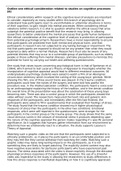
Outline one ethical consideration related to studies on cognitive processes
[8]
Ethical considerations within research at the cognitive level of analysis are important
to consider, especially as many studies within this branch of psychology aim to
understand how participants react to uncomfortable or unfamiliar situations in terms
of their cognition, to gain insight into mental processes. When considering ethical
violations within research, it is vital to question whether the ethical issues that arise
outweigh the potential positive benefit that the research may bring, in allowing
researchers to better understand the mental processes that guide human behaviour.
One ethical consideration at the cognitive level of analysis is protection of participants
from potential psychological harm. Researchers have a moral responsibility to ensure
that participants are protected from both mental and physical harm, and that
participants in research are not subjected to any lasting damage or impairment. The
risk that participants are exposed to should not be any greater than what they would
experience daily within a normal lifestyle. Researchers must also be aware of any
potential distress that may occur to a vulnerable group of participants, such as elderly
people or those suffering from mental illnesses, and take precautions to minimize this
potential for harm by carrying out health and wellbeing questionnaires.
One study that raises issues concerning psychological harm is that of Speisman et al.
[1964], which aimed to test Lazarus’s Theory of Appraisal to investigate whether the
manipulation of cognitive appraisal would lead to different emotional outcomes. 56
undergraduate psychology students were asked to watch a film of an Aboriginal
circumcision ceremony which involved the cutting of the young boys’ genitals. While
showing this film, one of three sound tracks was played. In the trauma condition,
participants could hear the noises of the surgery and were told how painful the
procedure was. In the intellectualization condition, the participants heard a voice-over
by an anthropologist explaining the history of the tradition, and in the denial condition
the overall tone of the presentation was about the celebration of these young boys
becoming men. There was also a control group in which the participants viewed the
video without sound. The researchers measured the heart rate and galvanic skin
responses of the participants, and immediately after the film had finished, the
participants were asked to fill in questionnaires that evaluated their feelings of stress.
The study found that the trauma condition showed much higher physiological
measures of stress than the participants in the other two conditions. Emotional
responses, which were self-reported in the questionnaire, were stronger for the
participants in the control group or the trauma group. The study shows that the same
visual stimulus varies in the amount of emotional stress it produces depending upon
the nature of the cognitive appraisal the person makes regarding it’s specific personal
significance. As it suggests that humans gather information from our environment to
determine how we emotionally react to a situation, the study supports Lazarus’s
Theory of Appraisal.
Watching such a graphic video as the one that the participants were subjected to is
ethically problematic, as it places the participants in an uncomfortable position and
they may feel like they cannot withdraw from watching the video. Watching such a
graphic video may leave long-lasting impacts on the participants, as it is not
something they are likely to forget watching. The explicitly violent content may also
have negative associations for particular participants who have experienced past
trauma. The stress associated with the video is shown explicitly through the elevated
physiological stress responses of the participants. However, the use of a stressful
video was imperative to the study in allowing the researchers to study differences in
how this stress response is manifested depending on how it is cognitively appraised.
[8]
Ethical considerations within research at the cognitive level of analysis are important
to consider, especially as many studies within this branch of psychology aim to
understand how participants react to uncomfortable or unfamiliar situations in terms
of their cognition, to gain insight into mental processes. When considering ethical
violations within research, it is vital to question whether the ethical issues that arise
outweigh the potential positive benefit that the research may bring, in allowing
researchers to better understand the mental processes that guide human behaviour.
One ethical consideration at the cognitive level of analysis is protection of participants
from potential psychological harm. Researchers have a moral responsibility to ensure
that participants are protected from both mental and physical harm, and that
participants in research are not subjected to any lasting damage or impairment. The
risk that participants are exposed to should not be any greater than what they would
experience daily within a normal lifestyle. Researchers must also be aware of any
potential distress that may occur to a vulnerable group of participants, such as elderly
people or those suffering from mental illnesses, and take precautions to minimize this
potential for harm by carrying out health and wellbeing questionnaires.
One study that raises issues concerning psychological harm is that of Speisman et al.
[1964], which aimed to test Lazarus’s Theory of Appraisal to investigate whether the
manipulation of cognitive appraisal would lead to different emotional outcomes. 56
undergraduate psychology students were asked to watch a film of an Aboriginal
circumcision ceremony which involved the cutting of the young boys’ genitals. While
showing this film, one of three sound tracks was played. In the trauma condition,
participants could hear the noises of the surgery and were told how painful the
procedure was. In the intellectualization condition, the participants heard a voice-over
by an anthropologist explaining the history of the tradition, and in the denial condition
the overall tone of the presentation was about the celebration of these young boys
becoming men. There was also a control group in which the participants viewed the
video without sound. The researchers measured the heart rate and galvanic skin
responses of the participants, and immediately after the film had finished, the
participants were asked to fill in questionnaires that evaluated their feelings of stress.
The study found that the trauma condition showed much higher physiological
measures of stress than the participants in the other two conditions. Emotional
responses, which were self-reported in the questionnaire, were stronger for the
participants in the control group or the trauma group. The study shows that the same
visual stimulus varies in the amount of emotional stress it produces depending upon
the nature of the cognitive appraisal the person makes regarding it’s specific personal
significance. As it suggests that humans gather information from our environment to
determine how we emotionally react to a situation, the study supports Lazarus’s
Theory of Appraisal.
Watching such a graphic video as the one that the participants were subjected to is
ethically problematic, as it places the participants in an uncomfortable position and
they may feel like they cannot withdraw from watching the video. Watching such a
graphic video may leave long-lasting impacts on the participants, as it is not
something they are likely to forget watching. The explicitly violent content may also
have negative associations for particular participants who have experienced past
trauma. The stress associated with the video is shown explicitly through the elevated
physiological stress responses of the participants. However, the use of a stressful
video was imperative to the study in allowing the researchers to study differences in
how this stress response is manifested depending on how it is cognitively appraised.