
Hoorcollege 1: introduction
Processes during development
There are many different processes needed to be properly executed and coordinated during
development
- Cell proliferation
- Differentiation
- Migration
- Morphogenesis
- Growth
- Cell death
- Homeostasis
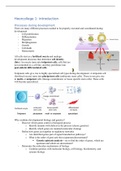
All cells start as a fertilized oocyte and undergo
development decisions that determine cell identity
(fate). An oocyte turns into totipotent cells, cells that are
not committed to a cell fate, and they proliferate into
post-mitotic differentiated cells.
Totipotent cells give rise to highly specialized cell types during development. A totipotent cell
(fertilized oocyte) turns into pluripotent cells (embryonic stem cells). These in tun give rise
to multi- or unipotent cells (lineage commitment, or tissue specific stem cells). These cells
will become specialized.
Why combine developmental biology and genetics?
- Discover which genes control a biological process
o Identify mutants with defects in the process (classic genetics)
o Identify which genes are mutated (molecular cloning)
- Define how genes act together in regulatory networks
o Are identified genes part of signal transduction pathways?
o What is the order of gene activities (upstream/downstream)?
Genetic epistasis analysis = try to find the order of genes, which are
upstream and which are downstream?
- Determine the molecular mechanisms of biology
o Combine genetics with molecular biology, cell biology, biochemistry, and
systems biology
,Model systems
Different model systems are needed
- Chicken: not a genetic model but it is used for development (not genes)
- Human
- Arabidopsis (plant): used as plant model
- Caenorhabditis elegans: used for nervous system
- Zebrafish: used for organ development
- Drosophilia melanogaster: easy to grow
- Mouse: used for reversed genetics, knock out.
Stem cells
Stem cells can self-renew and differentiate. There are different classes of stem cells
- Precursors of the germline are totipotent and self-
renew
- Mammalian embryonic stem cells (ES cells) are
pluripotent
- Tissue specific stem cells are multipotent or
unipotent and may be maintained by asymmetric cell
division = differentiation pathway + self-renew
pathway.
How do cells become different from each
other?
All cells have an identical genome, so what regulatory processes create variation?
- Transcription
o Chromatin regulators
o Transcription factors, co-repressors and co-activators
o RNA polymerases (initiation and elongation)
- RNA level
o Processing (splicing, polyadenylation, nuclear export)
o Degradation / stabilization
o Small RNA’s (degradation, translation, localization P bodies)
- Protein level
o Translation (binding factors, miRNA’s)
o Processing (cleavage, secretion)
o Localization, complex formation
o Modification (eg phosphorylation, ubiquitylation
etc)
o Degradation / stabilization
C. elegans
C. elegans is well suited for developmental genetics
- Simple animal: 959 nuclei + germ line
- Efficient genetics
- Transparent
- Cell lineage entirely known
,It had 2 sexes: hermaphrodites and males
- It starts of as a male and produces sperm
- It switches to hermaphrodites and produces oocytes so it can self-fertilize. Oocytes
move through spermathecae
Development begins with the fusion of two gametes
The germline produces gametes and is a special tissue.
- It generates cells that give rise to the totipotent zygote. It maintains the totipotent state
- It has a special cell cycle control. It alternates between mitotic and meiotic cell
division
- It is immortal, germ cell DNA can be transmitted “forever”. Maintenance of genetic
integrity is very important. It has efficient DNA repair pathways and
suprresion/silencing of foreign DNA (viruses, transposons, also introduced transgenes)
C. elegans cells undergo several switches
in development, all happen in a hollow
tube.
, - There is a switch from mitosis to meiosis
- There is a switch from oocyte to embryo
- There is a switch from meiosis to mitosis
Mitosis to meiosis
Meiosis is where there a 2 cycles of M phase without DNA
replication. In the embryonic cell cycle the G phases are
left out. In endoreduplication cycles there is no M phases
so the DNA increases a lot.
Meiosis has an extended prophase. This is where the
pairing of homologs takes place and synapsis. This creates
Bivalenst = crossing over.
First M phase segregates homologous chromosomes
Second M phase segregates sister chromatids, creates
haploid gamets.
Most germ-precursor cells are in Meiosis I prophase:
homolog pairing, synapsis, recombination.
There is a close association of the distal tip cell (DTC) with mitotic stem cell population.
When the DTC was removed cell proliferation in the germ line stopped. You will only be left
with a few cells in meiosis. DTC is needed for maintenance of the mitotic stem cell
population.
To find out which genes are important you need mutants who mimic the cell type of DTC
ablation. 3 genes are found by doing this: germline proliferation defective (Glp-1), lag-1
and lag-2.
Next the order for these genes needs to be found. To find a pathway with mutants you need
double mutants. When you combine these mutations, and it will result in the same phenotype
you can say that they work in the same pathway. When the phenotype is altered after
combining them they will not work in the same pathway.
To start ordering these genes you need a mutation with an opposite phenotype. So combine
these mutants with mutants who have too much proliferation of the mitotic stem cells.
There is also a mutant with and gain of function Glp-1 mutation. It has a germline tumor of
proliferating mitotic cells.
Processes during development
There are many different processes needed to be properly executed and coordinated during
development
- Cell proliferation
- Differentiation
- Migration
- Morphogenesis
- Growth
- Cell death
- Homeostasis
All cells start as a fertilized oocyte and undergo
development decisions that determine cell identity
(fate). An oocyte turns into totipotent cells, cells that are
not committed to a cell fate, and they proliferate into
post-mitotic differentiated cells.
Totipotent cells give rise to highly specialized cell types during development. A totipotent cell
(fertilized oocyte) turns into pluripotent cells (embryonic stem cells). These in tun give rise
to multi- or unipotent cells (lineage commitment, or tissue specific stem cells). These cells
will become specialized.
Why combine developmental biology and genetics?
- Discover which genes control a biological process
o Identify mutants with defects in the process (classic genetics)
o Identify which genes are mutated (molecular cloning)
- Define how genes act together in regulatory networks
o Are identified genes part of signal transduction pathways?
o What is the order of gene activities (upstream/downstream)?
Genetic epistasis analysis = try to find the order of genes, which are
upstream and which are downstream?
- Determine the molecular mechanisms of biology
o Combine genetics with molecular biology, cell biology, biochemistry, and
systems biology
,Model systems
Different model systems are needed
- Chicken: not a genetic model but it is used for development (not genes)
- Human
- Arabidopsis (plant): used as plant model
- Caenorhabditis elegans: used for nervous system
- Zebrafish: used for organ development
- Drosophilia melanogaster: easy to grow
- Mouse: used for reversed genetics, knock out.
Stem cells
Stem cells can self-renew and differentiate. There are different classes of stem cells
- Precursors of the germline are totipotent and self-
renew
- Mammalian embryonic stem cells (ES cells) are
pluripotent
- Tissue specific stem cells are multipotent or
unipotent and may be maintained by asymmetric cell
division = differentiation pathway + self-renew
pathway.
How do cells become different from each
other?
All cells have an identical genome, so what regulatory processes create variation?
- Transcription
o Chromatin regulators
o Transcription factors, co-repressors and co-activators
o RNA polymerases (initiation and elongation)
- RNA level
o Processing (splicing, polyadenylation, nuclear export)
o Degradation / stabilization
o Small RNA’s (degradation, translation, localization P bodies)
- Protein level
o Translation (binding factors, miRNA’s)
o Processing (cleavage, secretion)
o Localization, complex formation
o Modification (eg phosphorylation, ubiquitylation
etc)
o Degradation / stabilization
C. elegans
C. elegans is well suited for developmental genetics
- Simple animal: 959 nuclei + germ line
- Efficient genetics
- Transparent
- Cell lineage entirely known
,It had 2 sexes: hermaphrodites and males
- It starts of as a male and produces sperm
- It switches to hermaphrodites and produces oocytes so it can self-fertilize. Oocytes
move through spermathecae
Development begins with the fusion of two gametes
The germline produces gametes and is a special tissue.
- It generates cells that give rise to the totipotent zygote. It maintains the totipotent state
- It has a special cell cycle control. It alternates between mitotic and meiotic cell
division
- It is immortal, germ cell DNA can be transmitted “forever”. Maintenance of genetic
integrity is very important. It has efficient DNA repair pathways and
suprresion/silencing of foreign DNA (viruses, transposons, also introduced transgenes)
C. elegans cells undergo several switches
in development, all happen in a hollow
tube.
, - There is a switch from mitosis to meiosis
- There is a switch from oocyte to embryo
- There is a switch from meiosis to mitosis
Mitosis to meiosis
Meiosis is where there a 2 cycles of M phase without DNA
replication. In the embryonic cell cycle the G phases are
left out. In endoreduplication cycles there is no M phases
so the DNA increases a lot.
Meiosis has an extended prophase. This is where the
pairing of homologs takes place and synapsis. This creates
Bivalenst = crossing over.
First M phase segregates homologous chromosomes
Second M phase segregates sister chromatids, creates
haploid gamets.
Most germ-precursor cells are in Meiosis I prophase:
homolog pairing, synapsis, recombination.
There is a close association of the distal tip cell (DTC) with mitotic stem cell population.
When the DTC was removed cell proliferation in the germ line stopped. You will only be left
with a few cells in meiosis. DTC is needed for maintenance of the mitotic stem cell
population.
To find out which genes are important you need mutants who mimic the cell type of DTC
ablation. 3 genes are found by doing this: germline proliferation defective (Glp-1), lag-1
and lag-2.
Next the order for these genes needs to be found. To find a pathway with mutants you need
double mutants. When you combine these mutations, and it will result in the same phenotype
you can say that they work in the same pathway. When the phenotype is altered after
combining them they will not work in the same pathway.
To start ordering these genes you need a mutation with an opposite phenotype. So combine
these mutants with mutants who have too much proliferation of the mitotic stem cells.
There is also a mutant with and gain of function Glp-1 mutation. It has a germline tumor of
proliferating mitotic cells.



