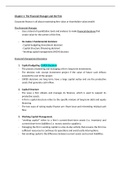
Chapter 1: The Financial Manager and the Firm
Corporate finance is all about maximizing firm value or shareholder value/wealth
The Financial Manager
- Uses a blend of quantitative tools and analyses to make financial decisions that
create value for the owners of the firm.
- He makes 3 fundamental decisions:
- Capital budgeting (investment decision)
- Capital Structure (Financing decision)
- Working capital management (WCM) decision
Financial Management Decisions
1. Capital budgeting (CAPEX Decision)
- The process of planning and managing a firm’s long-term investments.
- The decision rule: Accept investment project if the value of future cash inflows
exceeds the cost of the project.
- CAPEX decisions are long term, have a large capital outlay and are the productive
assets that generate cash inflow.
2. Capital Structure
- The ways a firm obtains and manages its finances, which is used to support its
productive assets.
- A firm’s capital structure refers to the specific mixture of long-term debt and equity
financing.
- The two ways of raising equity finance are: Share issue and reinvesting residual cash
flow.
3. Working Capital Management.
- “working capital” refers to a firm’s current/short-term assets (i.e. inventory) and
current/short-term liabilities (i.e. money owed to suppliers).
- Managing the firm’s working capital is a day-to-day activity that ensures the firm has
sufficient resources to continues its operations and avoid costly interruptions.
- Net working capital is the difference between current assets and current liabilities.
, Effects of Managers’ Decision on Statement of Financial Position
Corporate finance is all about maximizing firm value or shareholder value/wealth
The Financial Manager
- Uses a blend of quantitative tools and analyses to make financial decisions that
create value for the owners of the firm.
- He makes 3 fundamental decisions:
- Capital budgeting (investment decision)
- Capital Structure (Financing decision)
- Working capital management (WCM) decision
Financial Management Decisions
1. Capital budgeting (CAPEX Decision)
- The process of planning and managing a firm’s long-term investments.
- The decision rule: Accept investment project if the value of future cash inflows
exceeds the cost of the project.
- CAPEX decisions are long term, have a large capital outlay and are the productive
assets that generate cash inflow.
2. Capital Structure
- The ways a firm obtains and manages its finances, which is used to support its
productive assets.
- A firm’s capital structure refers to the specific mixture of long-term debt and equity
financing.
- The two ways of raising equity finance are: Share issue and reinvesting residual cash
flow.
3. Working Capital Management.
- “working capital” refers to a firm’s current/short-term assets (i.e. inventory) and
current/short-term liabilities (i.e. money owed to suppliers).
- Managing the firm’s working capital is a day-to-day activity that ensures the firm has
sufficient resources to continues its operations and avoid costly interruptions.
- Net working capital is the difference between current assets and current liabilities.
, Effects of Managers’ Decision on Statement of Financial Position