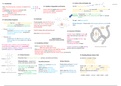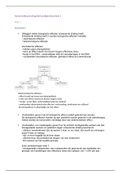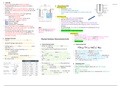
1.1. Introduction 2.2. Amino Acids and Peptide Link
Have 2 functional groups, carboxylic acid and primary 2.1. Peptides, Polypeptides and Proteins Has the functional group:
amine
20 important naturally occurring amino acids Amino acids link together to form peptides Amine group of one amino acid can react with carboxylic acid group of
Carbon bonded to 4 different groups 50 amino acids linked = polypeptides another amino acid – this forms an amide linkage -CONH-
molecule is chiral More than 50 = proteins
All naturally occurring amino acids exist as (-) Peptides – Compounds formed via amino acid linkages
enantiomer Dipeptide – Peptide with 2 amino acid groups, NH2 and CO2H groups
retained
2.4. Hydrolysis
1.2. Acid and Base Properties Can get tri and tetra peptides
Protein/peptide boiled in HCl of conc. 6
• Amino acids have an acidic and basic functional group Primary Structure – Protein with a fixed sequence of amino acids in the
Carboxylic acid has tendency to lose proton mol/dm3 for 24 hrs, it breaks down to
mixture of amino acids in original chain
Amine group has tendency to accept proton
protein/peptide
• Exist as “zwitterions”
have both a permanent positive charge and Peptide linkages are hydrolysed by acid
2.3. Structure of Proteins
permanent negative charge – compound is
neutral overall Helps find structure of proteins
Complex shapes, held by H-bonds and
other intermolecular forces like sulfur-
• They are ionic sulfur
so have high mpt and dissolve in water well Organic Chemistry: Shape is vital to their function – e.g.
white solid at room temp and behaves like an Amino Acid, Proteins and DNA enzymes
ionic salt Most are helical (spiral)
2.5. Stretchiness of Wool H-bonding holds helix in shape
In strongly acidic conditions, lone pair of H2N group
accepts a proton, forms positive ion – protonated Wool is a protein fibre with a helix Another arrangement is called pleating, Tertiary Structure of Helical Protein
In strongly alkaline conditions, OH group loses proton to helix held together by H-bonds protein ends up as pleated sheet
form the negative ion – deprotonated When gently stretched, H-bonds stretch and fibre extends
Releasing tension sends structure back to normal
Washing at high temp can permanently break H-bonds, permanently
distorting shape
2.7. Protein Structure 2.6. Bonding Between Amino Acids
All proteins have three levels of structure – primary, secondary and tertiary Can bond in a number of ways
Hydrogen Bonding
Primary Structure – sequence of Secondary Structure Tertiary Structure Ionic Attractions
amino acids along a protein chain Sulfur-Sulfur Bonds
Protein chain can form a helix or Protein chain can form a “α-helix”
Represented simply by sequence of folded sheet or folded sheet (“β-pleated Amino acid cysteine has side chain with CH2SH group,
three letter names of relevant Held in place by H-Bonding sheet”) under suitable oxidising conditions, 2 cysteine molecules
amino acids H-Bonds weaker than covalent can react and form S-S bonds, which forms a bridge
Held together by covalent bonding Structure can be easily disrupted by Held in place by H-Bonds, ionic between molecules and created a double amino acid
relatively stable gentle heating or changes in pH interactions and S-S bonds and called cystine
Requires harsh conditions to break vdw
apart ---CH2SH + HSCH2--- + [O] → ---CH2S---SCH2--- + H2O
Have 2 functional groups, carboxylic acid and primary 2.1. Peptides, Polypeptides and Proteins Has the functional group:
amine
20 important naturally occurring amino acids Amino acids link together to form peptides Amine group of one amino acid can react with carboxylic acid group of
Carbon bonded to 4 different groups 50 amino acids linked = polypeptides another amino acid – this forms an amide linkage -CONH-
molecule is chiral More than 50 = proteins
All naturally occurring amino acids exist as (-) Peptides – Compounds formed via amino acid linkages
enantiomer Dipeptide – Peptide with 2 amino acid groups, NH2 and CO2H groups
retained
2.4. Hydrolysis
1.2. Acid and Base Properties Can get tri and tetra peptides
Protein/peptide boiled in HCl of conc. 6
• Amino acids have an acidic and basic functional group Primary Structure – Protein with a fixed sequence of amino acids in the
Carboxylic acid has tendency to lose proton mol/dm3 for 24 hrs, it breaks down to
mixture of amino acids in original chain
Amine group has tendency to accept proton
protein/peptide
• Exist as “zwitterions”
have both a permanent positive charge and Peptide linkages are hydrolysed by acid
2.3. Structure of Proteins
permanent negative charge – compound is
neutral overall Helps find structure of proteins
Complex shapes, held by H-bonds and
other intermolecular forces like sulfur-
• They are ionic sulfur
so have high mpt and dissolve in water well Organic Chemistry: Shape is vital to their function – e.g.
white solid at room temp and behaves like an Amino Acid, Proteins and DNA enzymes
ionic salt Most are helical (spiral)
2.5. Stretchiness of Wool H-bonding holds helix in shape
In strongly acidic conditions, lone pair of H2N group
accepts a proton, forms positive ion – protonated Wool is a protein fibre with a helix Another arrangement is called pleating, Tertiary Structure of Helical Protein
In strongly alkaline conditions, OH group loses proton to helix held together by H-bonds protein ends up as pleated sheet
form the negative ion – deprotonated When gently stretched, H-bonds stretch and fibre extends
Releasing tension sends structure back to normal
Washing at high temp can permanently break H-bonds, permanently
distorting shape
2.7. Protein Structure 2.6. Bonding Between Amino Acids
All proteins have three levels of structure – primary, secondary and tertiary Can bond in a number of ways
Hydrogen Bonding
Primary Structure – sequence of Secondary Structure Tertiary Structure Ionic Attractions
amino acids along a protein chain Sulfur-Sulfur Bonds
Protein chain can form a helix or Protein chain can form a “α-helix”
Represented simply by sequence of folded sheet or folded sheet (“β-pleated Amino acid cysteine has side chain with CH2SH group,
three letter names of relevant Held in place by H-Bonding sheet”) under suitable oxidising conditions, 2 cysteine molecules
amino acids H-Bonds weaker than covalent can react and form S-S bonds, which forms a bridge
Held together by covalent bonding Structure can be easily disrupted by Held in place by H-Bonds, ionic between molecules and created a double amino acid
relatively stable gentle heating or changes in pH interactions and S-S bonds and called cystine
Requires harsh conditions to break vdw
apart ---CH2SH + HSCH2--- + [O] → ---CH2S---SCH2--- + H2O