Pre-master BA – Management Research Methods 2
Summary
Victor Roos
Content
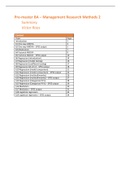
Topic Page
Introduction 2
§1 One-way ANOVA 3
§2 One-way ANOVA – SPSS output 5
§3 Moderation 7
§4 Factorial ANOVA 8
§5 Factorial ANOVA – SPSS output 10
§6 Regression (introduction) 14
§7 Regression (model testing) 16
§8 Regression (coefficient testing) 17
§9 Regression §6 t/m 8 – SPSS output 18
§10 Regression (model comparison) 21
§11 Regression (model comparison) – SPSS output 22
§12 Regression (multicollinearity) 26
§13 Regression (multicollinearity) – SPSS output 27
§14 Regression (Categorical PV’s) 28
§15 Regression (Categorical PV’s) – SPSS output 29
§16 Mediation 30
§17 Mediation – SPSS output 31
§18 Logistical regression 33
§19 Logistical regression – SPSS output 34
,Management Research Methods 2 – Pre-master BA – Summary
Introduction
Lecture 1
Terminology
Lecture 1
Variables
OV = Outcome variable or DV = dependent variable
Test variable, variable that needs to be explained
PV = Predictor variable or IV = Independent variable
Variable that explains
Qualitative/categorical variable (nominal, ordinal): subgroups are indicated by numbers.
Quantitative/numerical variable (discrete, interval, ratio): we use numerical scales, with equal
distances between values.
Hypothesis
Alternative/main hypothesis: that what you want to investigate.
Null hypothesis: the opposite of it.
Try to focus more on the main hypothesis.
P-value
This is the probability of obtaining a result (or test-statistic value) equal to (or ‘more extreme’ than)
what was actually observed (the result you actually got), assuming that the null hypothesis is true.
We use 0.05. If p is low, H0 should go.
Conceptual model
Lecture 1
A conceptual model is a visual representation of relations between theoretical constructs (and
variables) of interest. In research a model means a simplified description of reality. It can only have
one outcome variable, but multiple predictor variables.
2
Victor Roos
,Management Research Methods 2 – Pre-master BA – Summary
§1 One-way ANOVA
Lecture 1, Formula sheet, Summary of techniques
Definition
Lecture 1
ANOVA is used to test whether statistically significant differences exist in scores on a quantitative OV
between different levels (groups) of a categorical PV. It compares the variability between groups
against the variability within groups. ANOVA statistically examines how much of the variability in our
outcome variable can be explained by our predictor variable. ANOVA decomposes total variance into
variance explained by the model and residual variance. It breaks down these different measures of
variability through calculating sum of squares. Via these calculations, the ANOVA helps us test if the
mean scores of the groups are statistically different.
Assumptions
Lecture 1
- Outcome Variable (OV): quantitative
- Predictor Variable (PV): categorical with ≥ 2 groups
- Variance is homogenous across groups, can be tested with the Levene’s test. If this is not
assumed, you cannot run the test (in this course, it is always assumed).
o P < 0.05, reject H0 which means equal variances not assumed
o P > 0.05, do not reject H0, which means equal variances assumed
- Residuals are normally distributed (not part of the course)
- Groups are roughly equally sized (always assume they are in this course)
- Subjects can only be in one group
Formula’s
Lecture 1, Formula sheet
𝑆𝑆 𝑀⁄ 𝑆𝑆 𝑀⁄
𝑀𝑆 𝑀 𝐷𝐹 𝑀 (𝑘−1) 𝑆𝑆 𝑀
𝐹= 𝑀𝑆 𝑅
= 𝑆𝑆 𝑅⁄ = 𝑆𝑆 𝑅⁄ 𝑅2 = 𝑆𝑆 𝑇
𝐷𝐹 𝑅 (𝑛−𝑘)
MS M Mean Square Model, this is between groups
MS R Mean Square Residual, this is within groups
SS M Sum of Squares Model, this is between groups, this is the ‘good’ part
SS R Sum of Squares Residual, this is within groups, this is the ‘bad’ part, also called error
SS T Sum of Squares Total, this is SS M + SS R
DF M Degrees of Freedom Model, this is between groups, this is k – 1
DF R Degrees of Freedom Residual, this is within groups, this is n – k
K Number of categories in PV
N Number of observations for both
3
Victor Roos
, Management Research Methods 2 – Pre-master BA – Summary
F-test (one-way) ANOVA
The F-ratio states if there is a difference between one or more of the groups. The F-ratio can be
compared with a critical value in the F-table, but this is not something we have to do.
Hypotheses
H0: μ1 = μ2 = … = μi There is no difference in means across the different categories.
HA: μi ≠ μj There is at least one difference in the means.
Interpretations
P < 0.05 There is a significant difference between the PV and the OV
P > 0.05 There is no significant difference between the PV and the OV.
To know between which groups there is a difference, you need to perform a post hoc test, which you
can do while running the One-Way ANOVA test.
Post-hoc
P < 0.05 There is a significant difference between the 2 groups.
P > 0.05 There is no significant difference between the 2 groups.
See ‘Summary of all techniques’.
R2
R2 indicates the proportion of variance in the OV explained by the model. For R2, the higher the better.
However, this depends on the context. If R2 = 0 25, that would mean that 25% of the outcome variable
can be explained by the model. Nevertheless, the F-ratio however is the main thing.
4
Victor Roos
Summary
Victor Roos
Content
Topic Page
Introduction 2
§1 One-way ANOVA 3
§2 One-way ANOVA – SPSS output 5
§3 Moderation 7
§4 Factorial ANOVA 8
§5 Factorial ANOVA – SPSS output 10
§6 Regression (introduction) 14
§7 Regression (model testing) 16
§8 Regression (coefficient testing) 17
§9 Regression §6 t/m 8 – SPSS output 18
§10 Regression (model comparison) 21
§11 Regression (model comparison) – SPSS output 22
§12 Regression (multicollinearity) 26
§13 Regression (multicollinearity) – SPSS output 27
§14 Regression (Categorical PV’s) 28
§15 Regression (Categorical PV’s) – SPSS output 29
§16 Mediation 30
§17 Mediation – SPSS output 31
§18 Logistical regression 33
§19 Logistical regression – SPSS output 34
,Management Research Methods 2 – Pre-master BA – Summary
Introduction
Lecture 1
Terminology
Lecture 1
Variables
OV = Outcome variable or DV = dependent variable
Test variable, variable that needs to be explained
PV = Predictor variable or IV = Independent variable
Variable that explains
Qualitative/categorical variable (nominal, ordinal): subgroups are indicated by numbers.
Quantitative/numerical variable (discrete, interval, ratio): we use numerical scales, with equal
distances between values.
Hypothesis
Alternative/main hypothesis: that what you want to investigate.
Null hypothesis: the opposite of it.
Try to focus more on the main hypothesis.
P-value
This is the probability of obtaining a result (or test-statistic value) equal to (or ‘more extreme’ than)
what was actually observed (the result you actually got), assuming that the null hypothesis is true.
We use 0.05. If p is low, H0 should go.
Conceptual model
Lecture 1
A conceptual model is a visual representation of relations between theoretical constructs (and
variables) of interest. In research a model means a simplified description of reality. It can only have
one outcome variable, but multiple predictor variables.
2
Victor Roos
,Management Research Methods 2 – Pre-master BA – Summary
§1 One-way ANOVA
Lecture 1, Formula sheet, Summary of techniques
Definition
Lecture 1
ANOVA is used to test whether statistically significant differences exist in scores on a quantitative OV
between different levels (groups) of a categorical PV. It compares the variability between groups
against the variability within groups. ANOVA statistically examines how much of the variability in our
outcome variable can be explained by our predictor variable. ANOVA decomposes total variance into
variance explained by the model and residual variance. It breaks down these different measures of
variability through calculating sum of squares. Via these calculations, the ANOVA helps us test if the
mean scores of the groups are statistically different.
Assumptions
Lecture 1
- Outcome Variable (OV): quantitative
- Predictor Variable (PV): categorical with ≥ 2 groups
- Variance is homogenous across groups, can be tested with the Levene’s test. If this is not
assumed, you cannot run the test (in this course, it is always assumed).
o P < 0.05, reject H0 which means equal variances not assumed
o P > 0.05, do not reject H0, which means equal variances assumed
- Residuals are normally distributed (not part of the course)
- Groups are roughly equally sized (always assume they are in this course)
- Subjects can only be in one group
Formula’s
Lecture 1, Formula sheet
𝑆𝑆 𝑀⁄ 𝑆𝑆 𝑀⁄
𝑀𝑆 𝑀 𝐷𝐹 𝑀 (𝑘−1) 𝑆𝑆 𝑀
𝐹= 𝑀𝑆 𝑅
= 𝑆𝑆 𝑅⁄ = 𝑆𝑆 𝑅⁄ 𝑅2 = 𝑆𝑆 𝑇
𝐷𝐹 𝑅 (𝑛−𝑘)
MS M Mean Square Model, this is between groups
MS R Mean Square Residual, this is within groups
SS M Sum of Squares Model, this is between groups, this is the ‘good’ part
SS R Sum of Squares Residual, this is within groups, this is the ‘bad’ part, also called error
SS T Sum of Squares Total, this is SS M + SS R
DF M Degrees of Freedom Model, this is between groups, this is k – 1
DF R Degrees of Freedom Residual, this is within groups, this is n – k
K Number of categories in PV
N Number of observations for both
3
Victor Roos
, Management Research Methods 2 – Pre-master BA – Summary
F-test (one-way) ANOVA
The F-ratio states if there is a difference between one or more of the groups. The F-ratio can be
compared with a critical value in the F-table, but this is not something we have to do.
Hypotheses
H0: μ1 = μ2 = … = μi There is no difference in means across the different categories.
HA: μi ≠ μj There is at least one difference in the means.
Interpretations
P < 0.05 There is a significant difference between the PV and the OV
P > 0.05 There is no significant difference between the PV and the OV.
To know between which groups there is a difference, you need to perform a post hoc test, which you
can do while running the One-Way ANOVA test.
Post-hoc
P < 0.05 There is a significant difference between the 2 groups.
P > 0.05 There is no significant difference between the 2 groups.
See ‘Summary of all techniques’.
R2
R2 indicates the proportion of variance in the OV explained by the model. For R2, the higher the better.
However, this depends on the context. If R2 = 0 25, that would mean that 25% of the outcome variable
can be explained by the model. Nevertheless, the F-ratio however is the main thing.
4
Victor Roos