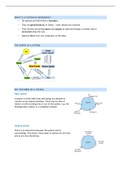
WHAT IS A SYSTEM IN GEOGRAPHY?
• All systems are held within a boundary.
• They are generalisations of reality - minor details are removed.
• They function by having inputs and outputs of material (energy or matter) that is
processed along the way.
• Material flows from one component to the other.
THE EARTH AS A SYSTEM
KEY FEATURES OF A SYSTEM
Open system
A system in which both mass and energy are allowed to
transfer across system boundary. There may be flow of
matter as well as energy into or out of the system, e.g. the
drainage basin (water) or a woodland (carbon).
Isolated system
There is no interaction between the system and its
surroundings. Practically, these types of systems do not exist
and so are only theoretical.
,Closed system
There may be flow of energy into or out of the system,
but no matter flow takes place across the system
boundary. This is the system with fixed mass, e.g. the
global water & carbon cycles.
FEEDBACK AND EQUILIBRIUM
Systems work on a balance of inputs and outputs – if even, this produces a dynamic equilibrium.
Dynamic equilibrium is when a system has inputs and outputs, but they are balanced, so the size
of the system remains the same.
However, if inputs or outputs suddenly change, then stores are forced to change and the
equilibrium is upset – known as feedback.
Positive feedback - Where the effects of an action
are amplified (increased) or multiplied by
subsequent or secondary ‘knock-on’ effects.
Negative feedback - Where the effects of an action are nullified (reduced or stopped) by its
subsequent knock-on effects.
,KEY DEFINITIONS
A system is a set of interrelated components working together towards
System
a process.
System boundary Outer edge of system; the interface between one system and another.
System elements are the kinds of things or substances composing the
System element system. They may be atoms or molecules, or larger bodies of matter,
e.g. sand grains, rain drops etc.
This is made up of a chain of open systems where the output from one
Cascading system open system forms the input into another. Rivers are a classic example
of open cascade systems.
Store/component A part of the system where energy/mass is stored or transformed.
A form of linkage between one store/component that involves
Flow/transfer
movement of energy or mass.
Input The addition of matter and/or energy or into a system.
Output The movement of matter and/or energy out of a system.
Dynamic This occurs when inputs balance outputs so that the overall system
equilibrium does not change.
Change in the state of a system that causes the initial change to
Positive feedback
increase.
Change in the state of a system that counteracts or dampens that
Negative feedback
change.
The Earth as a whole can be considered a closed system. Energy comes in as solar
radiation, balanced out by radiant energy lost by the Earth.
, EARTH’S 5 SYSTEMS
There are 5 subsystems on Earth:
• Atmosphere (air)
• Lithosphere (geology)
• Hydrosphere (water)
• Biosphere (organic life)
• Cryosphere (ice)
Each of the 5 subsystems work as
an open system with interlocking
relationships, known as a
cascading system.
These interlocking relationships
have a profound effect on the
Earth’s climate
ATMOSPHERE
Contains all of the gasses that surround our planet
Nitrogen and oxygen account for 99 percent of the gases in dry air.
Argon, carbon dioxide, helium, neon, and other gases making up minute portions.
Water vapour and dust are also part of Earth’s atmosphere.
The atmosphere is so spread out that we barely notice it. It is much thinner at high altitudes.
There is no atmosphere in space.
Scientists say many of the gases in our atmosphere were ejected into the air by early
volcanoes. At that time, there would have been little or no free oxygen surrounding the Earth.
The oxygen in today’s atmosphere probably took millions of years to accumulate.
Atmosphere acts as a gigantic filter, keeping out most ultraviolet radiation while letting in the
sun’s warming rays.
Ultraviolet radiation is harmful to living things and is what causes sunburns. Solar heat, on the
other hand, is necessary for all life on Earth.
Earth’s atmosphere has a layered structure. From the ground toward the sky, the layers are:
o The troposphere
o The stratosphere
o The mesosphere
o The thermosphere
o The exosphere
HYDROSPHERE
Contains all of the water found on and in our planet
It’s the total amount of water on our planet.
Includes water that is on the planet surface, underground, and in the air.
The water can be liquid, vapour, or ice.
On Earth, liquid water exists on the surface in the form of oceans, lakes and rivers; below
ground as groundwater, in wells and aquifers; and water vapour is most visible as clouds
and fog.
• All systems are held within a boundary.
• They are generalisations of reality - minor details are removed.
• They function by having inputs and outputs of material (energy or matter) that is
processed along the way.
• Material flows from one component to the other.
THE EARTH AS A SYSTEM
KEY FEATURES OF A SYSTEM
Open system
A system in which both mass and energy are allowed to
transfer across system boundary. There may be flow of
matter as well as energy into or out of the system, e.g. the
drainage basin (water) or a woodland (carbon).
Isolated system
There is no interaction between the system and its
surroundings. Practically, these types of systems do not exist
and so are only theoretical.
,Closed system
There may be flow of energy into or out of the system,
but no matter flow takes place across the system
boundary. This is the system with fixed mass, e.g. the
global water & carbon cycles.
FEEDBACK AND EQUILIBRIUM
Systems work on a balance of inputs and outputs – if even, this produces a dynamic equilibrium.
Dynamic equilibrium is when a system has inputs and outputs, but they are balanced, so the size
of the system remains the same.
However, if inputs or outputs suddenly change, then stores are forced to change and the
equilibrium is upset – known as feedback.
Positive feedback - Where the effects of an action
are amplified (increased) or multiplied by
subsequent or secondary ‘knock-on’ effects.
Negative feedback - Where the effects of an action are nullified (reduced or stopped) by its
subsequent knock-on effects.
,KEY DEFINITIONS
A system is a set of interrelated components working together towards
System
a process.
System boundary Outer edge of system; the interface between one system and another.
System elements are the kinds of things or substances composing the
System element system. They may be atoms or molecules, or larger bodies of matter,
e.g. sand grains, rain drops etc.
This is made up of a chain of open systems where the output from one
Cascading system open system forms the input into another. Rivers are a classic example
of open cascade systems.
Store/component A part of the system where energy/mass is stored or transformed.
A form of linkage between one store/component that involves
Flow/transfer
movement of energy or mass.
Input The addition of matter and/or energy or into a system.
Output The movement of matter and/or energy out of a system.
Dynamic This occurs when inputs balance outputs so that the overall system
equilibrium does not change.
Change in the state of a system that causes the initial change to
Positive feedback
increase.
Change in the state of a system that counteracts or dampens that
Negative feedback
change.
The Earth as a whole can be considered a closed system. Energy comes in as solar
radiation, balanced out by radiant energy lost by the Earth.
, EARTH’S 5 SYSTEMS
There are 5 subsystems on Earth:
• Atmosphere (air)
• Lithosphere (geology)
• Hydrosphere (water)
• Biosphere (organic life)
• Cryosphere (ice)
Each of the 5 subsystems work as
an open system with interlocking
relationships, known as a
cascading system.
These interlocking relationships
have a profound effect on the
Earth’s climate
ATMOSPHERE
Contains all of the gasses that surround our planet
Nitrogen and oxygen account for 99 percent of the gases in dry air.
Argon, carbon dioxide, helium, neon, and other gases making up minute portions.
Water vapour and dust are also part of Earth’s atmosphere.
The atmosphere is so spread out that we barely notice it. It is much thinner at high altitudes.
There is no atmosphere in space.
Scientists say many of the gases in our atmosphere were ejected into the air by early
volcanoes. At that time, there would have been little or no free oxygen surrounding the Earth.
The oxygen in today’s atmosphere probably took millions of years to accumulate.
Atmosphere acts as a gigantic filter, keeping out most ultraviolet radiation while letting in the
sun’s warming rays.
Ultraviolet radiation is harmful to living things and is what causes sunburns. Solar heat, on the
other hand, is necessary for all life on Earth.
Earth’s atmosphere has a layered structure. From the ground toward the sky, the layers are:
o The troposphere
o The stratosphere
o The mesosphere
o The thermosphere
o The exosphere
HYDROSPHERE
Contains all of the water found on and in our planet
It’s the total amount of water on our planet.
Includes water that is on the planet surface, underground, and in the air.
The water can be liquid, vapour, or ice.
On Earth, liquid water exists on the surface in the form of oceans, lakes and rivers; below
ground as groundwater, in wells and aquifers; and water vapour is most visible as clouds
and fog.