

Geschreven door studenten die geslaagd zijn Direct beschikbaar na je betaling Online lezen of als PDF Verkeerd document? Gratis ruilen 4,6 TrustPilot
logo-home
Document preview thumbnail
Voorbeeld 2 van de 13 pagina's
Tentamen (uitwerkingen)

CALT Exam 2026/2027 Questions & Answers | 100+ Questions | Dyslexia, Phonics, Phonology, Language Domains & Reading Development

Document preview thumbnail
Voorbeeld 2 van de 13 pagina's

This comprehensive CALT Exam 2026/2027 study resource contains 100+ exam-focused questions, definitions, and answers designed to support preparation for Certified Academic Language Therapist–related coursework and assessment. The material provides detailed coverage of alphabetic language and the alphabetic principle, analytic and synthetic phonics, auditory discrimination, decoding and encoding, graphemes, phonemes, phonemic awareness, phonological awareness, phonetics, phonology, orthography, morphology, semantics, syntax, pragmatics, structural analysis, sound-symbol correspondence, and rapid automatized naming (RAN). A major focus is structured literacy and the processes underlying effective reading and spelling instruction. The document distinguishes analytic from synthetic phonics, examines multisensory and kinesthetic approaches, and reviews irregular words, morphemes, prefixes, suffixes, diphthongs, trigraphs, quadrigraphs, schwa, voiced and unvoiced sounds, and English orthographic conventions. It also covers decoding as the use of sound-symbol relationships and structural analysis for reading unfamiliar words, while encoding is addressed in relation to spelling. The resource provides substantial coverage of language and literacy development. It reviews the domains of language—phonology, morphology, syntax, semantics, and pragmatics—along with receptive and expressive language and the progression from oral receptive language through speaking, reading, spelling, and writing. Jeanne Chall's reading-development framework is covered from Stage 0 pre-reading through Stage 5 construction and reconstruction, while spelling and written-language development are addressed from early prephonetic and imitation stages through increasingly sophisticated, personalized writing. Additional exam material addresses dyslexia-related terminology and associated language or learning conditions, including Samuel Orton's concept of strephosymbolia, dyscalculia, dysarthria, dyspraxia, apraxia, dysphasia, aphasia, alexia, echolalia, and otitis media. Concepts such as the Matthew Effect, metalinguistic awareness, compensatory approaches, Dolch high-frequency words, cross or mixed dominance, invented spelling, and the historical development of reading instruction are also included. This resource is most relevant for CALT candidates, Academic Language Therapists, dyslexia therapists, structured literacy practitioners, reading specialists, literacy interventionists, special education teachers, elementary educators, educational diagnosticians, and students studying reading science, literacy education, special education, language development, dyslexia intervention, or related fields. It can be used for exam review, terminology reinforcement, concept recall, and focused practice across major literacy and language-development topics. The uploaded document does not identify a specific university or formal course code, so these details are marked as unspecified rather than inventing unsupported information. Keywords: CALT Exam 2026, CALT Exam 2027, CALT exam questions and answers, Certified Academic Language Therapist, CALT certification exam, CALT practice questions, CALT study guide, academic language therapy, dyslexia, dyslexia therapy, structured literacy, science of reading, alphabetic principle, analytic phonics, synthetic phonics, phonics instruction, phonological awareness, phonemic awareness, phonological processing, phonetics, phonology, graphemes, phonemes, decoding, encoding, sound symbol correspondence, orthography, morphology, semantics, syntax, pragmatics, language domains, receptive language, expressive language, rapid automatized naming, RAN, reading development, Chall reading stages, spelling development, writing development, structural analysis, dyscalculia, dysarthria, dyspraxia, apraxia, aphasia, alexia, Matthew Effect, multisensory reading instruction, reading intervention

Voorbeeld van de inhoud

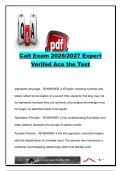
Calt Exam 2026/2027 Expert
Verifed Ace the Test


alphabetic language - ANSWER ✔✔English; meaning symbols and

letters reflect pronunciation of a sound; ESL students' first lang may not

be alphabetic because they use symbols; phonological knowledge must

be taught, so alphabet needs to be taught


Alphabetic Principle - ANSWER ✔✔an understanding that letters and

letter patterns represent the sounds of spoken words.


Analytic Phonics - ANSWER ✔✔In this approach, instruction begins

with the identification of a familiar word. The teacher then introduces a

particular sound/spelling relationship within that familiar word

, Synthetic Phonics - ANSWER ✔✔In this systematic and explicit

approach, students learn to transform letters and letter combinations into

sounds and then the sounds together to form recognizable words. Teach

individual parts and build to whole


auditory discrimination - ANSWER ✔✔The ability to hear differences

in sounds


auditory span - ANSWER ✔✔the number of words, numbers, or

sounds a student can hold in his working memory. Can limit dictation or

note taking.


blend - ANSWER ✔✔two or more sounds that are frequently grouped

together- each sound can be separated into its individual components


cedilla - ANSWER ✔✔a diacritical mark (,) placed below the letter c

to indicate that it is pronounced as an s


circumflex - ANSWER ✔✔the code marked placed over vowels to

indicate an unusual pronunciation


compensatory approach - ANSWER ✔✔one does not attempt to

remediate the problem but instead recommends modifications within the

learning environment which allows the student to be successful

Documentinformatie

Geüpload op
14 augustus 2026
Aantal pagina's
13
Geschreven in
2026/2027
Type
Tentamen (uitwerkingen)
Bevat
Vragen en antwoorden
€16,87

Verkeerd document? Gratis ruilen Binnen 14 dagen na aankoop en voor het downloaden kun je een ander document kiezen. Je kunt het bedrag gewoon opnieuw besteden.
Geschreven door studenten die geslaagd zijn
Direct beschikbaar na je betaling
Online lezen of als PDF

Seller avatar
De reputatie van een verkoper is gebaseerd op het aantal documenten dat iemand tegen betaling verkocht heeft en de beoordelingen die voor die items ontvangen zijn. Er zijn drie niveau’s te onderscheiden: brons, zilver en goud. Hoe beter de reputatie, hoe meer de kwaliteit van zijn of haar werk te vertrouwen is.
NinjaNerd
3,4
(76)
Verkocht
401
Volgers
6
Items
15386
Laatst verkocht
2 dagen geleden


Echte notities, van echte studenten
Elk document op Stuvia is geschreven door een medestudent die hetzelfde vak deed. Zo leer je van iemand die het al heeft gehaald.


Waarom studenten kiezen voor Stuvia

Gemaakt door medestudenten, geverifieerd door reviews

Kwaliteit die je kunt vertrouwen: geschreven door studenten die slaagden en beoordeeld door anderen die dit document gebruikten.

Niet tevreden? Kies een ander document

Geen zorgen! Je kunt voor hetzelfde geld direct een ander document kiezen dat beter past bij wat je zoekt.

Betaal zoals je wilt, start meteen met leren

Geen abonnement, geen verplichtingen. Betaal zoals je gewend bent via iDeal of creditcard en download je PDF-document meteen.

Student with book image

“Gekocht, gedownload en geslaagd. Zo makkelijk kan het dus zijn.”

Alisha Student

Bezig met je bronvermelding?

Maak nauwkeurige citaten in APA, MLA en Harvard met onze gratis bronnengenerator.

Bezig met je bronvermelding?

Veelgestelde vragen


