Week 6:
Preparation: Chap 13: Investments
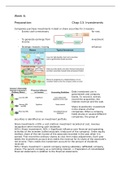
Companies purchase investments in debt or share securities for 3 reasons:
- Excess cash unnecessary for now.
- To generate earnings from investment
income
- Strategic reasons: having influence
Debt investment are in
government and company
bonds. To record it, entries
record the acquisition, the
interest revenue and the sale.
Share investments: investment
in the shares of other
companies. When a company
holds shares or several different
companies, the group of
securities is identified as an investment portfolio.
Share investments <20% = cost method, investment recorded at cost, revenue
recognition when receiving cash dividends.
20%< Share investment< 50% = Significant influence over financial and operating
activities of the investee (called associate, kinda part of the company). Under equity
method, share of the net income of the associate recorded in the year when it is
earned. First record the ordinary shares at cost, then make adjustments. Each year
debits the investment account and credits the revenue for its share of the associate’s
net income. Then credits the investment account for the amount of dividends
received.
50%< Share investment = parent company owning subsidiary (affiliated) company
shares. The parent company as a controlling interest -> Preparation of consolidated
financial statements in addition to the financial statements.
, Fair value is the mount for which a security could be sold in a normal market.
Companies must determine how to measure their financial assets based on two
criteria: the company’s business model for managing its financial assets and the
contractual cash flow characteristics of the specific financial asset. Financial assets
are trading, non-trading or held-for-collection.
Debt investments are classified in two categories:
- Trading securities
- Held-for-collection securities = amortized cost.
Share investment: no fixed interest or principal payment schedules, so never
classified as held-for-collection securities. 2 categories:
- Trading securities
- Non-trading securities: change in fair value during the year is not reported in
net income, but as a component of other comprehensive income in its
statement.
(<20%)
Trading securities: held in order to sell them in a short period (usually less than a
month).
Trading= frequent buying and selling. Changes= unrealized gains or losses ≠ btw
total cost and total fair value. Short-term investments: increases the likelihood to
sold them at fair value (may not be able to time their sale) and that there will be
gains and losses.
The fair value of the securities is the amount reports on the statement of financial
position.
Short-term investments or marketable securities are held by a company and are
readily marketable and intended to be converted into cash. If not both: long-term
investment.
Readily marketable when can be sold easily whenever the need for cash arises.
Intent to convert management intends to sell the investment within the next year or
operating cycle, whichever is longer.
Consolidated financial statements combine separate companies.
Transactions between the affiliated companies are intercompany transactions. If
excluded when preparing consolidated statement: intercompany eliminations
(because they eliminate duplicate date).
Consolidated statement of financial position: facilized by the use of a worksheet.
Lecture:
Debt and equity securities: bonds, shares
Preparation: Chap 13: Investments
Companies purchase investments in debt or share securities for 3 reasons:
- Excess cash unnecessary for now.
- To generate earnings from investment
income
- Strategic reasons: having influence
Debt investment are in
government and company
bonds. To record it, entries
record the acquisition, the
interest revenue and the sale.
Share investments: investment
in the shares of other
companies. When a company
holds shares or several different
companies, the group of
securities is identified as an investment portfolio.
Share investments <20% = cost method, investment recorded at cost, revenue
recognition when receiving cash dividends.
20%< Share investment< 50% = Significant influence over financial and operating
activities of the investee (called associate, kinda part of the company). Under equity
method, share of the net income of the associate recorded in the year when it is
earned. First record the ordinary shares at cost, then make adjustments. Each year
debits the investment account and credits the revenue for its share of the associate’s
net income. Then credits the investment account for the amount of dividends
received.
50%< Share investment = parent company owning subsidiary (affiliated) company
shares. The parent company as a controlling interest -> Preparation of consolidated
financial statements in addition to the financial statements.
, Fair value is the mount for which a security could be sold in a normal market.
Companies must determine how to measure their financial assets based on two
criteria: the company’s business model for managing its financial assets and the
contractual cash flow characteristics of the specific financial asset. Financial assets
are trading, non-trading or held-for-collection.
Debt investments are classified in two categories:
- Trading securities
- Held-for-collection securities = amortized cost.
Share investment: no fixed interest or principal payment schedules, so never
classified as held-for-collection securities. 2 categories:
- Trading securities
- Non-trading securities: change in fair value during the year is not reported in
net income, but as a component of other comprehensive income in its
statement.
(<20%)
Trading securities: held in order to sell them in a short period (usually less than a
month).
Trading= frequent buying and selling. Changes= unrealized gains or losses ≠ btw
total cost and total fair value. Short-term investments: increases the likelihood to
sold them at fair value (may not be able to time their sale) and that there will be
gains and losses.
The fair value of the securities is the amount reports on the statement of financial
position.
Short-term investments or marketable securities are held by a company and are
readily marketable and intended to be converted into cash. If not both: long-term
investment.
Readily marketable when can be sold easily whenever the need for cash arises.
Intent to convert management intends to sell the investment within the next year or
operating cycle, whichever is longer.
Consolidated financial statements combine separate companies.
Transactions between the affiliated companies are intercompany transactions. If
excluded when preparing consolidated statement: intercompany eliminations
(because they eliminate duplicate date).
Consolidated statement of financial position: facilized by the use of a worksheet.
Lecture:
Debt and equity securities: bonds, shares