Week 3 :
Preparation: Chap 6:
Inventories
When reporting the inventory : classification of the inventory (based on its
completeness degree) and the determination of inventory amounts.
Classifying inventory
Merchandising: inventory consists of many different items owned by the company
and in a ready for sale to customers form. So only one inventory classification:
merchandise inventory.
Manufacturing: Some inventory may not yet be ready for sale. So three categories:
- Finished goods inventory: manufactured items completed and ready for sale.
- Work in process: portion of inventory placed into the production process but
not yet complete.
- Raw materials: basic goods that will be used in production but have not yet
been placed into production.
All are reported under Current Asset on the statement of financial position.
Physical inventory: under a periodic system, can be to determine the inventory on
hand at the statement of financial position date, or to determine the COGS for the
period.
Determining inventory:
- Taking a physical inventory of goods on hand
- Determining the ownership of goods.
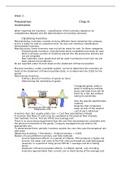
Consigned goods: when a
good is holding by another
party and tried to be sell for
them for a fee, but without
taking its ownership.
Also the specific identification
method:
Requires that companies
keep records of the original
cost of each individual
inventory item. But usually pretty rare -> Cost flow assumptions instead.
It assumes that flows of costs may be unrelated to the physical flow of goods.
Two methods: First-in, first-out (FIFO) and average-cost.
There is no accounting requirement that the cost flow assumption be consistent with
the physical movement of the goods. Company management just selects the
appropriate one.
To demonstrate them: periodic inventory system bcs very few uses the perpetual one
with them.
(Beginning Inventory + Purchases) – Ending Inventory = COGS
Reason of using different inventory cost flow methods:
- Income statement effects: In a period of inflation, FIFO produces a higher net
income, the lower unit costs of the first units purchased are matched against
revenues. In a period of rising prices FIFO NI > average-cost NI ≠ Falling
prices.
- statement of financial position effects: in inflation period, cost of ending
inventory approximates their current cost ≠ shortcoming of the average-cost
, method in an inflation period: cost allocated to ending inventory understated
in terms of current cost.
- tax effects: in inflation period: NI< so taxes<.
Cost flow method used by a company should be used consistently -> consistency
concept. (to be able to compare years).
An error in the ending inventory of the current period will have a reverse effect on
net income of the next accounting period.
Inventory fraud increases during recessions. Such fraud includes pricing inventory at
amount in excess of its actual value or claiming a nonexistent inventory. ->
Overstates ending inventory, COGS and so income. Do not affect Liability.
When the value of an inventory is lower than its cost, companies must write down the
inventory to its net realizable value. (Valuing at the lower-of-cost-or-net realizable
value called LCNRV). Accounting concept of prudence. Net realizable value: net
amount a company excepts to realize (receive) from the sale inventory.
Inventory turnover measures the number of times on average the inventory is sold
during the period. (Liquidity measurement).
Cost of Goods Sold ÷ Average Inventory = Inventory turnover
Variant: days in inventory.
Lecture: Inventories 11/11
Income statement helps company to still distinguish btw cost of goods sold (canvas)
Inventory in merchandising firms are purchased goods intended for sale to customers
In manufacturing firms, ≠ categories: raw material; work in process; finished goods.
Holding inventory is costly. Firms try to keep inventories as small as possible (just-in-
time inventory system).
Companies determine physical inventory at the end of the accounting period:
For firms using a periodic system, a physical determination of the inventory is
necessary to determine the ending inventory and the cost of goods sold.
For firms using a perpetual system a physical determination of inventory is necessary
Preparation: Chap 6:
Inventories
When reporting the inventory : classification of the inventory (based on its
completeness degree) and the determination of inventory amounts.
Classifying inventory
Merchandising: inventory consists of many different items owned by the company
and in a ready for sale to customers form. So only one inventory classification:
merchandise inventory.
Manufacturing: Some inventory may not yet be ready for sale. So three categories:
- Finished goods inventory: manufactured items completed and ready for sale.
- Work in process: portion of inventory placed into the production process but
not yet complete.
- Raw materials: basic goods that will be used in production but have not yet
been placed into production.
All are reported under Current Asset on the statement of financial position.
Physical inventory: under a periodic system, can be to determine the inventory on
hand at the statement of financial position date, or to determine the COGS for the
period.
Determining inventory:
- Taking a physical inventory of goods on hand
- Determining the ownership of goods.
Consigned goods: when a
good is holding by another
party and tried to be sell for
them for a fee, but without
taking its ownership.
Also the specific identification
method:
Requires that companies
keep records of the original
cost of each individual
inventory item. But usually pretty rare -> Cost flow assumptions instead.
It assumes that flows of costs may be unrelated to the physical flow of goods.
Two methods: First-in, first-out (FIFO) and average-cost.
There is no accounting requirement that the cost flow assumption be consistent with
the physical movement of the goods. Company management just selects the
appropriate one.
To demonstrate them: periodic inventory system bcs very few uses the perpetual one
with them.
(Beginning Inventory + Purchases) – Ending Inventory = COGS
Reason of using different inventory cost flow methods:
- Income statement effects: In a period of inflation, FIFO produces a higher net
income, the lower unit costs of the first units purchased are matched against
revenues. In a period of rising prices FIFO NI > average-cost NI ≠ Falling
prices.
- statement of financial position effects: in inflation period, cost of ending
inventory approximates their current cost ≠ shortcoming of the average-cost
, method in an inflation period: cost allocated to ending inventory understated
in terms of current cost.
- tax effects: in inflation period: NI< so taxes<.
Cost flow method used by a company should be used consistently -> consistency
concept. (to be able to compare years).
An error in the ending inventory of the current period will have a reverse effect on
net income of the next accounting period.
Inventory fraud increases during recessions. Such fraud includes pricing inventory at
amount in excess of its actual value or claiming a nonexistent inventory. ->
Overstates ending inventory, COGS and so income. Do not affect Liability.
When the value of an inventory is lower than its cost, companies must write down the
inventory to its net realizable value. (Valuing at the lower-of-cost-or-net realizable
value called LCNRV). Accounting concept of prudence. Net realizable value: net
amount a company excepts to realize (receive) from the sale inventory.
Inventory turnover measures the number of times on average the inventory is sold
during the period. (Liquidity measurement).
Cost of Goods Sold ÷ Average Inventory = Inventory turnover
Variant: days in inventory.
Lecture: Inventories 11/11
Income statement helps company to still distinguish btw cost of goods sold (canvas)
Inventory in merchandising firms are purchased goods intended for sale to customers
In manufacturing firms, ≠ categories: raw material; work in process; finished goods.
Holding inventory is costly. Firms try to keep inventories as small as possible (just-in-
time inventory system).
Companies determine physical inventory at the end of the accounting period:
For firms using a periodic system, a physical determination of the inventory is
necessary to determine the ending inventory and the cost of goods sold.
For firms using a perpetual system a physical determination of inventory is necessary