

Geschreven door studenten die geslaagd zijn Direct beschikbaar na je betaling Online lezen of als PDF Verkeerd document? Gratis ruilen 4,6 TrustPilot
logo-home
Document preview thumbnail
Voorbeeld 2 van de 13 pagina's
Tentamen (uitwerkingen)

PPCT Instructor Course 2026/2027 | 100+ Questions & Answers | Use of Force, Reactionary Gap, Control Theory & Instructor Certification

Document preview thumbnail
Voorbeeld 2 van de 13 pagina's

This PPCT Instructor Course 2026/2027 exam study guide contains 100+ questions and correct answers across 13 pages, providing focused preparation in PPCT use-of-force principles, reactionary-gap concepts, levels of resistance and control, human factors, handcuffing theory, physical-skills instruction, survival performance and instructor certification requirements. The document is specifically presented as a 2026/2027 PPCT Instructor Course exam resource and combines operational theory with the teaching and assessment concepts instructor candidates are expected to review. A central section covers the PPCT reactionary gap and use-of-force framework. The reactionary gap is defined in the material as the minimum safe zone an officer should maintain when dealing with others, while tactical reactionary options are discussed in terms of engagement or penetration and disengagement. The guide also identifies four PPCT components of acceptability: tactical acceptability, medical acceptability, legal acceptability and human factors. These concepts establish the framework through which the remainder of the course approaches defensive-tactics decision-making. The document provides extensive examination coverage of Total Control Theory and One-Plus-One Theory, along with distinctions between levels of resistance and levels of control. Resistance concepts include expressive or nonverbal indicators, passive resistance, defensive resistance, active aggression and deadly-force behavior. Control concepts progress through officer presence and empty-hand control to intermediate and higher levels of force. The material further distinguishes pain compliance, stunning, distraction, balance displacement and motor dysfunction, allowing instructor candidates to review the terminology used throughout the PPCT curriculum. Another important section examines reaction time and tactical handcuffing theory. Students review movement time, response time, reactionary distance, cooperative and uncooperative subject classifications, approach-to-contact considerations, control upon touch, application speed and double-locking. The guide also addresses the relationship between restraint and searching, making these questions useful for instructor candidates expected to explain not only PPCT terminology but also the sequencing and safety concepts taught in the course. The middle portion reviews a range of defensive-control and force concepts appearing in the PPCT curriculum. These include pressure-point and motor-point terminology, joint-control concepts, counter-strike theory, neck-restraint classifications, shoulder-restraint concepts, intermediate-force considerations and survival strategies. Because some of these subjects involve potentially dangerous physical techniques, they are best treated here as written-examination topics rather than operational instructions; practical application should be taught and evaluated only by qualified instructors under current agency policy. A particularly important feature of this document is its emphasis on PPCT instructional methodology. The guide discusses the need to motivate learners, create early confidence and break skill development into a clear beginning, middle and end. Instructor candidates review the three physical-skill practice stages—static, fluid and dynamic training—as well as conditioned-response training and the importance of connecting practice with the specific conditions in which a learned response may be required. The final pages focus on instructor administration, testing and certification. According to the uploaded material, candidates review requirements concerning current student manuals, instructor and instructor-trainer certification periods, certification extensions, training-course requests, written and practical examinations, injury reporting and student-to-instructor ratios. The source states an 80% written-exam passing score, an “adequate” minimum practical rating, and a ratio of one instructor to 24 students. It also includes Michigan-specific instructor certification information, making the document especially relevant to candidates studying the version of the PPCT program represented in this source. The final section returns to human performance under stress, including the autonomic nervous system, sympathetic and parasympathetic responses, the Inverted-U relationship, fine, complex and gross motor skills, memory stages and energy systems. This combination of defensive-tactics theory, human performance and instructor-development content makes the document a specialized PPCT Instructor Course exam-preparation resource, rather than a general defensive-tactics question bank. The file does not identify a formal course code, university, college or training academy, so Institution Not Specified is used instead of inventing an affiliation. Relevant students: This document is most relevant for PPCT instructor candidates, defensive-tactics instructor trainees, authorized law-enforcement trainers, corrections instructors, police academy trainers, public-safety instructors and personnel preparing for PPCT instructor certification or recertification. It is particularly useful for candidates reviewing reactionary-gap theory, use-of-force frameworks, resistance and control classifications, human factors, handcuffing theory, instructor methodology, static-fluid-dynamic training, testing standards and instructor certification requirements. Keywords: PPCT Instructor Course 2026, PPCT Instructor Course 2027, PPCT Instructor exam, PPCT Instructor questions and answers, PPCT Instructor study guide, PPCT Instructor certification, PPCT Instructor training, defensive tactics instructor, defensive tactics instructor exam, PPCT defensive tactics, reactionary gap, PPCT components of acceptability, tactical acceptability, medical acceptability, legal acceptability, human factors, Total Control Theory, One Plus One Theory, levels of resistance, levels of control, use of force, use of force continuum, officer presence, soft empty hand control, hard empty hand control, intermediate control, pain compliance, motor dysfunction, reaction time, movement time, response time, tactical handcuffing, PPCT training methods, static training, fluid training, dynamic training, conditioned response training, PPCT written exam, PPCT practical exam, PPCT instructor certification Michigan, law enforcement instructor course, police instructor training, corrections instructor training

Voorbeeld van de inhoud

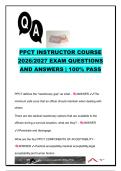
PPCT INSTRUCTOR COURSE
2026/2027 EXAM QUESTIONS
AND ANSWERS | 100% PASS


PPCT defines the "reactionary gap" as what - ANSWER ✔✔The

minimum safe zone that an officer should maintain when dealing with

others

There are two tactical reactionary options that are available to the

officers during a survival situation, what are they? - ANSWER

✔✔Penetrate and disengage


What are the four PPCT COMPONENTS OF ACCEPTABILITY -

ANSWER ✔✔tactical acceptability,medical acceptability,legal

acceptability,and human factors

, Use of force continuums are structured around two different control

theories, what are they? - ANSWER ✔✔Total control theory and the

one-plus-one


Total control theory is centered upon the use of what? - ANSWER

✔✔The use of an intermediate weapon, such as ( taser,baton,and

chemical agents


The one-plus-one theory is based upon? - ANSWER ✔✔The concept

of responding to levels of resistance ( an eye for an eye)


Describe Levels of Resistance - ANSWER ✔✔Describes

threatening,resistive or assaultive behavior on behalf of the subject (the

inmates resisting)


Describe levels of Control - ANSWER ✔✔Detailing the escalating

methods of subject control by officers (Road deputies/ Corrections)


What is expressive body indicators - ANSWER ✔✔Nonverbal cues.

Attitude,appearance and physical readiness (blank stare,clenching of

fists,tightening of jaw muscle. (Etc)


What is passive resistance - ANSWER ✔✔Passive resistance is any

type of resistance where the subject does not attempt to touch or control

him/her (protesters not moving but dead weight )

Documentinformatie

Geüpload op
12 augustus 2026
Aantal pagina's
13
Geschreven in
2026/2027
Type
Tentamen (uitwerkingen)
Bevat
Vragen en antwoorden
€16,93

Verkeerd document? Gratis ruilen Binnen 14 dagen na aankoop en voor het downloaden kun je een ander document kiezen. Je kunt het bedrag gewoon opnieuw besteden.
Geschreven door studenten die geslaagd zijn
Direct beschikbaar na je betaling
Online lezen of als PDF

Seller avatar
De reputatie van een verkoper is gebaseerd op het aantal documenten dat iemand tegen betaling verkocht heeft en de beoordelingen die voor die items ontvangen zijn. Er zijn drie niveau’s te onderscheiden: brons, zilver en goud. Hoe beter de reputatie, hoe meer de kwaliteit van zijn of haar werk te vertrouwen is.
NinjaNerd
3,4
(76)
Verkocht
397
Volgers
6
Items
15334
Laatst verkocht
10 uur geleden


Echte notities, van echte studenten
Elk document op Stuvia is geschreven door een medestudent die hetzelfde vak deed. Zo leer je van iemand die het al heeft gehaald.


Waarom studenten kiezen voor Stuvia

Gemaakt door medestudenten, geverifieerd door reviews

Kwaliteit die je kunt vertrouwen: geschreven door studenten die slaagden en beoordeeld door anderen die dit document gebruikten.

Niet tevreden? Kies een ander document

Geen zorgen! Je kunt voor hetzelfde geld direct een ander document kiezen dat beter past bij wat je zoekt.

Betaal zoals je wilt, start meteen met leren

Geen abonnement, geen verplichtingen. Betaal zoals je gewend bent via iDeal of creditcard en download je PDF-document meteen.

Student with book image

“Gekocht, gedownload en geslaagd. Zo makkelijk kan het dus zijn.”

Alisha Student

Bezig met je bronvermelding?

Maak nauwkeurige citaten in APA, MLA en Harvard met onze gratis bronnengenerator.

Bezig met je bronvermelding?

Veelgestelde vragen


