

Geschreven door studenten die geslaagd zijn Direct beschikbaar na je betaling Online lezen of als PDF Verkeerd document? Gratis ruilen 4,6 TrustPilot
logo-home
Document preview thumbnail
Voorbeeld 3 van de 24 pagina's
Tentamen (uitwerkingen)

PPCT Defensive Tactics 2026/2027 | 150+ Questions & Answers | Use of Force, Survival Stress, Control Continuum & Officer Safety

Document preview thumbnail
Voorbeeld 3 van de 24 pagina's

This PPCT Defensive Tactics 2026/2027 exam study guide contains 150+ questions and correct answers across 24 pages covering the theoretical, physiological, legal and tactical concepts presented in the uploaded PPCT material. Major areas include the autonomic nervous system, sympathetic and parasympathetic responses, survival stress, combat performance, use-of-force decision-making, resistance and control levels, reaction time, handcuffing, officer safety, control principles and defensive-tactics terminology. The question-and-answer format provides a concentrated revision resource for learners preparing for a written PPCT Defensive Tactics examination or related training assessment. The opening section concentrates on the Autonomic Nervous System (ANS) and its sympathetic (SNS) and parasympathetic (PNS) branches. Students review homeostasis, SNS activation triggers, objective threat and fear perceptions, physical exhaustion, startle responses and physiological changes involving adrenal and vascular activity and perceptual narrowing. The material connects these responses with changes in heart rate, respiration, pupil dilation, auditory perception and vision, as well as the effects of heightened arousal on fine, complex and gross motor performance. A related section examines combat anxiety, survival stress and combat stress, including the document's discussion of tunnel vision, perceptual changes, PNS backlash and critical-incident amnesia. The study material reviews an inverted-U relationship between arousal and performance and identifies mindset, motor-skill selection, nutrition and hydration, fitness and belief systems as combat-performance variables. It also discusses tactical breathing, visualization, confidence and other approaches presented in the course material for managing survival stress. The guide provides extensive coverage of PPCT use-of-force concepts, including tactical, legal and medical acceptability, Total Control Theory, One-plus-One Theory and escalation/de-escalation principles. Students distinguish levels of resistance such as psychological intimidation, verbal noncompliance, passive resistance, defensive resistance, active aggression and deadly-force assault. Corresponding control levels discussed in the material range from officer presence and verbal direction through empty-hand control and intermediate options to deadly force. The document repeatedly emphasizes assessing force under the totality of the circumstances and from the perspective of a reasonable officer at the scene. Another important section addresses controlling resistance and survival reaction time. The material identifies pain compliance, motor dysfunction, distraction, stunning and balance displacement as control principles and reviews the perceptual and decision-making stages between recognizing a threat cue and initiating a response. Officer-safety concepts include reactionary distance, situational factors affecting control decisions, danger signs and the course's list of common officer-safety errors. The document also contains substantial material on handcuffing and subject control, including classifications of cooperative and uncooperative subjects, tactical considerations, circumstances presented in the course as supporting handcuff use, double-locking, equipment selection and common handcuff failures. Later questions address pressure-point and motor-point concepts, soft versus hard empty-hand control and the relationship between verbal commands, compliance and de-escalation. The final sections review higher-risk defensive-tactics topics presented in the source, including nerve-point terminology, restraints, intermediate-force concepts, baton terminology, weapon-retention concepts and disarming theory. Because these subjects involve potentially dangerous physical techniques, this study description treats them as examination topics rather than practical instructions; hands-on skills should be learned and assessed only through appropriately qualified instructors and the governing agency's current policies. Overall, this resource is best understood as a broad PPCT Defensive Tactics theory and exam-preparation question bank. It integrates human stress physiology, performance under pressure, resistance classification, proportional control concepts, officer-safety considerations and PPCT terminology into a single revision document. The uploaded file does not provide a formal course code, university, academy or training institution, so Institution Not Specified is used rather than adding an unsupported affiliation. Relevant students: This document is most relevant for PPCT Defensive Tactics trainees, law-enforcement academy students, criminal justice students, corrections trainees, security and public-safety learners, and personnel completing authorized defensive-tactics education. It is particularly useful for written examination review involving survival stress, the autonomic nervous system, use-of-force principles, resistance classifications, control levels, reaction time, officer safety, handcuffing theory and PPCT terminology. Keywords: PPCT Defensive Tactics 2026, PPCT Defensive Tactics 2027, PPCT exam questions and answers, PPCT exam, PPCT study guide, PPCT certification exam, defensive tactics exam, defensive tactics questions, law enforcement defensive tactics, police defensive tactics, use of force exam, use of force continuum, control continuum, levels of resistance, levels of control, officer safety, survival stress, sympathetic nervous system, parasympathetic nervous system, autonomic nervous system, combat stress, combat anxiety, critical incident amnesia, survival reaction time, reactionary gap, tactical decision making, totality of circumstances, reasonable officer standard, escalation and de escalation, Total Control Theory, One Plus One Theory, passive resistance, defensive resistance, active aggression, deadly force, empty hand control, intermediate force, handcuffing theory, pain compliance, motor dysfunction, PPCT training, criminal justice exam, law enforcement academy exam

Voorbeeld van de inhoud

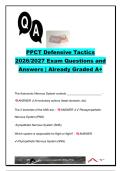
PPCT Defensive Tactics
2026/2027 Exam Questions and
Answers | Already Graded A+


The Autonomic Nervous System controls ______________________ -

ANSWER ✔✔Involuntary actions (heart stomach, etc)


The 2 branches of the ANS are: - ANSWER ✔✔-Parasympathetic

Nervous System (PNS)

-Sympathetic Nervous System (SNS)


Which system is responsible for flight or flight? - ANSWER

✔✔Sympathetic Nervous System (SNS)

,What is the balance between SNS and PNS called? - ANSWER

✔✔Homeostasis


When does the highest level of cerebral cortex processing happen? -

ANSWER ✔✔Homeostasis


What are the SNS activation triggers? - ANSWER ✔✔-Objective

threat perceptions

-Objective fear perceptions

-Physical exhaustion

-Startle response


The objective threat perception includes... - ANSWER ✔✔-Threat is

within close proximity

-Minimal time to control threat

-Person is not confident with their abilities

-Threat perception is a new experience


The Objective Fear Perception includes.... - ANSWER ✔✔-Fear of

death

-Injury

-Killing

, -Incorrect decision making

-Failure

-Or fear itself


Physical Exhaustion includes... - ANSWER ✔✔-Depletion of ATP fuel

system

-Inadequate nutrition

-Can cause officers to escalate their use of force


The startle response includes... - ANSWER ✔✔-Spontaneous threat


-Unexpected loud noise

-Unexpected touch

-Threat is within close proximity

Sympathetic Nervous System Activation and Physiological Changes -

ANSWER ✔✔-Adrenal Activity


-Vascular Activity

-Perceptual Narrowing


Increased adrenal activity effects.... - ANSWER ✔✔Heart rate,

respiration, pupil dilation, auditory exclusion


COPYRIGHT©NINJANERD 2025/2026. YEAR PUBLISHED 2026. COMPANY REGISTRATION NUMBER: 619652435. TERMS OF USE. PRIVACY
STATEMENT. ALL RIGHTS RESERVED
3


Documentinformatie

Geüpload op
12 augustus 2026
Aantal pagina's
24
Geschreven in
2026/2027
Type
Tentamen (uitwerkingen)
Bevat
Vragen en antwoorden
€16,93

Verkeerd document? Gratis ruilen Binnen 14 dagen na aankoop en voor het downloaden kun je een ander document kiezen. Je kunt het bedrag gewoon opnieuw besteden.
Geschreven door studenten die geslaagd zijn
Direct beschikbaar na je betaling
Online lezen of als PDF

Seller avatar
De reputatie van een verkoper is gebaseerd op het aantal documenten dat iemand tegen betaling verkocht heeft en de beoordelingen die voor die items ontvangen zijn. Er zijn drie niveau’s te onderscheiden: brons, zilver en goud. Hoe beter de reputatie, hoe meer de kwaliteit van zijn of haar werk te vertrouwen is.
NinjaNerd
3,4
(76)
Verkocht
397
Volgers
6
Items
15334
Laatst verkocht
10 uur geleden


Echte notities, van echte studenten
Elk document op Stuvia is geschreven door een medestudent die hetzelfde vak deed. Zo leer je van iemand die het al heeft gehaald.


Waarom studenten kiezen voor Stuvia

Gemaakt door medestudenten, geverifieerd door reviews

Kwaliteit die je kunt vertrouwen: geschreven door studenten die slaagden en beoordeeld door anderen die dit document gebruikten.

Niet tevreden? Kies een ander document

Geen zorgen! Je kunt voor hetzelfde geld direct een ander document kiezen dat beter past bij wat je zoekt.

Betaal zoals je wilt, start meteen met leren

Geen abonnement, geen verplichtingen. Betaal zoals je gewend bent via iDeal of creditcard en download je PDF-document meteen.

Student with book image

“Gekocht, gedownload en geslaagd. Zo makkelijk kan het dus zijn.”

Alisha Student

Bezig met je bronvermelding?

Maak nauwkeurige citaten in APA, MLA en Harvard met onze gratis bronnengenerator.

Bezig met je bronvermelding?

Veelgestelde vragen

