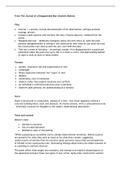
From The Journal of a Disappointed Man (Andrew Motion)
Title
• 'Journal' = a precise, factual documentation of his observations; perhaps personal
musings, private.
• Creates a poet persona who narrates the story. Passive observer, isolated from the
action.
• 'Disappointed man' - deliberate ambiguity about who this refers to, both the poet
persona (disappointment in seeing in the construction men what he can never be) and
the construction men (fed up with the job, can't shift the pile).
• Title has a sense of formality – we perhaps wonder if his disappointment is grand and
existential (does the poem live up to this or is there a comic, self-deprecating bathos?
Or does it work on both of these levels?)
Themes
• Gender, masculine role and expectations of men
• Challenges
• Binary separation between two ‘types’ of men
• Identity
• Uncertainty, lack of resolution
• Implicit rather than explicit emotions and conflicts
• An individual’s conflicted reactions (awe vs derision)
• Observer poet persona, his understanding as a narrator
Form
Poem is structured in a long block, stanzas of 4 lines – this visual regularity reflects a
concrete building block, basic and absolute. No rhyme scheme, with a conversational tone
– informally recounts his thoughts to the reader, observational description.
Voice and context
Motion's style:
• Interest in narrative
• Use of understatement
• Meditative style of storytelling
"Whilst possessing an accessible clarity (simple observational narrative), Motion's poems
are powerful for what they omit as much as for what they contain, suggesting
undercurrents of emotion that his narrators (poet persona's insecurities and comparisons
of himself to the construction men, fluctuating feelings about them) are either unaware of
or unwilling to confront/disclose".
The poem offers little insight into emotions, and instead is an implicit dramatization of
the separation between these two types of men (virile, alpha male construction workers
Title
• 'Journal' = a precise, factual documentation of his observations; perhaps personal
musings, private.
• Creates a poet persona who narrates the story. Passive observer, isolated from the
action.
• 'Disappointed man' - deliberate ambiguity about who this refers to, both the poet
persona (disappointment in seeing in the construction men what he can never be) and
the construction men (fed up with the job, can't shift the pile).
• Title has a sense of formality – we perhaps wonder if his disappointment is grand and
existential (does the poem live up to this or is there a comic, self-deprecating bathos?
Or does it work on both of these levels?)
Themes
• Gender, masculine role and expectations of men
• Challenges
• Binary separation between two ‘types’ of men
• Identity
• Uncertainty, lack of resolution
• Implicit rather than explicit emotions and conflicts
• An individual’s conflicted reactions (awe vs derision)
• Observer poet persona, his understanding as a narrator
Form
Poem is structured in a long block, stanzas of 4 lines – this visual regularity reflects a
concrete building block, basic and absolute. No rhyme scheme, with a conversational tone
– informally recounts his thoughts to the reader, observational description.
Voice and context
Motion's style:
• Interest in narrative
• Use of understatement
• Meditative style of storytelling
"Whilst possessing an accessible clarity (simple observational narrative), Motion's poems
are powerful for what they omit as much as for what they contain, suggesting
undercurrents of emotion that his narrators (poet persona's insecurities and comparisons
of himself to the construction men, fluctuating feelings about them) are either unaware of
or unwilling to confront/disclose".
The poem offers little insight into emotions, and instead is an implicit dramatization of
the separation between these two types of men (virile, alpha male construction workers